Blog
Observability
minutes

Qovery Observe is Here: Your Deployments, Your Data, Your Visibility

Monitor your deployments with Qovery Observe: real-time metrics, logs, and events, directly integrated with your AWS applications and containers.
December 9, 2025
Julien Dan
Technical Product Manager
Summary
Twitter icon
linkedin icon

Qovery Observe is Here: Your Deployments, Your Data, Your Visibility

We're thrilled to announce that Qovery Observe is now available to all users.

After several weeks of our early access program (EAP) with five pilot customers, we are thrilled to officially launch Qovery Observe (our observability feature). These customers got exclusive early access to the feature and worked closely with our product team for one month. Their real-world use cases, continuous feedback, and hands-on testing allowed us to improve performance, add the right features, and refine the user experience to be as intuitive as possible.

The Observability gap: Why we built Qovery's Observe Solution

Engineering teams often face these difficult choices when it comes to monitor their application:

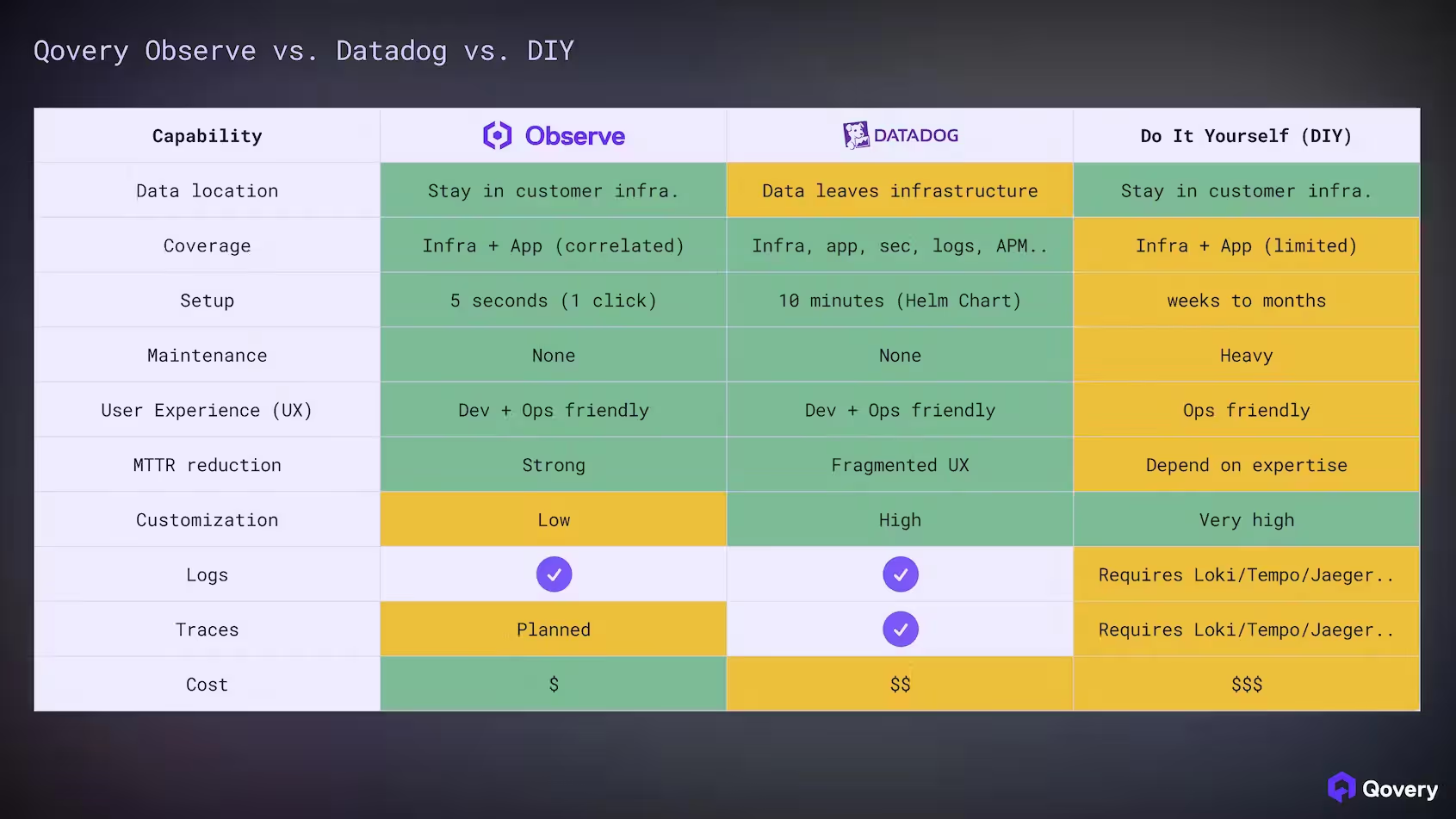
  1. Third-party SaaS tools:Feature-rich but expensive, with data leaving your infrastructure and weak correlation with your deployed services.
  2. DIY monitoring stacks: Flexible but complex to set up, hard to maintain, and time-consuming to scale.
  3. Qovery Observe: The best of both worlds: built-in, zero maintenance, and tightly integrated with your deployments.
Observability tools comparison

What You Get with Qovery Observe:

  • Instantly check service health to know if your applications are running as expected.
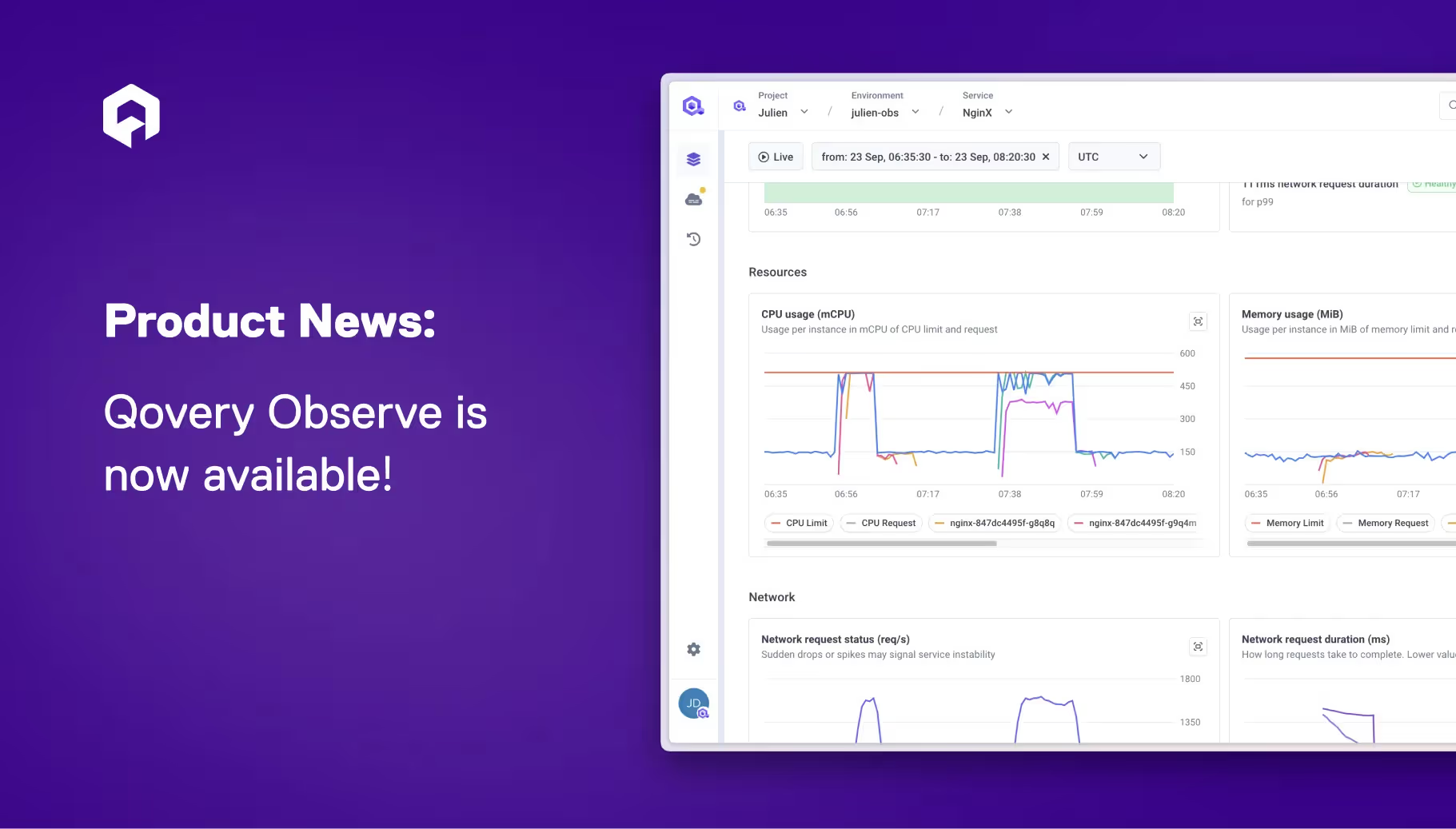
  • Monitor key metrics like CPU, memory, and network usage for every service.
  • Access detailed logs with up to 90 days of retention to quickly troubleshoot issues.
  • Track events from both Qovery and Kubernetes, giving you a correlated view of deployments, scaling, pod failures, and more.
"Qovery’s new observability feature provides real-time visibility into cluster performance, pod allocation, and scaling behavior, making it easy to monitor deployments and resource usage across staging and production environments." Clément Garbay, Co-founder & CTO at Hyperline

Built with our customers, for our customers

Qovery Observe was not built in a vacuum, it was shaped directly with our users.

During our EAP, we onboarded five customers who tested the feature in their own environments before anyone else. Over the course of a month, we:

  • Collected feedback from real-world usage.
  • Added new functionalities requested by our pilot users.
  • Tuned performance to handle production workloads.
  • Improved the UX with concrete suggestions from engineers and operators.

This collaborative approach helped us ensure that Qovery Observe is not just powerful, but also developer- and ops-friendly.

"Qovery Observe feature has been really valuable as a quick way to observe service performance at a glance. Being able to immediately spot failing deployments or spikes in memory usage is helpful, and I especially like the pod allocation dashboard for understanding how auto-scaling behaves in our environment." Nick Roberts, Senior Developer at Greektrack

What’s next

We’re just getting started. Today, Qovery's Observability tool for DevOps is available for applications and containers running on AWS clusters.

Coming soon:

  • Support for Scaleway, GCP, and Azure clusters.
  • Extended observability for Jobs, Managed Databases, and Helm charts.
  • Even more advanced metrics and visualization capabilities.

Stay tuned: this is only the beginning of a stronger, more integrated monitoring experience inside Qovery.

Get started today!

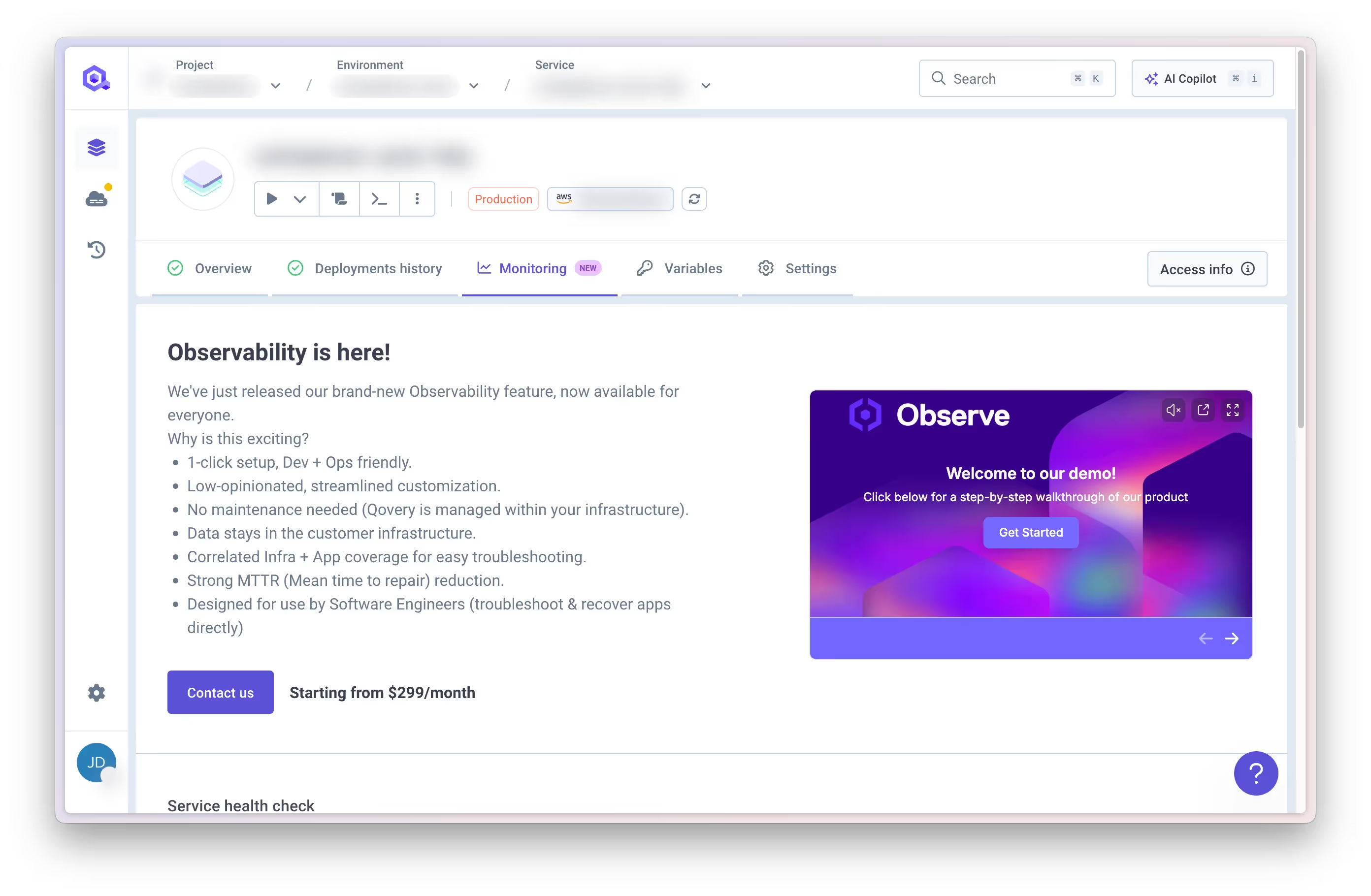
Qovery Observe is now available for all customers. Request access directly in your Qovery console from one of your service monitoring tab:

Stop wasting time juggling tools and dashboards. With Qovery, observability lives right where your deployments are.

👉 Contact us

👉 Watch the demo

👉 Available from $299/month

Share on :
Twitter icon
linkedin icon
Tired of fighting your Kubernetes platform?
Qovery provides a unified Kubernetes control plane for cluster provisioning, security, and deployments - giving you an enterprise-grade platform without the DIY overhead.
See it in action

Suggested articles

Kubernetes
7
 minutes
Day 2 operations: an executive guide to Kubernetes operations and scale

Kubernetes success is determined by Day 2 execution, not Day 1 deployment. While migration is a bounded project, maintenance is an infinite loop that often consumes 40% of senior engineering capacity. To protect margins and velocity, enterprises must transition from manual toil to agentic automation that handles scaling, security, and cost.

Mélanie Dallé
Senior Marketing Manager
Kubernetes
8
 minutes
The 2026 guide to Kubernetes management: master day-2 ops with agentic control

Master Kubernetes management in 2026. Discover how Agentic Automation resolves Day-2 Ops, eliminates configuration drift, and cuts cloud spend on vanilla EKS/GKE/AKS.

Romaric Philogène
CEO & Co-founder
DevOps
Kubernetes
6
 minutes
Day-0, day-1, and day-2 Kubernetes: defining the phases of fleet management

Day-0 is planning, Day-1 is deployment, and Day-2 is the infinite lifecycle of maintenance. While Day-0/1 are foundational, Day-2 is where enterprise operational debt accumulates. At fleet scale (1,000+ clusters), managing these differences manually is impossible, requiring agentic automation to maintain stability and eliminate toil.

Morgan Perry
Co-founder
Kubernetes
7
 minutes
Kubernetes multi-cluster: the Day-2 enterprise strategy

A multi-cluster Kubernetes architecture distributes application workloads across geographically separated clusters rather than a single environment. This strategy strictly isolates failure domains, ensures regional data compliance, and guarantees global high availability, but demands centralized Day-2 control to prevent exponential cloud costs and operational sprawl.

Morgan Perry
Co-founder
Kubernetes
6
 minutes
Kubernetes observability at scale: cutting the noise in multi-cloud environments

Stop overpaying for Kubernetes observability. Learn how in-cluster monitoring and AI-driven troubleshooting with Qovery Observe can eliminate APM ingestion fees, reduce SRE bottlenecks, and make your cloud costs predictable.

Mélanie Dallé
Senior Marketing Manager
Kubernetes
 minutes
Understanding CrashLoopBackOff: Fixing AI workloads on Kubernetes

Stop fighting CrashLoopBackOff on your AI deployments. Learn why traditional Kubernetes primitives fail large models and GPU workloads, and how to orchestrate AI infrastructure without shadow IT.

Mélanie Dallé
Senior Marketing Manager
Kubernetes
Platform Engineering
 minutes
Kubernetes multi-cluster architecture: solving day-2 fleet sprawl

Kubernetes multi-cluster management is the Day-2 operational practice of orchestrating applications, security, and configurations across geographically distributed clusters. Because native Kubernetes was designed for single-cluster orchestration, enterprise platform teams must implement a centralized control plane to prevent configuration drift and manage a global fleet without scaling manual toil.

Mélanie Dallé
Senior Marketing Manager
Engineering
Product
11
 minutes
How to achieve zero downtime on kubernetes: a Day-2 architecture guide

Achieving zero-downtime deployments on Kubernetes requires more than running multiple pods. It demands a standardized architecture utilizing Pod Disruption Budgets (PDBs), precise liveness and readiness probes, pod anti-affinity, and graceful termination handling. At an enterprise scale, these configurations must be enforced via a centralized control plane to prevent catastrophic configuration drift.

Pierre Mavro
CTO & Co-founder

It’s time to change
the way you manage K8s

Turn Kubernetes into your strategic advantage with Qovery, automating the heavy lifting while you stay in control.