
Alessandro Carrano
Head of Product
Alessandro leads product at Qovery. He drives the changelog, roadmap, and product strategy - turning customer feedback into platform capabilities.
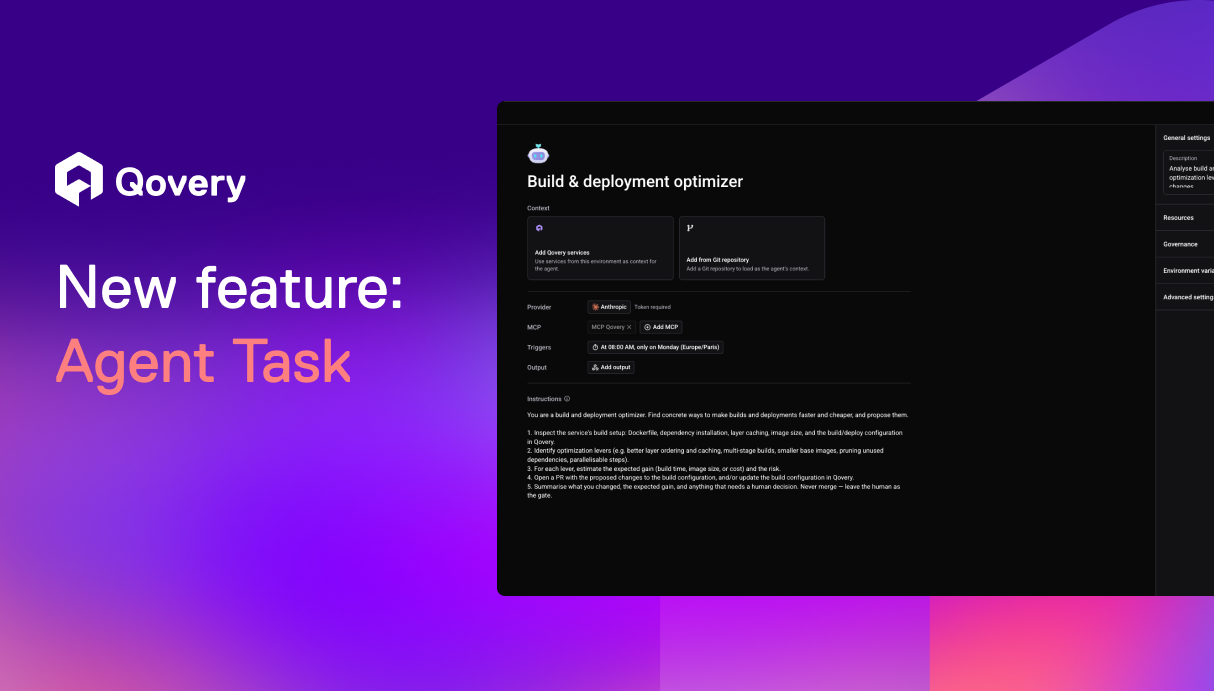
Stop Building Your Own Agent Infrastructure. Meet Agent Tasks
Agent Tasks let you run one-time or scheduled AI agents on your own infrastructure, with network guardrails, centralized MCP access and custom agent environment.
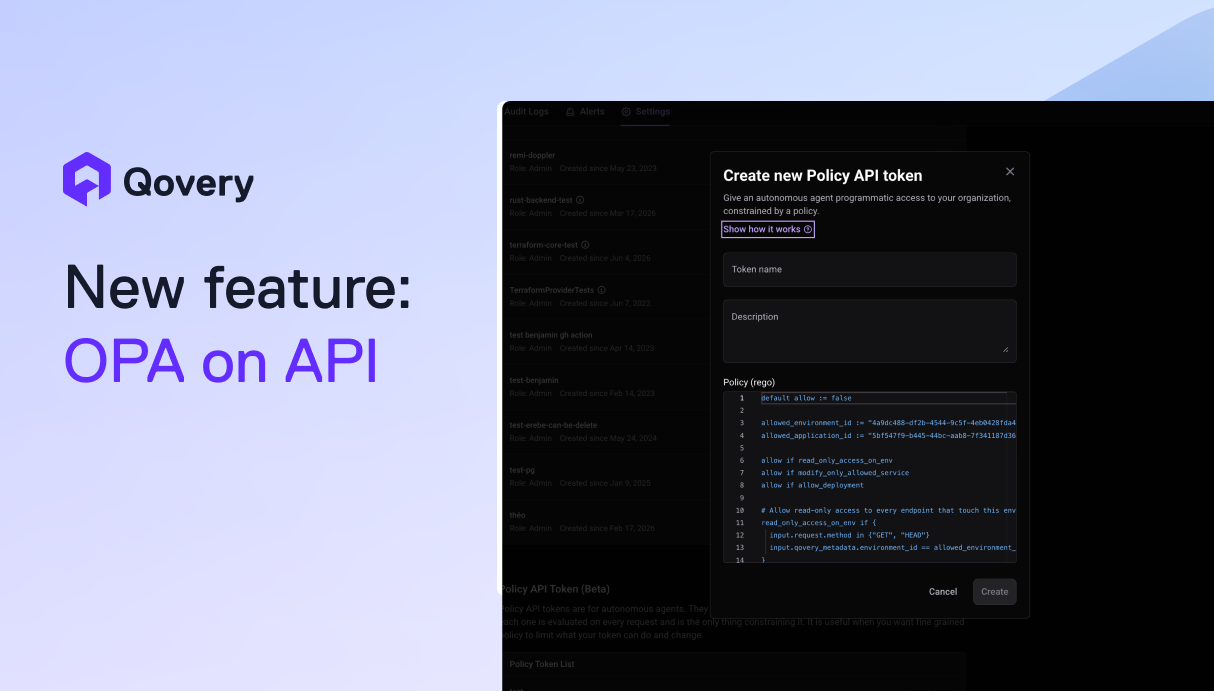
Full Control Over Permissions, Welcome API Policy Tokens
API Policy Tokens let you control what a Qovery token can do action by action, using OPA and Rego, so an agent or script never gets more access than the one job it was built for.
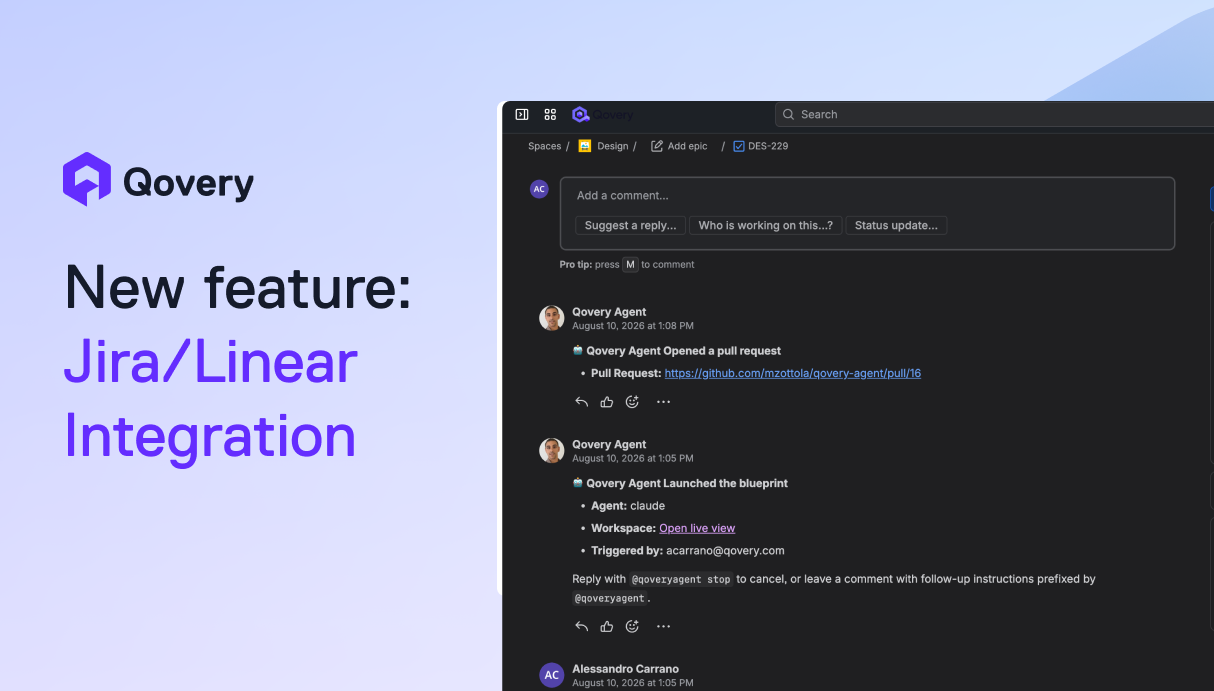
Jira and Linear Are Now a Trigger Into Your Governed Infrastructure
Agent Triggers extend Qovery's control plane to a new entry point: a ticket. Tag it on Jira or assign it on Linear, and it triggers the execution of a governed environment on your own infrastructure, where an agent performs whatever action it's configured for, given the context of that ticket, under the same guardrails as any other workload.
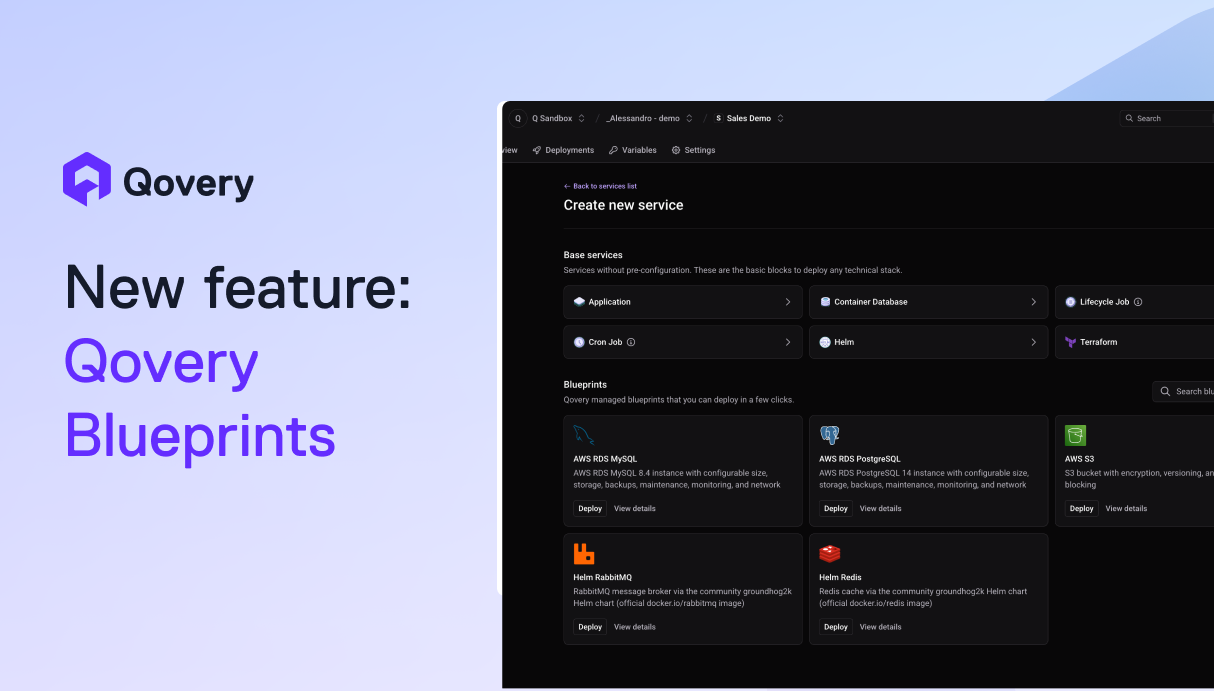
Your Agents Need Infrastructure Too. Meet Qovery Blueprints.
AI agents are provisioning infrastructure now, not just writing code. Qovery Blueprints let you define what an agent, or a developer, is allowed to deploy and under what cost rules, so that self-service or delegation doesn't mean losing control.
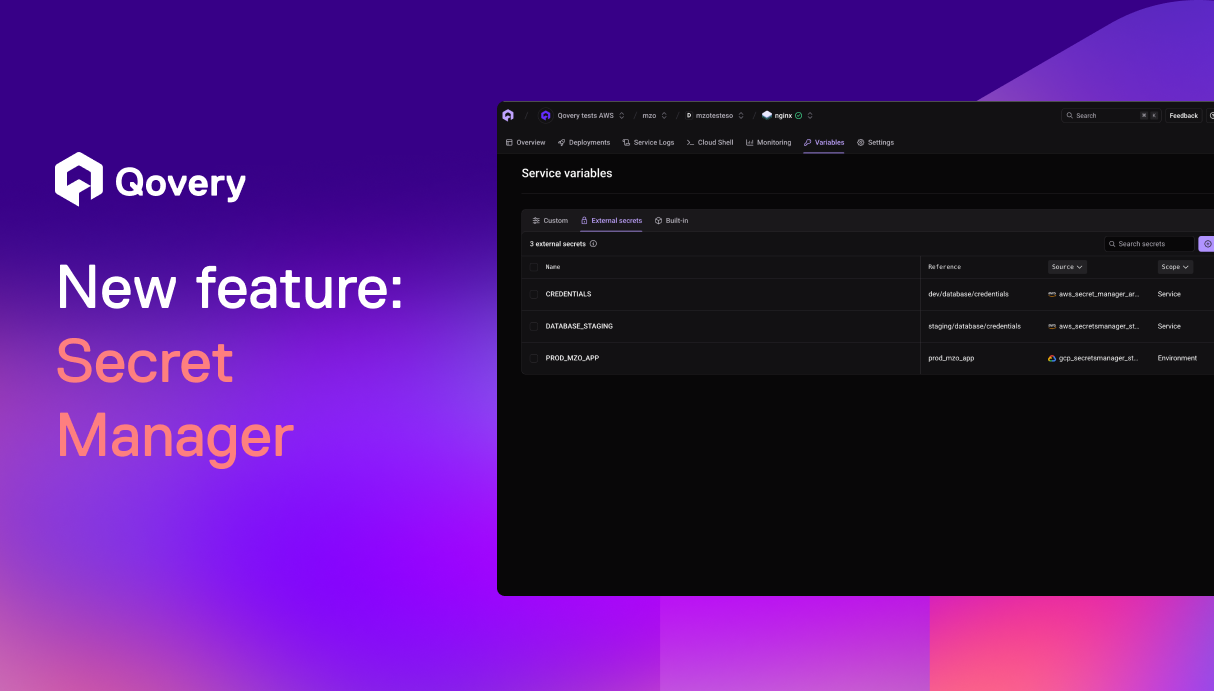
Secret Manager Integration: One Source of Truth for Humans and Agents.
Production secrets should live in one place and stay there, whether your next deployment is triggered by a developer or an AI agent. The Secret Manager integration connects AWS Secrets Manager, AWS SSM, or GCP Secret Manager to Qovery so secrets are referenced, never copied, and enterprise governance holds regardless of who deploys.
Keep ArgoCD. Get Qovery. ArgoCD Integration Is Here.
Moving to a new platform shouldn't mean weeks of migration work before you see any value. Qovery now lets you connect your ArgoCD server and manage your existing applications directly alongside your Terraform modules, lifecycle jobs, and Qovery-native services, from a single control plane.
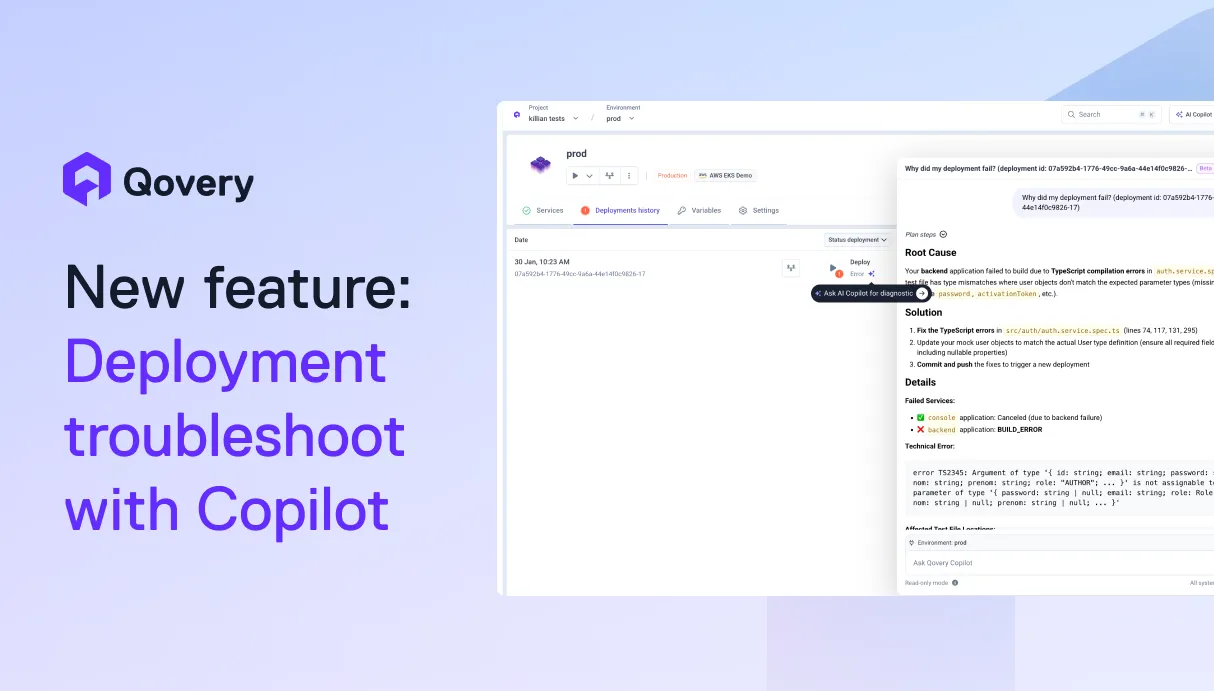
Stop Guessing, Start Shipping. AI-Powered Deployment Troubleshooting
AI is helping developers write more code, faster than ever. But writing code is only half the story. What happens after? Building, deploying, debugging, scaling. That's where teams still lose hours.We're building Qovery for this era. Not just to deploy your code, but to make everything that comes after writing it just as fast.
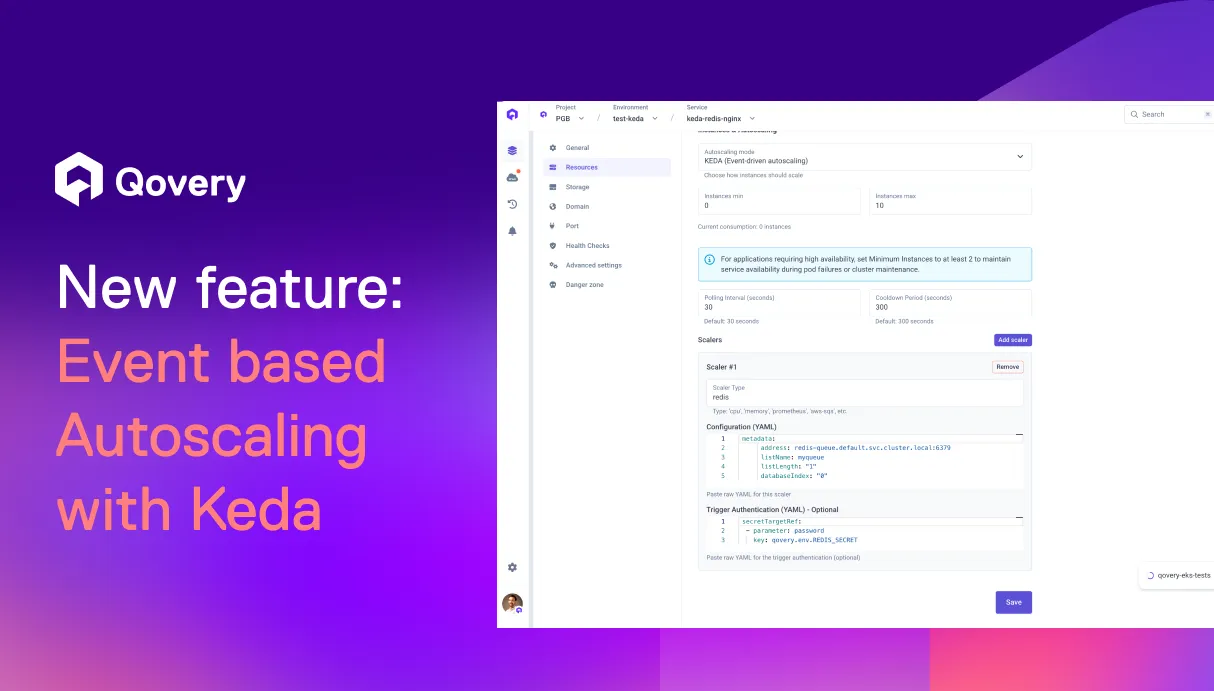
Scale What Matters, Not Just CPU - Welcome Keda autoscaling
Not every workload should scale on CPU. Qovery brings event-driven autoscaling into the application lifecycle, letting applications scale on real signals like queue depth or request latency.
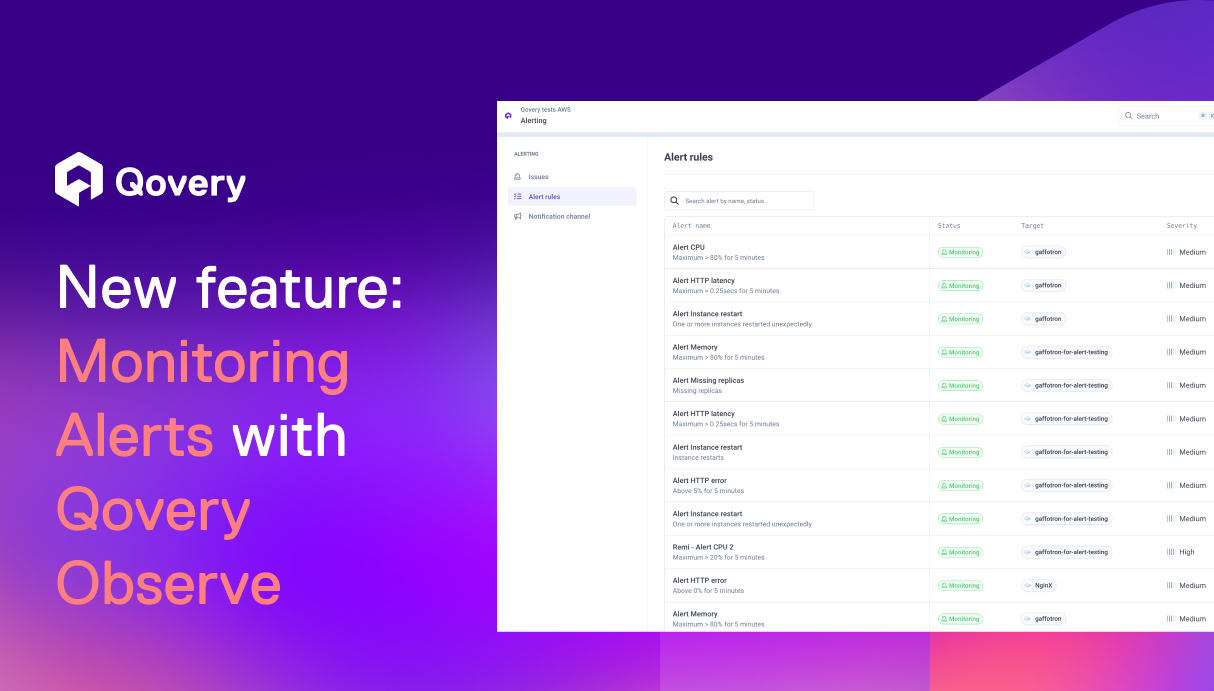
Alerting with guided troubleshooting in Qovery Observe
Get alerted and fix issues with full context. Qovery Observe notifies you when something goes wrong and guides you straight to the metrics and signals that explain why, all in one place.
Announcing Qovery Observability: the simplest way to understand your application
We are thrilled to announce the next major milestone in our platform vision: Qovery observability! Qovery Observability is our new product, ready to give you the fastest way to gain a crystal-clear, unified understanding of your application and infrastructure. Fully managed, zero lock-in, you keep the data. Devs love it, no DevOps needed. Coming soon!
Troubleshoot Faster with the New Log Search and Filtering in Qovery Observability
Following the launch of Qovery Observability, we’re progressively adding new capabilities to help you better monitor, debug, and understand your applications. Today, we’re excited to announce a major improvement to the Logs experience: you can now search and filter directly within your application logs.
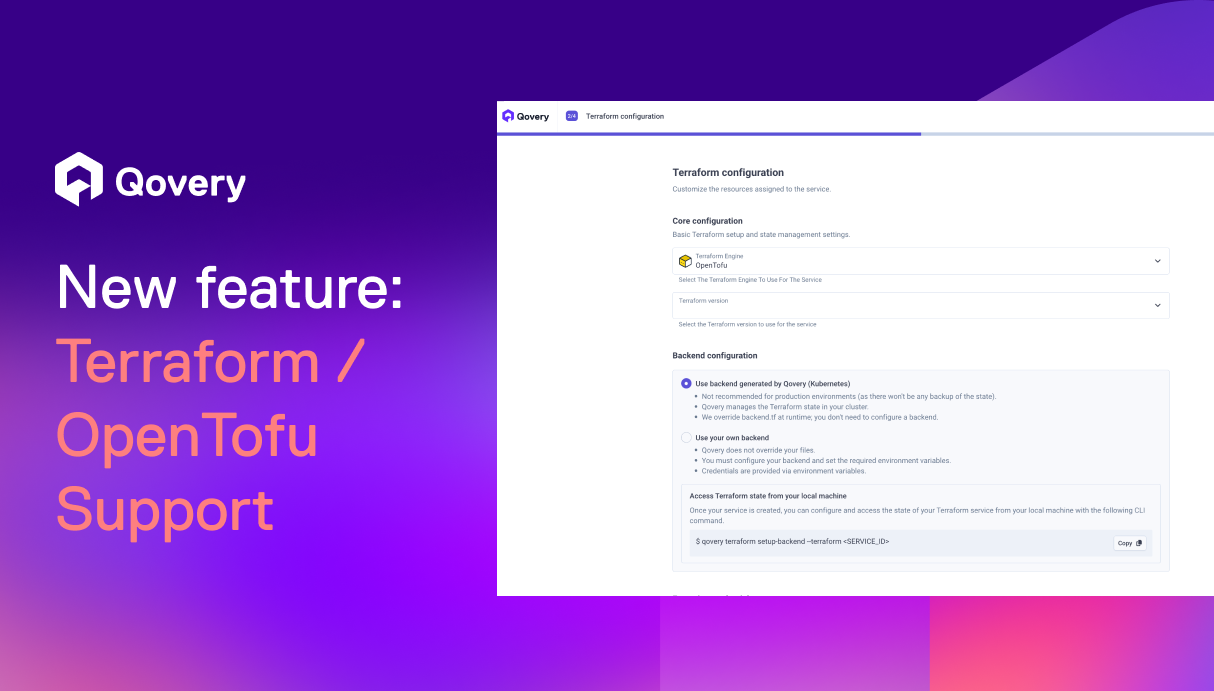
Stop tool sprawl - Welcome to Terraform/OpenTofu support
Provisioning cloud resources shouldn’t require a second stack of tools. With Qovery’s new Terraform and OpenTofu support, you can now define and deploy your infrastructure right alongside your applications. Declaratively, securely, and in one place. No external runners. No glue code. No tool sprawl.
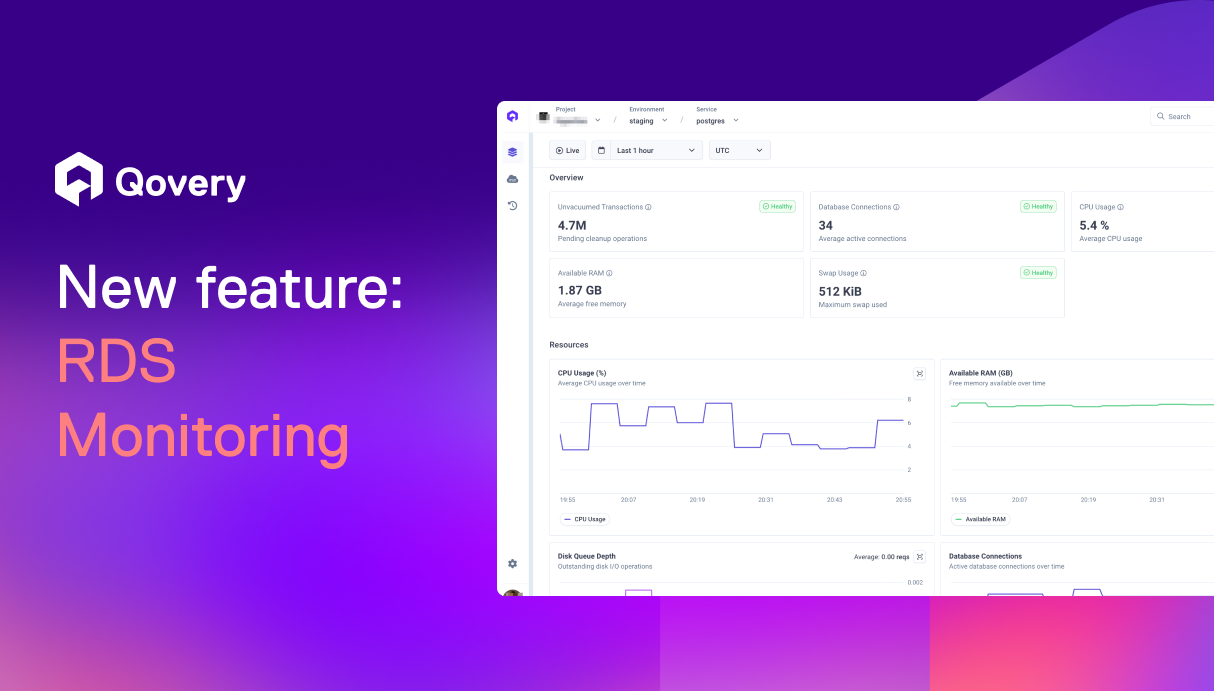
RDS monitoring is now available in Qovery Observe
Starting today, get full visibility on your RDS databases directly inside Qovery. Troubleshoot app and database issues from one place without jumping into the AWS console
GPU workloads on EKS just got way simpler with Qovery
Running GPU workloads on EKS has never been easy, until now. With Qovery’s latest update, you can enable GPU nodes, configure GPU access, and optimize costs automatically, all without writing a single line of YAML or touching Helm charts. Qovery now handles everything behind the scenes so you can focus entirely on your applications.
All things you should know to be a Meeting Master
While meetings are part of today's organizations, they can also bring some frustration preventing one from scratching its TODO list. It can be a good idea to try to promote asynchronous mediums such as Notion pages, Slack channels, etc. This page aims to bring some insights regarding WHEN / WHY holding or not a meeting.
How to Deploy Helm Charts on Kubernetes the Easy Way with Qovery
Deploying Helm charts on Kubernetes can be complex, especially when dealing with configuration overrides, security, and environment-specific setups. In this article, we show how Qovery simplifies Helm chart deployment through a seamless developer experience, robust security defaults, and powerful automation, without sacrificing flexibility.