Blog
Product
3
minutes

May 2020, What's new? Custom domain, dotenv file, CLI improvements, Hasura Con 2020

In this Newsletter, we're happy to introduce some updates: Custom domain, dotenv file, CLI improvements, and new resources.
Romaric Philogène
CEO & Co-founder
Summary
Twitter icon
linkedin icon

Hello 👋​​,
In this Newsletter, we're happy to introduce some updates: Custom domain, dotenv file, CLI improvements, and new resources.

Product updates

Custom domain

It is now possible to use your domain name with Qovery. You can put one or more domain names per application and environment. Read more...

Dotenv file

Qovery supports environment variables in dotenv (.env) file. It's as simple as adding a ".env" file at the root of your project with your environment variables. Read more...

CLI improvements

Tons of improvements have been made on the Qovery CLI. First, upgrade it now! Here are the improvements:

  • New feature: "qovery template <template_name>" command allows you to quickly bootstrap a project with the most popular frameworks</template_name>
  • New feature: "qovery redeploy" command lets you redeploy your application
  • New feature: "qovery domain" command allows you to manage your custom domains
  • Improvement: More descriptive error messages
  • Improvement: Better .qovery.yml and Dockerfile configuration checker
  • Improvement: Better Windows 10 support
  • Improvement: "qovery init" command has a better onboarding flow

New documentation

New Qovery Documentation

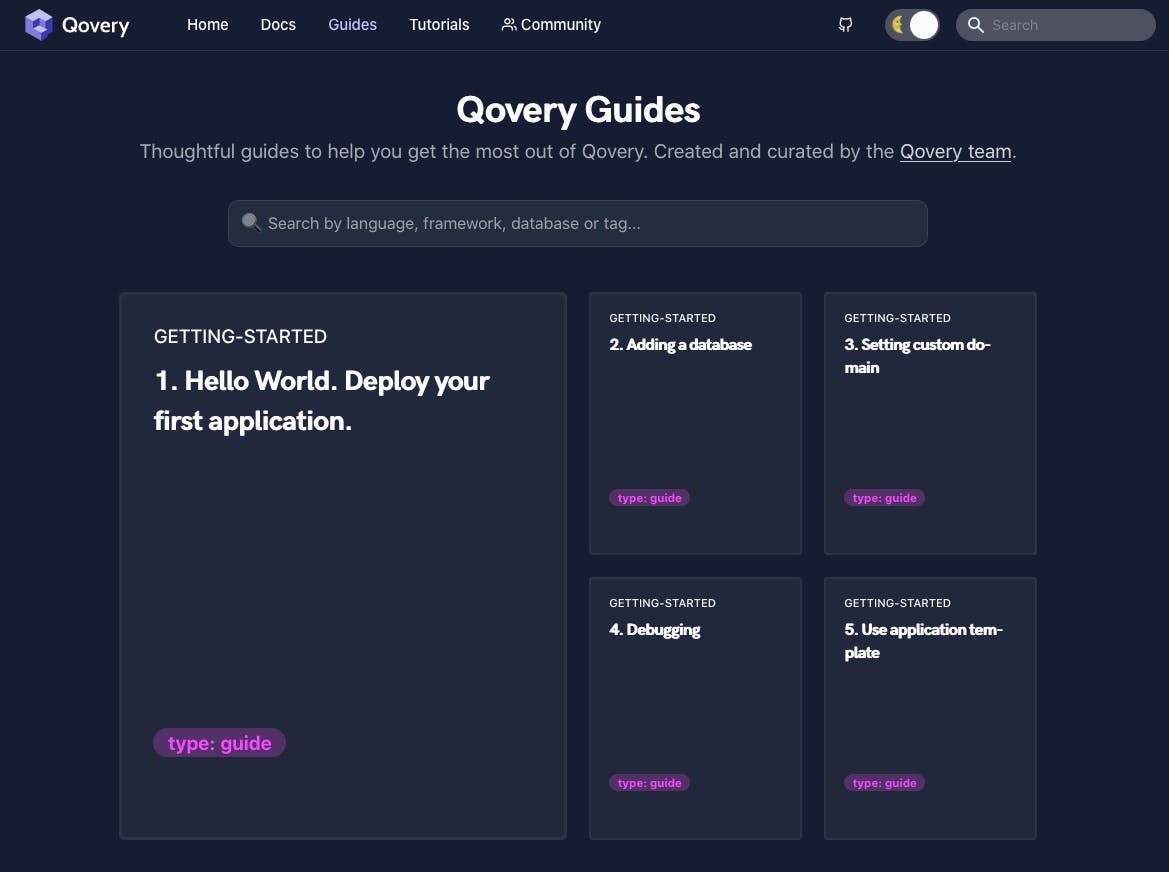
We are happy to announce that our new documentation website is out!

What's new inside?

Feedback / Roadmap

Your feedback is welcome, they help to improve our product, and we'll do our best to do them. Also, do not hesitate to vote for wanted features or submit your ideas.

Community

Thanks, Alexis

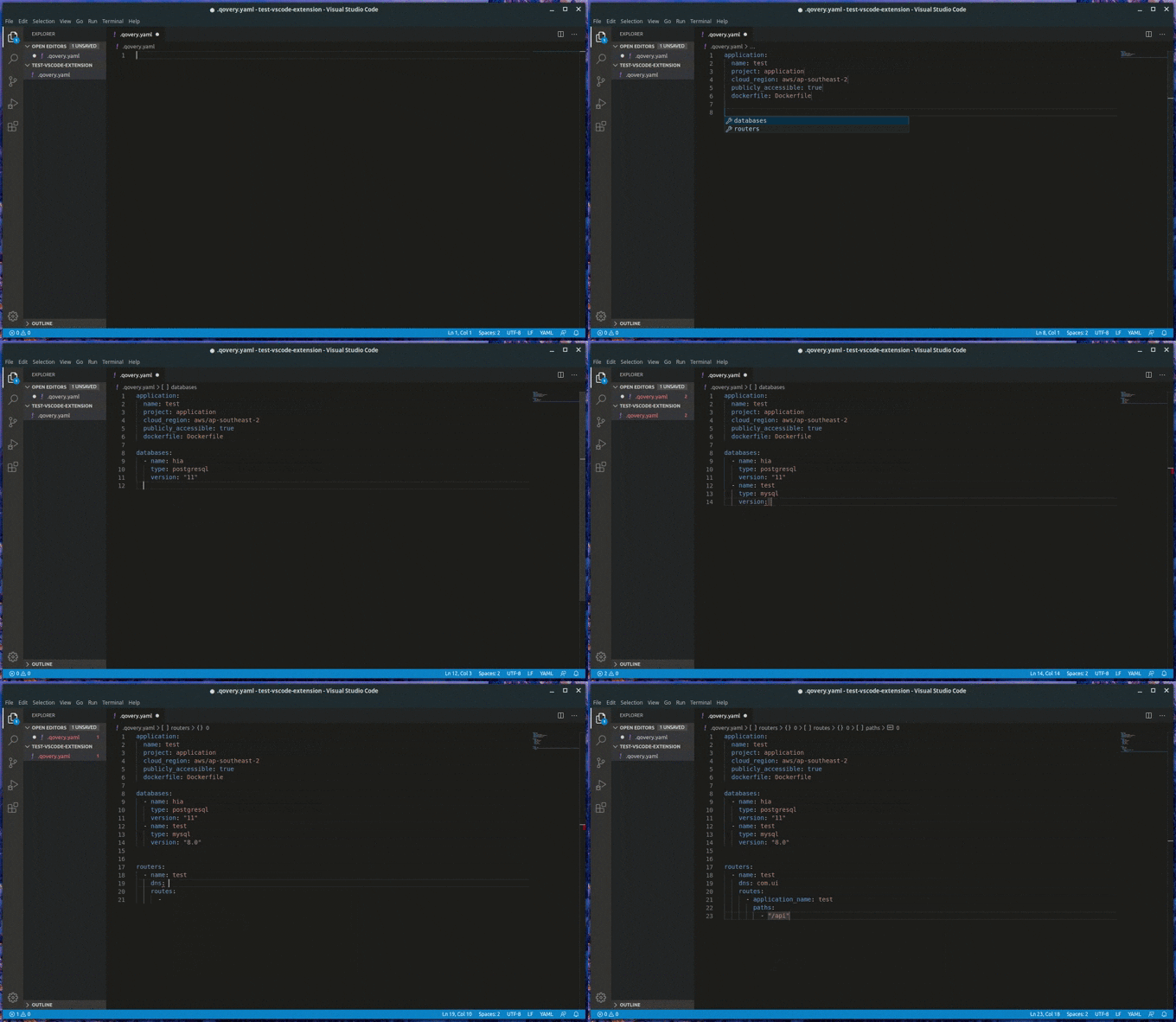
Big thanks to Alexis Viscogliosi. We appreciate your contributions.

Alexis' contributions:

Qovery extension in action with Visual Studio Code

Alexis, you are officially part of our Qovery contributors! 🎉

Do you want to contribute and receive our contributor gifts? Join us on Discord

Are you a passionate technical writer?

Do you like to share your knowledge and your passion for the code? We are looking for two technical writers for an ambitious new project. Interested? Contact us

Resource highlights

Interesting reading from the last month

What's next?

Here is what we are working on this month

  • Web interface: The first release of the Qovery web interface is expected for next month (June).
  • Talk: We speak at the Hasura Con' 2020.
  • Gitlab: We plan to support Gitlab repositories before the end of this month (May).
  • Tool: We are preparing to launch a tool to help the developers to choose the right database. (Do you want to know more? Contact us)
  • DX: We work to improve the speed of deployment

As always, we would love to get your feedback on these updates.

That's all folks

The Qovery Team.

Share on :
Twitter icon
linkedin icon
Ready to rethink the way you do DevOps?
Qovery is a DevOps automation platform that enables organizations to deliver faster and focus on creating great products.
Book a demo

Suggested articles

DevOps
 minutes
TPUs vs. GPUs: The DevOps Guide to AI Hardware Selection

Stop guessing on AI hardware. This DevOps guide details when to use TPUs vs. GPUs for optimal performance, cost, and framework compatibility in MLOps.

Mélanie Dallé
Senior Marketing Manager
Cloud
Business
10
 minutes
The DevOps Guide to Docker Monitoring: Tools, Best Practices, and Unified Observability

Stop tool sprawl. Compare top Docker monitoring tools (Prometheus, Datadog, Qovery) and learn how unified observability simplifies K8s debugging and speeds up feature delivery.

Romaric Philogène
CEO & Co-founder
Cloud
Heroku
Internal Developer Platform
Platform Engineering
9
 minutes
The Top 8 Tools to Build a Zero-Toil PaaS on Your Cloud

Stop managing K8s complexity. Discover the top 8 platform tools (Qovery, Rancher, Dokku) that let you build a customizable, zero-maintenance PaaS on your cloud.

Morgan Perry
Co-founder
Kubernetes
 minutes
How to Deploy a Docker Container on Kubernetes: Step-by-Step Guide

Simplify Kubernetes Deployment. Learn the difficult 6-step manual process for deploying Docker containers to Kubernetes, the friction of YAML and kubectl, and how platform tools like Qovery automate the entire workflow.

Mélanie Dallé
Senior Marketing Manager
Observability
DevOps
 minutes
Observability in DevOps: What is it, Observe vs. Monitoring, Benefits

Observability in DevOps: Diagnose system failures faster. Learn how true observability differs from traditional monitoring. End context-switching, reduce MTTR, and resolve unforeseen issues quickly.

Mélanie Dallé
Senior Marketing Manager
DevOps
Cloud
8
 minutes
6 Best Practices to Automate DevSecOps in Days, Not Months

Integrate security seamlessly into your CI/CD pipeline. Learn the 6 best DevSecOps practices—from Policy as Code to continuous monitoring—and see how Qovery automates compliance and protection without slowing development.

Morgan Perry
Co-founder
Heroku
15
 minutes
Top 10 Heroku Alternatives: When Simplicity Hits the Scaling Wall

Escape rising Heroku costs & outages. Compare top alternatives that deliver PaaS simplicity on your own cloud and scale without limits.

Mélanie Dallé
Senior Marketing Manager
Product
Infrastructure Management
Deployment
 minutes
Stop tool sprawl - Welcome to Terraform/OpenTofu support

Provisioning cloud resources shouldn’t require a second stack of tools. With Qovery’s new Terraform and OpenTofu support, you can now define and deploy your infrastructure right alongside your applications. Declaratively, securely, and in one place. No external runners. No glue code. No tool sprawl.

Alessandro Carrano
Head of Product

It’s time to rethink
the way you do DevOps

Say goodbye to DevOps overhead. Qovery makes infrastructure effortless, giving you full control without the trouble.