How to automate environment sleeping and stop paying for idle Kubernetes resources
Scaling your deployments to zero is only half the battle. If your cluster autoscaler does not aggressively bin-pack and terminate the underlying worker nodes, you are still paying for idle metal. True environment sleeping requires tight integration between your ingress layer and your node provisioner to actually realize FinOps savings.
Intent-based hibernation evaluates actual usage (traffic, git activity, API calls) to sleep clusters automatically rather than relying on assumed schedules.
Frictionless wake-ups intercept requests at the ingress layer to restore environments without ticketing systems or manual SRE intervention.
Centralized policies applied across EKS, GKE, and AKS prevent configuration drift and orphaned resources at fleet scale.
A significant portion of your cloud bill is generated while your engineering team is asleep. A typical staging environment only needs to be active for roughly 40 hours per week when engineers are actively pushing code and testing against it. Yet, most enterprises pay for the full 168 hours because they lack an automated mechanism to scale the environment down during idle time.
Across a fleet of non-production clusters, this idle compute adds up fast. Each cluster running overnight, over weekends, and through holidays represents capacity that no workload is consuming. Platform and SRE teams see the resulting AWS or GCP invoices but lack a mechanism to enforce sleeping policies that actually work across different cloud providers and time zones. When you try to force the issue, you usually end up creating friction that pushes engineers to work around your controls entirely.
The 1,000-cluster reality
Scaling a manual shutdown script for one development cluster is trivial. A single cron job that scales replicas to zero at 8 PM and restores them at 8 AM handles the problem for a small startup team. Attempting to manage downtime schedules for 1,000 non-production clusters globally is an operational liability that no script-based approach can sustain.
Each cluster belongs to a different team, operates in a different time zone, and runs workloads with different availability requirements. A shutdown policy that works for a European development team will inevitably block an Asia-Pacific team starting their workday. You cannot enforce FinOps efficiency if every single cluster requires bespoke cron jobs or manual YAML tuning. At fleet scale, Day-2 Kubernetes hibernation must be governed centrally through intelligent policies that account for actual usage rather than assumed human schedules.
🚀 Real-world proof
RxVantage needed to control spiraling AWS costs across dozens of isolated QA environments without creating massive bottlenecks for their engineering teams.
Why manual and cron-based shutdowns fail
When you try to build an automated sleeping system using native Kubernetes primitives, you almost always start with a cron job that executes kubectl scale deployment --all --replicas=0.
The reality is that StatefulSets, DaemonSets, and the actual worker nodes are still running. The cloud provider still bills you for the EC2 instances. Unless your script also triggers an engine like Karpenter-and you have spent time properly configuring Karpenter to consolidate and terminate the physical nodes, you are saving pennies on the dollar.
Even with aggressive node consolidation, relying on humans to manually trigger or manage scale-down scripts guarantees orphaned resources. Engineers context-switch to other priorities, leave for the weekend without running the shutdown script, or skip the process because they lack the specific RBAC permissions required to modify the deployment state in that namespace. The environments run unattended for weeks, accumulating cloud waste until you are forced to undergo a massive Kubernetes cost optimization exercise..
Simple time-based schedules create developer friction that undermines adoption. Engineers who need environments outside the scheduled window respond predictably. They delete the cron job, override the scaling policy, or provision a shadow environment that exists outside the platform governance framework. The cost of these workarounds always exceeds the savings the cron job was meant to deliver.
The cost of configuration drift
Manual overrides by developers trying to keep environments alive create configuration drift between the FinOps policy and the actual infrastructure state. Your sleeping policy dictates the environment should be down at midnight, but an engineer overwrote the replica count to keep it running for a late-night integration test.
Finance sees the cost but cannot trace it to a specific override. The platform team has no visibility into which environments have been manually kept alive versus which are running according to policy.
The shift to intent-based agentic sleeping
The transition from reactive scripts to proactive agents changes what the system evaluates when deciding whether an environment should be running. While a cron job looks at a clock, an agentic control plane looks at intent.
If an environment receives zero traffic, zero pull request updates, and zero API calls for a defined period, it goes to sleep automatically regardless of what time it is. If a developer pushes a commit at 2 AM, the environment wakes up to process it. The sleeping decision is based on whether anyone or anything is actively using the environment.
This model eliminates the time zone problem, the override problem, and the orphaned environment problem. The policy adapts to actual usage patterns rather than enforcing a rigid, localized window.
Frictionless wake-ups and ingress interception
Platform teams cannot save money if the sleeping mechanism blocks engineering velocity. If waking a sleeping environment requires filing a Jira ticket, waiting for an SRE, or manually scaling replicas back up, engineers will circumvent the system. The savings evaporate when developers respond by keeping environments permanently awake to avoid the friction of bringing them back up.
An agentic control plane handles wake-ups by intercepting the trigger event directly at your Ingress controller. When a developer accesses a sleeping environment's URL, the platform detects the request, holds it, restores the environment to its prior state, and routes the traffic once the readiness probes report healthy.
This works exceptionally well for ephemeral environments; when a developer pushes a commit to a branch associated with a sleeping environment, the CI/CD pipeline triggers the platform to wake the environment, deploy the change, and return to monitoring for an idle state. The developer experiences a brief DNS wait rather than a multi-step manual process.
Agents ship fast. Guardrails keep them safe.
Qovery ensures every agent action is scoped, audited, and policy-checked. Start deploying in under 10 minutes.
Qovery as the agentic control plane for hibernation
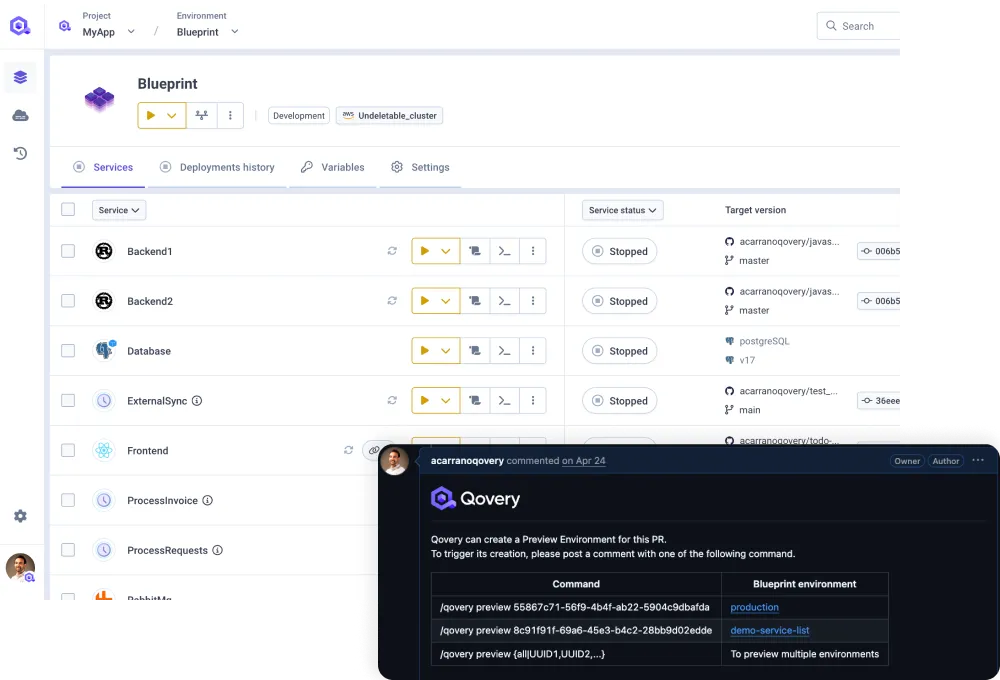
Qovery centralizes environment sleeping policies above EKS, GKE, and AKS, translating global hibernation rules into provider-specific actions. Platform leaders define default fleet-wide sleeping policies that apply to all new non-production Kubernetes clusters automatically. A team provisioning a new staging environment inherits the organization's rules without writing any additional YAML.
The platform supports both scheduled and intent-based sleeping within the same policy framework. You can set a baseline schedule (all non-production environments sleep between 8 PM Friday and 8 AM Monday) and layer intent-based rules on top through a simple .qovery.yml configuration:
Developers wake environments through normal workflow actions like accessing a URL, pushing code, or triggering a deployment through the Qovery CLI. The combination of centralized policy and frictionless restoration makes the savings sustainable at scale.
Standardizing Day-2 FinOps operations
Idle infrastructure is a fixable engineering problem, not an inherent cost of doing business when it comes to Day-2 operations. The downtime hours of the week that each non-production environment sits unused represents compute capacity that can be reclaimed automatically, consistently, and without developer friction. This only works when the mechanism is governed by intent rather than schedules.
An agentic Kubernetes platform makes this reclamation the default state for every non-production cluster in your fleet. New environments inherit sleeping policies, existing environments are evaluated against usage signals, and overrides are tracked and attributed to specific users. The result is a FinOps posture where cost governance is embedded directly into the platform rather than dependent on human discipline.
Managing 100+ K8s Clusters
From cluster sprawl to fleet harmony. Master the intent-based orchestration and predictive sizing required to build high-performing, AI-ready Kubernetes fleets.
What is automated environment sleeping in Kubernetes?
Automated environment sleeping is the practice of scaling non-production Kubernetes environments to zero or near-zero resource consumption during periods of inactivity. An agentic implementation goes beyond scheduled shutdowns by evaluating usage signals like traffic, deployment activity, and API calls to determine when an environment should hibernate, then automatically restoring it when activity resumes.
Why do cron-based sleeping schedules fail at fleet scale?
Cron jobs enforce rigid time windows that cannot account for teams in different time zones, developers working outside standard hours, or environments with irregular usage patterns. At fleet scale, maintaining per-cluster cron configurations creates severe configuration drift. Engineers bypass schedules that block their work, resulting in a state where the FinOps policy exists on paper but infrastructure continues running unchecked.
How do developers wake a sleeping environment without filing a ticket?
In an agentic model, the control plane intercepts trigger events like URL access, git pushes, or API calls directed at a sleeping environment. The platform automatically restores the environment to its prior running state and routes the request once the underlying services pass their readiness probes. The developer experiences a brief startup delay rather than a manual process, eliminating the friction that usually kills FinOps initiatives.
Melanie leads content at Qovery. She covers platform engineering trends, Kubernetes operations, FinOps, and the tools that help engineering teams ship faster.
Next step
Agents ship fast. Guardrails keep them safe.
Qovery ensures every agent action is scoped, audited, and policy-checked. Start deploying in under 10 minutes.