Provisioning is the wrong evaluation criteria: Every tool on this list can spin up a cluster. The real differentiator is how each one handles configuration drift, fleet-wide RBAC, and cost governance at scale - the Day-2 work that consumes most of your platform team's time.
Proprietary CRDs are a long-term liability: OpenShift Routes, Tanzu-specific controllers, and vendor-specific Operators accumulate across clusters. The exit cost of unwinding them grows linearly with fleet size and rarely appears in the initial evaluation.
Agentic automation is now the baseline, not a premium feature: In 2026, platforms that require manual kubectl interventions for routine fleet operations are not enterprise-grade. The question is not whether a tool automates, but what it automates and how much it hides from the team that needs to debug it.
The most common mistake when evaluating Kubernetes management platforms is testing them on how fast they spin up a cluster. That takes about 20 minutes with any of the tools on this list. What separates them is what happens afterwards: drift detection, certificate lifecycle, cost governance, and whether your developers can ship without filing a ticket.
Tools like Terraform or kOps are excellent for spinning up the underlying EC2 instances and networking. They do absolutely nothing to prevent configuration drift, automate certificate rotation, or right-size idle workloads once the cluster is actually running. That gap, between initial provisioning and ongoing operation, is where the real cost of Kubernetes management accumulates.
At two clusters, manual operations are manageable. Engineers bypass GitOps occasionally, apply hotfixes via kubectl, and clean it up later. At 100 clusters, those habits become a systematic failure mode. Configuration drift accumulates silently. Certificate expirations go undetected. The upgrade cycle breaks three environments simultaneously because nobody tracked which ones had manual changes applied.
In 2026, the market has split clearly between basic infrastructure provisioners and agentic management platforms that handle Day-0, Day-1, and Day-2 operations. The following guide covers the ten tools that enterprise teams are actually running at fleet scale, what each one does well, and where each one will frustrate you.
Top 10 Kubernetes Fleet & Cluster Tools
Platform
Primary enterprise use case
Key differentiator
Day-2 complexity
1. Qovery
Fleet automation and developer self-service
Intent-based agentic abstraction on vanilla AWS/GCP/Azure infrastructure
Low (Agentic)
2. Red Hat OpenShift
Heavily regulated on-premise environments
Strict compliance workflows and certified stateful Operator ecosystem
High (Proprietary)
3. SUSE Rancher
Multi-cluster fleet operations
Universal management and centralised RBAC for bare-metal fleets
High (Manual ops)
4. VMware Tanzu
vSphere and VMware data centres
Integrates container orchestration into legacy vCenter hypervisor layers
High (VMware lock-in)
5. Rafay
SRE teams and fleet automation
Cluster blueprinting, GitOps drift prevention, and zero-trust access logging
High (Steep curve)
6. Spectro Cloud
Edge computing and bare metal
Full stack: OS, Kubernetes binaries, and apps deployed as a single cluster profile
Medium (Niche)
7. Mirantis
Legacy Docker modernisation
Managed control plane supporting both Kubernetes and Docker Swarm
High (Legacy)
8. Portainer
SMBs and lightweight scaling
Simplest UI for exposing Kubernetes primitives to non-specialist teams
Low (Basic UI)
9. Platform9
Hybrid and SaaS operations
SaaS-hosted control plane for on-premise worker nodes
Medium (SaaS)
10. Lens
Individual developer observability
Client-side desktop IDE for visual troubleshooting without CLI commands
Low (Client-side)
1. Qovery
Qoveryis built for teams that need to turn Kubernetes into a standardised asset rather than a source of operational drag.
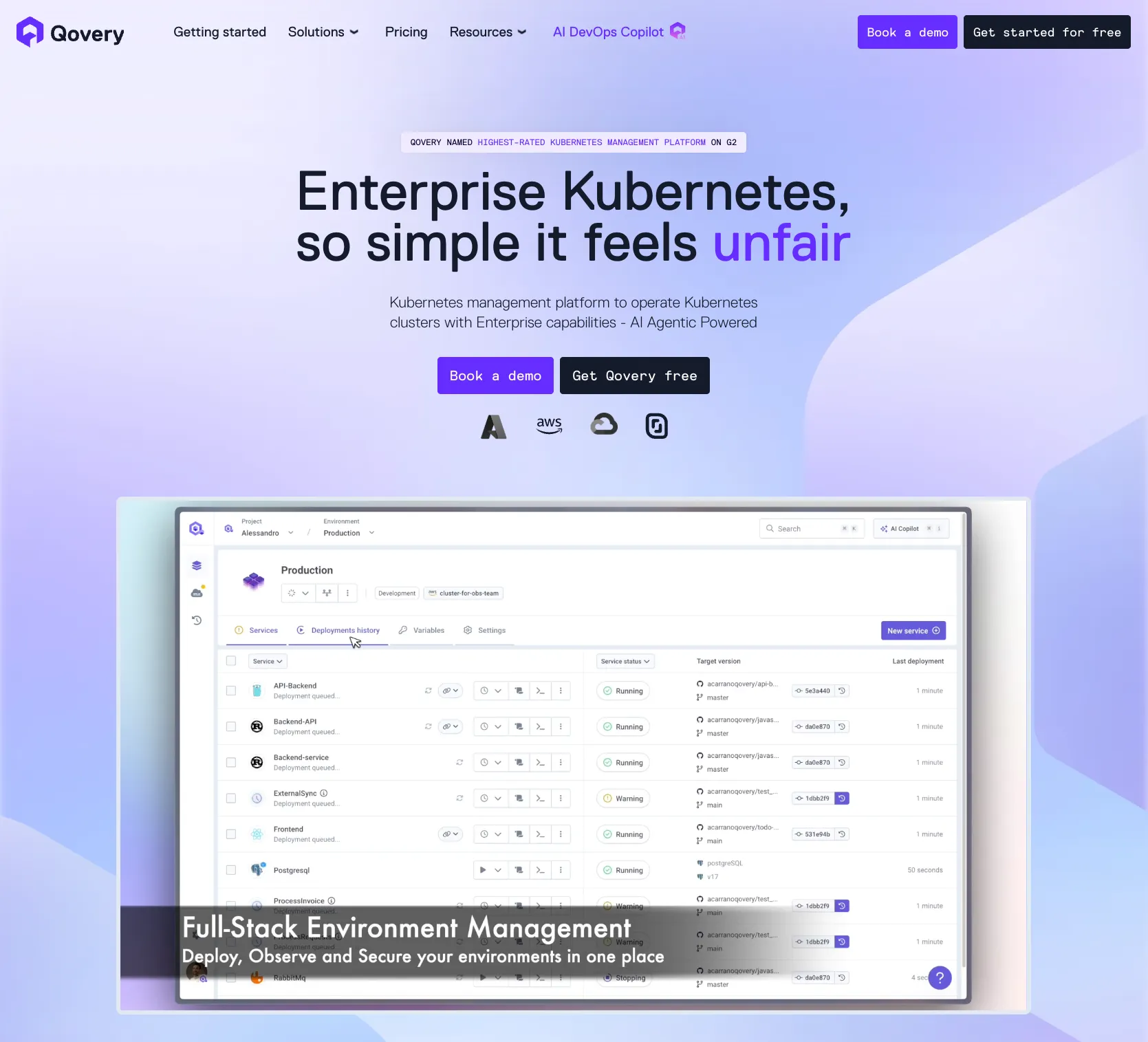
It layers on top of your existing cloud infrastructure - EKS, AKS, GKE - and handles Day-2 operations through intent-based agentic automation. You define what you want the infrastructure to do. The platform reconciles the underlying Kubernetes primitives automatically.
The developer experience angle is concrete: instead of writing raw YAML to expose a service, a developer defines the outcome in a simple configuration file and the platform generates the correct, standard Kubernetes manifests underneath.
The auto_stop configuration is worth paying attention to. Non-production environments hibernating automatically after four hours of idle time is a FinOps feature, not just a developer convenience. Across a fleet of 50 preview environments, that is real budget recovery without anyone having to remember to shut things down.
**Where it works best:**
Teams running cloud-native workloads on EKS, GKE, or AKS who need fleet governance, developer self-service, and FinOps automation without building and maintaining the control plane themselves.
The honest limitation:
Teams that need raw, unmediated access to the Kubernetes API for highly bespoke networking configurations may find the managed abstraction layer restrictive. If your platform engineers regularly drop to kubectl for non-standard operations, evaluate whether the abstraction fits your workflows before committing.
🚀 Real-world proof
Alan, the French digital health unicorn, was managing 50+ Elastic Beanstalk environments with deployments taking over an hour and failing unpredictably, with a full-time engineer dedicated solely to keeping the platform operational.
2. Red Hat OpenShift
OpenShift is not just a management tool. It is a complete, opinionated Platform-as-a-Service built on Kubernetes, and it remains the default choice for heavily regulated enterprises that need strict compliance guarantees and commercial support with an SLA attached.
The security posture is genuinely differentiated. OpenShift's default restricted-v2 Security Context Constraints will refuse to run containers that do not comply with its security requirements. For regulated industries, that hard enforcement is the point.
On-premise regulated environments - financial services, healthcare, government - where commercial support, certified Operators, and strict security defaults justify the cost and complexity.
The honest limitation:
The exit cost is real and consistently underestimated. OpenShift's proprietary Route CRDs, DeploymentConfig objects, and vendor-specific Operators accumulate across clusters. Migrating back to vanilla Kubernetes means rewriting all of them. On a fleet of any meaningful size, that is a multi-quarter engineering project.
Rancher remains the industry standard for teams that need to manage a genuinely heterogeneous fleet from a single interface.
The ability to import almost any CNCF-certified cluster, whether provisioned by Rancher itself, an EKS deployment, or bare-metal RKE2, and manage them all under one authentication boundary is its defining capability.
**Where it works best:**
Large, disparate fleets spanning on-premise hardware and multiple cloud providers, where the priority is centralised RBAC and fleet visibility rather than developer self-service or FinOps automation.
The honest limitation:
The Rancher management server itself can become a resource-heavy single point of failure if not architected for high availability from the start. Getting the HA setup right adds significant operational complexity before you get any of the fleet management value. Top 10 Rancher alternatives: beyond cluster management.
4. VMware Tanzu (Tanzu Platform)
For organisations deeply invested in VMware vSphere infrastructure, Tanzu is the path to Kubernetes that does not require rebuilding the operational model from scratch.
It integrates container orchestration directly into the hypervisor layer, which means VM administrators can provision Kubernetes clusters through the same vCenter interface they have used for years.
Tanzu Mission Control adds a centralised SaaS management layer for policy enforcement across hybrid deployments.
**Where it works best:**
Enterprises with significant existing VMware investment where the priority is adding Kubernetes capability without disrupting the existing infrastructure team's workflows.
The honest limitation:
Outside of VMware environments, Tanzu makes little sense. Teams operating purely on AWS or GCP will find the integration overhead and licensing costs outweigh the benefits. It is a VMware-shop solution.
5. Rafay
Rafay is built for SRE teams that need to enforce configuration standardisation across large fleets with no tolerance for drift.
The blueprint model is the core differentiator: you define a cluster blueprint specifying ingress controllers, logging agents, security policies, and network configuration, and the platform enforces that blueprint across every cluster in the fleet.
The zero-trust access logging is equally important for compliance-heavy environments. Every kubectl command executed by any user against any cluster is logged, making audit trails a byproduct of normal operations rather than something assembled manually.
Where it works best:
Platform engineering teams at enterprises where governance, compliance auditing, and drift prevention across hundreds of clusters are the primary requirements.
The honest limitation:
The feature set is deep and the learning curve reflects that. For teams deploying basic microservices or just starting to scale their fleet, Rafay's governance tooling is significant overkill. The complexity pays off at scale. Before that, it adds friction.
6. Spectro Cloud
Spectro Cloud's Palette product takes a different architectural approach from most tools on this list.
Rather than managing just the Kubernetes layer, Palette models the OS, the Kubernetes binaries, and the application add-ons as a single deployable "Cluster Profile." That full-stack approach makes it particularly resilient for edge computing deployments where a central management plane may be unreliable or unavailable.
Where it works best:
Edge computing environments and bare-metal deployments where decentralised cluster intelligence is a requirement, not a preference.
The honest limitation:
Spectro Cloud is a newer player relative to Red Hat and VMware. The edge use case is real, but outside that specific context the platform's advantages are less clear compared to more established tools with larger support ecosystems.
7. Mirantis
Mirantis occupies a specific niche: enterprises that need to modernise away from Docker Swarm without fully committing to a Kubernetes-only architecture immediately.
Their platform is one of the few that runs both Kubernetes and Docker Swarm orchestrators side-by-side, which makes it a practical transition path for organisations with significant Swarm-based workloads.
Where it works best:
Enterprises mid-migration from Docker Swarm to Kubernetes who need to run both during the transition rather than forcing a hard cutover.
The honest limitation:
Outside of the legacy modernisation context, Mirantis is rarely the competitive choice. Teams starting fresh on Kubernetes have no reason to carry Swarm compatibility overhead.
8. Portainer
Portainer started as a Docker visualiser and has grown into a lightweight Kubernetes management UI.
It is typically the first tool small teams reach for when Kubernetes starts feeling overwhelming, and it genuinely succeeds at making primitives like PersistentVolumeClaims and Ingress routes readable to engineers who did not grow up with YAML.
Where it works best:
Small teams and early-stage companies that need to reduce the CLI barrier for non-specialist engineers. It is a legitimate starting point.
The honest limitation:
Portainer has no GitOps drift reconciliation, no fleet FinOps, and no agentic policy enforcement. Once a team grows past a handful of clusters, they typically outgrow it quickly. If you are evaluating Portainer for an enterprise fleet, you are evaluating the wrong tool.
9. Platform9
Platform9 inverts the typical hosting model. Instead of you managing the control plane, Platform9 hosts it as a SaaS service.
You provide the compute nodes - on-premise servers or cloud VMs - and they handle etcd backups, API server scaling, and version upgrades remotely. The result is a CNCF-certified, standard Kubernetes experience without the control plane operational burden.
Where it works best:
Organisations with on-premise compute they want to keep but no appetite for managing Kubernetes control plane infrastructure themselves. The SaaS model is clean for this specific use case.
The honest limitation:
The SaaS control plane creates a hard external dependency. Uninterrupted outbound internet connectivity from your data centre is a requirement, not an option. If that connectivity is unreliable or restricted by security policy, the operational model breaks down.
10. Lens
Lens is not a server-side cluster manager in the same category as the other tools on this list.
It is a client-side desktop IDE that gives developers and platform engineers immediate visual access to cluster state without typing CLI commands. Pod metrics, live logs, cluster event streams, one-click port-forwarding, direct shell access - all available through a clean interface that makes multi-cluster context-switching practical.
Where it works best:
Individual developers and platform engineers who work directly with clusters daily and want faster troubleshooting without building institutional kubectl fluency first.
The honest limitation:
Lens does not enforce anything. No RBAC policies, no cost governance, no drift reconciliation. It is a viewing and debugging tool, not a governance platform. The category it competes in is developer productivity, not enterprise fleet management. Pair it with a real management platform rather than treating it as one.
Agents ship fast. Guardrails keep them safe.
Qovery ensures every agent action is scoped, audited, and policy-checked. Start deploying in under 10 minutes.
The market has shifted permanently from asking how to install a cluster to asking how to operate a fleet without burning out the platform team. For a deeper look at the architectural frameworks and agentic workflows behind that shift, the complete 2026 guide to Kubernetes Day-2 operations is worth reading alongside this comparison.
The choice between tools comes down to a few honest questions. If the priority is strict compliance enforcement across disparate bare-metal hardware, OpenShift or Rafay are the established heavyweights and for good reason. If the fleet spans multiple cloud providers and the main problem is centralising RBAC and visibility, Rancher handles that better than most.
If the priority is stripping away operational overhead, recovering cloud spend, and giving developers a path to self-service that does not route every deployment through a ticket queue, an agentic platform like Qovery is the clearer choice. The intent-based abstraction means platform engineers define policies and outcomes rather than managing YAML at cluster level. The underlying infrastructure stays vanilla and portable. And the FinOps automation works on the fleet automatically rather than waiting for someone to action a cost report.
Most teams are not choosing between all ten tools on this list. They are choosing between two or three that fit their architecture and evaluating them on the Day-2 capabilities that will matter in 18 months, not the provisioning speed that matters in the demo.
FAQs
What is the difference between Kubernetes orchestration and Kubernetes management?
Orchestration is what Kubernetes itself does: scheduling containers onto nodes and maintaining declared replica counts. Kubernetes management is the operational layer above that. It covers security patching across a fleet, version upgrades, cost allocation, RBAC governance, and certificate lifecycle. Orchestration keeps your workloads running. Management keeps the entire platform healthy, auditable, and cost-efficient over time. The distinction matters when evaluating tools because many provisioners are marketed as management platforms but only address the orchestration layer.
How do AI agents improve Kubernetes Day-2 operations?
AI agents replace reactive monitoring with proactive remediation. Standard monitoring tells you something went wrong. An agent detects the conditions preceding a failure, including memory pressure building over hours, a certificate within days of expiry, or a replica count drifting from its declared state, and applies a corrective action before the outage occurs. At fleet scale, the volume of signals coming off hundreds of clusters is too high for humans to process continuously. Agents are not a convenience at that scale. They are the only sustainable operating model.
Why is vanilla Kubernetes important for enterprise fleet management?
Proprietary Kubernetes distributions introduce custom resource definitions specific to that vendor's ecosystem. As clusters accumulate those proprietary resources, the exit cost of migrating to standard Kubernetes grows proportionally. On a fleet of 10 clusters that migration is a sprint. On a fleet of 100, it is a multi-quarter project that competes directly with product development for engineering time. Building on standard EKS, GKE, or AKS from the start eliminates that future liability. It also means every standard Kubernetes tool, operator, and integration works without modification.
Melanie leads content at Qovery. She covers platform engineering trends, Kubernetes operations, FinOps, and the tools that help engineering teams ship faster.
Next step
Agents ship fast. Guardrails keep them safe.
Qovery ensures every agent action is scoped, audited, and policy-checked. Start deploying in under 10 minutes.