Top 10 Rafay alternatives for enterprise Kubernetes operations
Is Rafay's complexity slowing you down? Compare the top 10 Rafay alternatives for 2026. From fleet managers like Rancher to developer platforms like Qovery, find the balance between control and velocity.
Rafay has built a strong reputation as a Governance First platform. It excels at enforcing strict OPA (Open Policy Agent) rules, managing multi-tenancy, and ensuring that every cluster in a massive fleet is identical. For central Platform Teams in banking or defense, it is a powerful control mechanism.
But for many organizations, Rafay creates a "Bottleneck of Control."
Its focus on restriction ("You can't do this") often comes at the expense of Developer Velocity ("I need to ship this"). Engineering teams often find Rafay complex, rigid, and disconnected from their daily workflow.
We analyzed the top 10 alternatives, categorizing them into Governance Tools (Ops focus) and Developer Platforms (App focus).
Top 10 Rafay Alternatives for Enterprise Kubernetes Operations
Tool
Best For
Strategy
1. Qovery
Teams moving from "Governance" to "Self-Service" (IDP).
Teams who specifically want Kyverno policy management.
Niche Swap
4. Spectro Cloud
Managing "Bare Metal" profiles at the Edge.
Edge Focus
5. Platform9
SaaS-Managed K8s on bare metal with an SLA.
SaaS Ops
6. OpenShift
FIPS compliance and "Full Stack" Red Hat support.
Enterprise
7. Loft (vCluster)
Creating isolated virtual clusters for dev teams.
Isolation
8. Portainer
Simple visualization without complex governance.
Lightweight
9. Hyperscalers
Teams standardizing on one public cloud provider.
Hyperscaler
10. Tanzu
Teams needing to run K8s inside existing VMware.
Legacy
1. Qovery – The "Developer-First" Alternative
Best For: Teams who want to stop "Policing" developers and start "Empowering" them.
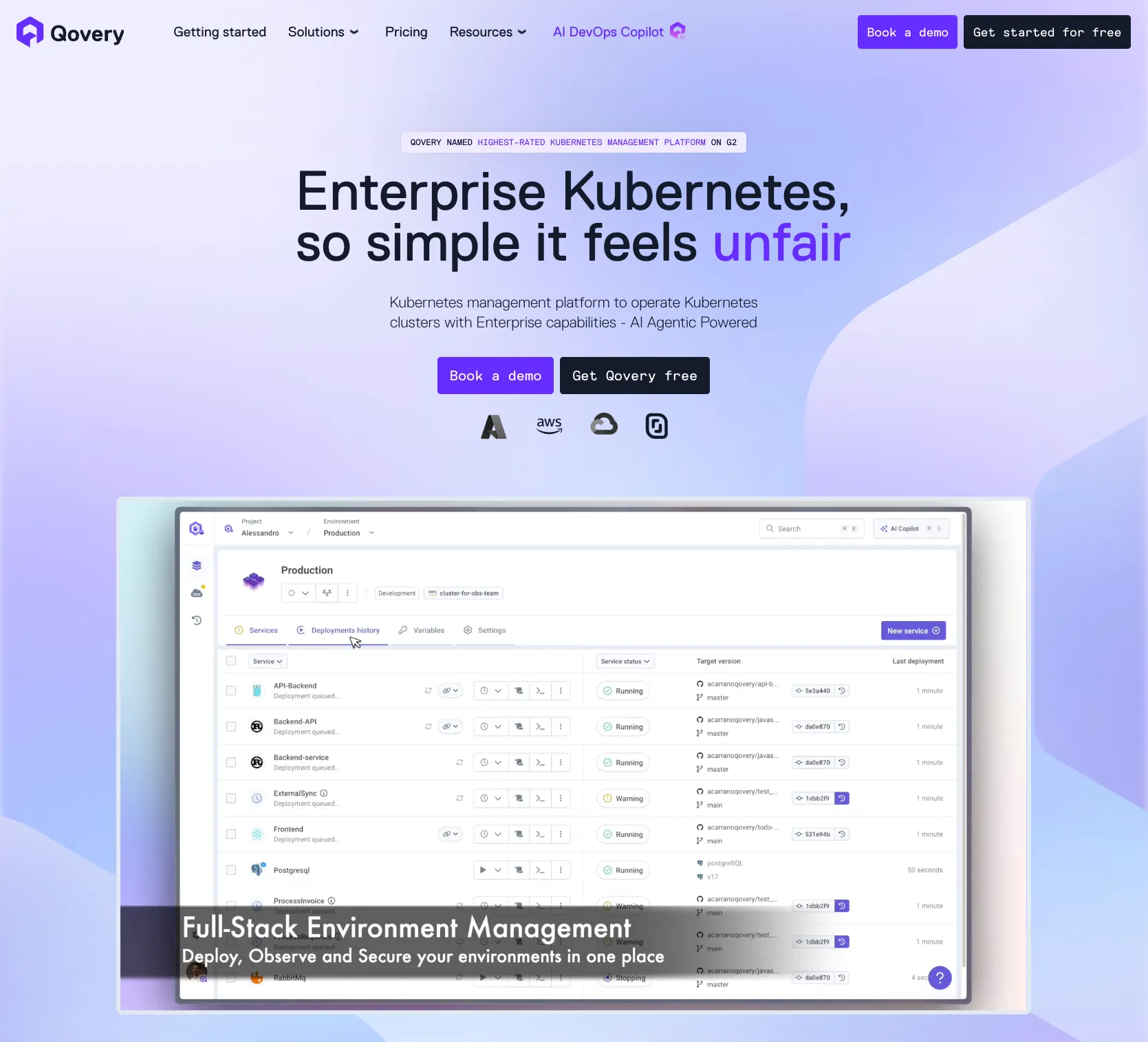
The Strategy: Rafay focuses on Governance (locking down the cluster). Qovery is a Kubernetes management platform that focuses on Delivery (shipping the app).Instead of building complex OPA rules to restrict what developers can do, Qovery provides a "Golden Path." It gives developers a self-service portal to deploy apps and environments within pre-set guardrails, removing the need for heavy-handed policing.
Pros:
Developer Experience: A UI that developers actually like, with "Clone Environment" and "Preview PR" features.
Zero Maintenance: A fully managed SaaS control plane that requires no patching.
Adoption: Higher internal adoption from engineering teams compared to Ops-heavy tools.
Cons:
Governance Depth: Lacks the granular OPA (Open Policy Agent) enforcement engine of Rafay.
Focus: Designed for Applications, not for deep cluster fleet standardization.
Master Fleet-First Kubernetes
From cluster sprawl to fleet harmony, learn the operational strategies and architectural frameworks required to orchestrate high-performing, global, AI-ready Kubernetes fleets.
Best For: Ops teams managing mixed fleets of On-Prem and Cloud clusters.
The Strategy: Rancher is the primary "General Purpose" competitor to Rafay. It provides excellent fleet management and centralized authentication (SSO) but uses a more open, community-driven approach than Rafay’s strict enterprise model.
Pros:
Cost: Open-source foundation allows for significantly lower TCO.
Flexibility: Works with any CNCF-certified Kubernetes distro (RKE, K3s, EKS).
Cons:
Policy: While it supports OPA, the policy engine is less sophisticated/integrated than Rafay’s.
Maintenance: You are responsible for maintaining the Rancher management server yourself.
3. Nirmata – The Policy Specialist
Best For: Teams who bought Rafay specifically for Policy/Governance and nothing else.
The Strategy: Nirmata is the commercial platform behind Kyverno (the Kubernetes-native policy engine). If your main goal is "Ensure no one runs root containers," Nirmata does this better and simpler than Rafay.
Pros:
Kyverno Native: Uses Kubernetes CRDs for policy, which is often easier to learn than Rafay’s OPA/Rego.
Focus: Pure focus on governance and compliance.
Cons:
One Trick: It is a policy tool, not a full lifecycle management platform (doesn't handle deployment/IDP).
4. Spectro Cloud (Palette) – The "Profile" Engine
Best For: Managing full-stack profiles (OS + K8s) at the Edge.
The Strategy: Rafay manages the Kubernetes layer well, but Spectro Cloud manages the entire stack including the Operating System. For edge use cases (e.g., 5,000 retail stores), Spectro’s declarative profiles prevent "drift" better than Rafay.
Pros:
Full Stack: Controls the Linux OS layer, not just the K8s layer.
Edge: Built specifically for low-connectivity environments.
Cons:
Complexity: Like Rafay, it is a complex tool built for Operators, not Developers.
5. Platform9 – The SaaS Operator
Best For: Enterprises who want Rafay’s "SaaS Management" model but for on-prem bare metal.
The Strategy: Both Rafay and Platform9 use a SaaS control plane. However, Platform9 positions itself as a "Virtual Ops Team." They take responsibility for the SLA of the cluster upgrades, whereas Rafay provides the tool for you to do the upgrades.
Pros:
SLA: They handle the patching and upgrades, reducing your operational risk.
Support: Excellent for "Hands-off" operations.
Cons:
Cost: Can be expensive for large scale deployments compared to DIY Rancher.
6. Red Hat OpenShift – The Compliance OS
Best For: Highly regulated industries (Banking/Gov) requiring FIPS compliance.
The Strategy: If you are using Rafay for compliance, OpenShift is the logical "Heavy" alternative. It enforces security by default (e.g., containers cannot run as root) at the OS level.
Ecosystem: Integrated registry, CI/CD, and monitoring.
Cons:
Lock-in: Deep dependency on Red Hat CoreOS and tools.
Cost: Significant per-core licensing fees.
7. Loft (vCluster) – The Isolation Specialist
Best For: Teams using Rafay for "Multi-Tenancy" (Sharing clusters).
The Strategy: Rafay uses software multi-tenancy to isolate teams. Loft uses Virtual Clusters. It allows you to spin up fully isolated "fake" clusters inside a real one. This gives developers admin access to their own sandbox without breaking the real cluster.
Pros:
Isolation: Better separation than standard namespaces.
Cost: Reduces the need for physical clusters.
Cons:
Niche: It solves multi-tenancy, but it isn't a full fleet manager.
8. Portainer – The Visual Manager
Best For: Smaller teams needing visibility without the heavy governance.
The Strategy: Rafay is often overkill for teams with <10 clusters. Portainer provides a lightweight UI to visualize workloads and manage access without the steep learning curve.
Pros:
Simplicity: Installs in seconds. Great for visualization.
Price: Significantly cheaper than Rafay.
Cons:
Limits: Lacks the deep "Fleet Policy" features of Rafay (no complex OPA enforcement).
9. AWS EKS / Google GKE – The Native Option
Best For: Teams standardizing on a single cloud.
The Strategy: Rafay is valuable for Hybrid (AWS + On-Prem). If you are 100% on AWS, Rafay is just an extra tax. AWS EKS now has decent built-in dashboarding and add-on management.
Pros:
Simplicity: One less vendor to manage.
Integration: Native IAM and VPC integration.
Cons:
No Fleet View: Harder to manage if you split across 20+ accounts/regions.
10. VMware Tanzu – The Legacy Bridge
Best For: Teams deeply embedded in vSphere.
The Strategy: Rafay is often brought in to modernize legacy on-prem ops. Tanzu offers a similar promise but integrated directly into the VMware hypervisor.
Pros:
Familiarity: Ops teams use vCenter to manage K8s.
Stability: Mature hypervisor integration.
Cons:
Broadcom Risk: Rising costs make this a "Legacy" choice rather than a forward-looking one.
Melanie leads content at Qovery. She covers platform engineering trends, Kubernetes operations, FinOps, and the tools that help engineering teams ship faster.
Next step
Agents ship fast. Guardrails keep them safe.
Qovery ensures every agent action is scoped, audited, and policy-checked. Start deploying in under 10 minutes.