Stopping Kubernetes cloud waste: agentic automation for enterprise fleets
Agentic Kubernetes resource reclamation is the practice of using an autonomous control plane to continuously identify, suspend, and delete idle infrastructure across a multi-cloud Kubernetes fleet. It replaces manual cleanup and reactive autoscaling with intent-based policies that act on business state, eliminating the configuration drift and cloud waste typical of unmanaged fleets.
Most enterprises can waste up to 30% of their Kubernetes spend on resources that are provisioned but never actively used. This is driven by orphaned environments, over-provisioned requests, and autoscaling that fails to scale back down.
Passive cost dashboards show where money is going but cannot stop the spending. Reactive autoscalers respond to CPU and memory metrics but lack the business context to reclaim resources that are idle by intent, not by load.
An agentic control plane translates fleet-wide cost policies into provider-specific actions across EKS, GKE, and AKS, hibernating non-production environments, right-sizing workloads based on actual usage, and shifting cleanup responsibility from engineers to the platform.
Enterprise Kubernetes fleets carry a cloud tax that most organizations accept as a cost of doing business. Industry estimates suggest that up to 30% of cloud spending goes to resources that are provisioned but never actively used: development clusters left running over weekends, staging environments that persist months after a feature shipped, and production workloads padded with resource requests that no traffic pattern has ever justified.
FinOps teams see the billing spikes but lack the tooling to trace them to specific idle resources across a fleet of clusters spanning multiple cloud providers. The frustration is consistent: the data shows waste, but no one has the mechanism to act on it at scale.
The 1,000-cluster reality
Managing costs for five clusters is a manual annoyance that a single platform engineer can absorb, while managing costs for 1,000 clusters globally is an architectural impossibility without automation. Scaling policies scattered across AWS, GCP, and Azure dashboards cannot be reconciled into a coherent strategy when each provider reports costs differently, uses different resources, and applies different discount models.
Manual YAML tuning often starts breaking at a larger scale. An SRE who right-sizes resource requests on one cluster has no mechanism to propagate that change across the fleet. The same over-provisioned deployment exists independently on dozens of clusters, each quietly consuming capacity that no workload requires.
From the CTO and platform architect perspective, the inability to enforce cost policy globally means that every cluster added to the fleet increases the waste baseline rather than the operational capacity.
The hidden drivers of cloud waste at scale
The orphaned environment problem
Ephemeral development environments and staging clusters become ghost infrastructure that quietly drains the budget long after the feature they hosted has shipped. Often times, developers provision bespoke environments for specific testing, which, once complete, continue running because no automated lifecycle policy exists to shut it down.
Across a fleet of hundreds of clusters, these orphaned environments can accumulate into a significant line item that no team owns and no dashboard attributes to a specific project or cost center.
Day 2 Operations & Scaling Checklist
Is Kubernetes a bottleneck? Audit your Day 2 readiness and get a direct roadmap to transition to a mature, scalable Platform Engineering model.
SREs pad resource requests to avoid performance degradation alerts, often adding margins that exceed actual workload needs. This static “just in case” padding makes sense at the level of a single service, but across thousands of deployments it compounds into capacity that is permanently reserved and never consumed.
The padding becomes structural: no one reduces them because reducing risks triggering alerts, and the cumulative over-provisioning persists as a hidden cost that grows with every new service deployed.
🚀 Real-world proof
Healthcare technology provider RxVantage outgrew their initial infrastructure and needed to control escalating costs and Kubernetes complexity across their AWS environments.
Configuration drift in autoscaling
Manual, cluster-by-cluster YAML updates to Horizontal Pod Autoscaler or Karpenter NodePool configurations create scaling leaks where clusters scale up under load but fail to scale back down properly. An autoscaler threshold tuned on one cluster may never be applied to another, or a consolidation policy that works on AWS may not be configured on the equivalent GKE cluster.
These inconsistencies mean that the fleet carries a permanent leftover of scaled-up capacity from past traffic spikes, with each cluster retaining its own drift from the intended scaling baseline.
Agents ship fast. Guardrails keep them safe.
Qovery ensures every agent action is scoped, audited, and policy-checked. Start deploying in under 10 minutes.
A common assumption is that FinOps visibility equates to savings. However, a billing dashboard that shows which clusters are overspending doesn’t provide enough value. Visibility tells an organization that it is overspending, but it does not stop the overspending.
Standard autoscalers like HPA and Karpenter are reactive by design. They respond to CPU and memory utilization metrics, scaling nodes and pods in response to measured load. They cannot distinguish between a staging environment with zero traffic that should be hibernated and a production environment with zero traffic that is waiting for a scheduled batch job.
The distinction between these two states is business context, which reactive autoscalers don’t have access nor lever to act on. Intent-based reclamation, where policies act on business state rather than infrastructure metrics, is what separates cost governance from cost monitoring.
Qovery: the agentic control plane for enterprise fleets
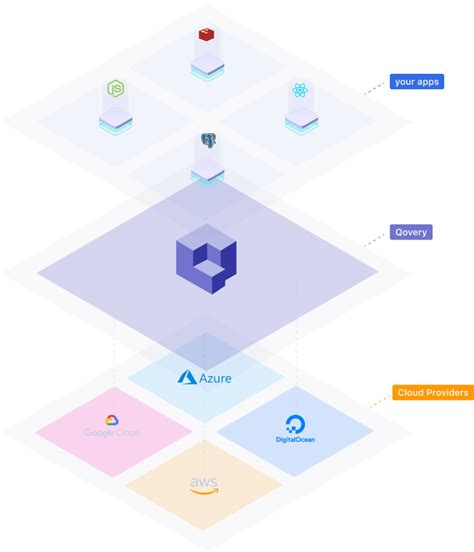
Qovery acts as the centralized intelligence layer for cost across multi-cloud Kubernetes fleets. It sits above EKS, GKE, and AKS, translating global intent policies into provider-specific actions without requiring manual YAML intervention on individual clusters.
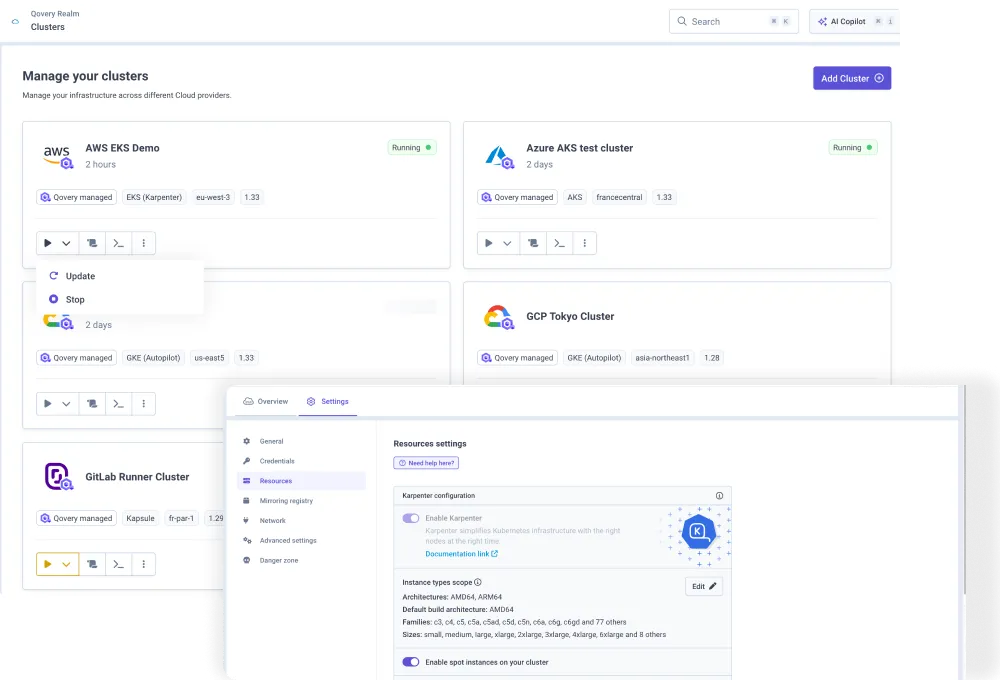
A policy like “hibernate all non-production clusters at 8 PM Friday and restore them at 8 AM Monday” is defined once in Qovery and executed across every applicable environment in the fleet, regardless of cloud provider.
The platform handles the provider-specific mechanics of scaling down nodes, pausing workloads, and restoring state, while the platform team defines intent at the fleet level. This approach eliminates the waste that comes from environments running during hours when no engineer or automated process is using them.
Implementing intent-based resource reclamation
An agentic control plane executes “owner-aware” reclamation. If an environment shows zero traffic or deployment activity for a defined period, the agent can automatically hibernate the resource or notify the owner for deletion.
The burden of cleanup shifts from the engineer, who may not remember that the environment exists, to the platform, which continuously evaluates lifecycle state against policy.
This reclamation model operates on business signals rather than infrastructure metrics. An environment that has not received a git push in two weeks, has no associated open pull request, and shows no inbound traffic is a candidate for hibernation regardless of its CPU utilization.
The platform can act on this finding automatically or surface it to the owning team for confirmation, depending on the organization's risk tolerance. Either way, the default shifts from “environments persist until someone manually deletes them” to “environments justify their existence or the platform reclaims them.”
Standardizing day-2 FinOps operations
True fleet cost management requires treating disparate multi-cloud infrastructure as a single, programmable compute pool that is optimized for cost by default. This means environment lifecycle policies, resource right-sizing rules, and hibernation schedules propagate from a central policy layer rather than being configured independently per cluster and per provider.
Organizations that implement this model can systematically reduce the cloud tax that accumulates across unmanaged fleets. The 30% waste baseline that most enterprises carry reflects the cost of managing Kubernetes without centralized cost governance, not an inherent cost of running Kubernetes at scale.
An agentic control plane eliminates the structural drivers of that waste: orphaned environments, over-provisioned resources, and autoscaling drift, converting idle infrastructure into recovered budget that can be reinvested in product development.
FAQs
What is the difference between agentic resource reclamation and standard Kubernetes autoscaling?
Standard autoscalers like HPA and Karpenter react to CPU and memory metrics, scaling resources in response to measured load. Agentic reclamation operates on business intent: it evaluates whether an environment is actively in use based on signals like deployment activity, traffic patterns, and ownership state, then hibernates or deletes resources that no longer serve a purpose. Autoscaling optimizes running workloads, while agentic reclamation eliminates workloads that should not be running at all.
How does an agentic control plane handle cost governance across AWS, GCP, and Azure simultaneously?
The control plane translates fleet-wide cost policies into provider-specific actions. A hibernation schedule or right-sizing rule defined once applies to every cluster in the fleet, regardless of whether that cluster runs on EKS, GKE, or AKS. The platform handles the differences in scaling APIs, billing models, and resources across providers, so the policy author works at the intent level without writing provider-specific configuration.
Can agentic Kubernetes reclamation work alongside existing FinOps tools like Kubecost?
Agentic reclamation and cost visibility tools serve complementary functions. Kubecost and similar tools provide the data layer: cost attribution, allocation reporting, and spend tracking. An agentic control plane provides the action layer: it takes the insights those tools surface and executes automated remediation like hibernating idle environments, right-sizing over-provisioned workloads, and enforcing lifecycle policies. The combination of visibility and automated action is what moves an organization from knowing about waste to eliminating it.
Melanie leads content at Qovery. She covers platform engineering trends, Kubernetes operations, FinOps, and the tools that help engineering teams ship faster.
Next step
Agents ship fast. Guardrails keep them safe.
Qovery ensures every agent action is scoped, audited, and policy-checked. Start deploying in under 10 minutes.