Understanding CrashLoopBackOff: Fixing AI workloads on Kubernetes
Stop fighting CrashLoopBackOff on your AI deployments. Learn why traditional Kubernetes primitives fail large models and GPU workloads, and how to orchestrate AI infrastructure without shadow IT.
The Architectural Mismatch: Standard Kubernetes primitives were designed for lightweight, stateless, CPU-bound web services. They inherently fail when applied to massive, stateful, GPU-dependent AI models.
The Timeout & Scheduling Trap: 15GB+ container images and rigid GPU hardware constraints break default Kubernetes timeout windows (triggering endless CrashLoopBackOff loops) and overwhelm standard cluster autoscalers.
The Rise of Shadow Infrastructure: When the standard deployment pipeline fails AI workloads, data scientists bypass platform governance. They spin up unmanaged EC2 instances, destroying cost visibility and security controls.
The Control Plane Fix: The solution isn't abandoning Kubernetes; it's adding an intelligent management layer (like Qovery) that automatically adapts deployment strategies, image caching, and GPU scheduling specifically for AI lifecycles.
Most engineering teams running Kubernetes have a deployment pipeline that works flawlessly for web services. Developers push code, CI builds the image, Helm renders the chart, and the new version rolls out across staging and production. This standard pipeline thrives on small container images, fast startups, stateless request handling, and horizontal scaling on CPU nodes.
But when an organization starts deploying AI models, the reality completely shifts. You package an inference server with a 15 GB container image, request a GPU node with specific CUDA driver compatibility, and need a persistent volume for model weights that takes minutes to mount. The existing pipeline treats this massive, stateful workload exactly like a lightweight Go binary, and it fails.
These failures cannot be fixed by Helm values or retry logic, because the flaw is not in the workload itself, but in the standard Kubernetes management primitives. Here is a breakdown of where this mismatch occurs and how to fix it.
The 3 Pillars of Management Failure
1. Image and Storage Management
Standard Kubernetes management assumes that container images pull quickly and pods start in seconds. The default imagePullPolicy expects a registry round-trip to complete within a reasonable timeout window.
AI containers break these fundamental assumptions at the registry level:
Massive Image Sizes: A model-serving image can easily reach more than 10 GB. On a freshly provisioned GPU node with no layer cache, pulling that image over the network takes several minutes.
The Timeout Trap: The failure mode is predictable: the kubelet marks the container as failed because the pull exceeded the timeout window. Kubernetes triggers CrashLoopBackOff, and the pod enters a restart loop that never fixes itself.
Volume Mounting Delays: Attaching and mounting persistent volumes (like EBS or EFS) with hundreds of gigabytes of model data takes minutes. The default initialDelaySeconds on liveness probes rarely accounts for this, causing Kubernetes to kill the pod before the model finishes loading into memory.
2. Resource Management and the GPU Scheduling Gap
Web applications scale horizontally on CPU and memory, which Kubernetes handles seamlessly via the scheduler, horizontal pod autoscaler, and cluster autoscaler. GPU workloads, however, are far more rigid.
Hardware constraints do not map cleanly onto standard Kubernetes scheduling primitives:
Strict Hardware Matching: A pod requesting an NVIDIA A100 cannot run on a node with a T4, and a workload compiled against CUDA 12.4 will fail on a node running CUDA 11.8 drivers.
Autoscaler Limitations: The standard Cluster Autoscaler was built to provision homogeneous CPU node groups. When a GPU pod goes pending, the autoscaler struggles to identify which node group carries the correct GPU type, CUDA driver version, and instance family. Furthermore, cloud providers take significantly longer to provision GPU node groups.
Configuration Nightmares: Managing this manually requires writing complex nodeSelector labels, taints, tolerations, and affinity rules for every AI workload. A single misconfigured label leaves the pod perpetually pending, forcing platform teams to maintain a complex matrix of GPU configurations.
3. Lifecycle Management: State Versus Stateless
Kubernetes was designed around the assumption that pods are disposable. The RollingUpdate strategy cycles through replicas to achieve zero-downtime updates, which works perfectly for stateless web services where any pod can handle any request.
AI workloads fundamentally reject this lifecycle management:
Expensive Restarts: AI inference servers are not stateless. Loading a large language model into GPU memory takes minutes. A RollingUpdate that kills an inference pod forces the replacement to repeat the full loading sequence, causing severe latency spikes or capacity drops.
Interdependent Training: Distributed training runs across multiple GPU nodes accumulate state in memory across all workers. Kubernetes treats these workers as independent pods, meaning the eviction of a single pod could destroy an entire training run.
The Paradigm Shift: Killing an AI pod is expensive in time, compute cost, and lost training progress. The management layer must adapt to understand that these workloads require a longer, protected lifecycle.
Master Fleet-First Kubernetes
From cluster sprawl to fleet harmony, learn the operational strategies and architectural frameworks required to orchestrate high-performing, global, AI-ready Kubernetes fleets.
When the standard Kubernetes pipeline repeatedly fails AI deployments, data scientists predictably resort to working around the platform.
They spin up EC2 instances with GPU AMIs, SSH into them, and run inference servers directly. They provision endpoints outside of IT governance and subscribe to third-party APIs with no cost ceiling.
This shadow AI stack is not a governance failure from data scientists; it is a platform failure. Because standard Kubernetes does not serve their needs, they build their own infrastructure. The organizational cost compounds rapidly: security teams cannot audit what they cannot see, platform teams lose visibility, and cost controls evaporate.
Qovery: Intelligent Kubernetes Management for AI
Fixing this structural mismatch requires a management layer that adapts its deployment strategies, resource scheduling, and ingress configuration for workloads that do not fit the standard web app pattern.
Qovery is a Kubernetes management platform that provides this layer. It sits on top of existing Kubernetes clusters and automates the operational decisions that platform teams currently make manually for AI workloads.
Automated GPU Scheduling: Qovery manages the complexity of matching workloads to the correct hardware, mapping workloads to the appropriate GPU node pool, instance type, and driver compatibility automatically.
Optimized Build Pipelines: Qovery handles massive Docker images with optimized layer caching, ensuring iterative changes to model-serving code do not require full base image rebuilds.
AI-Specific Ingress: Inference endpoints (like FastAPI or Flask) need specific connection handling. Qovery automatically adjusts timeout thresholds and proxy buffer sizes without requiring manual Nginx configuration edits.
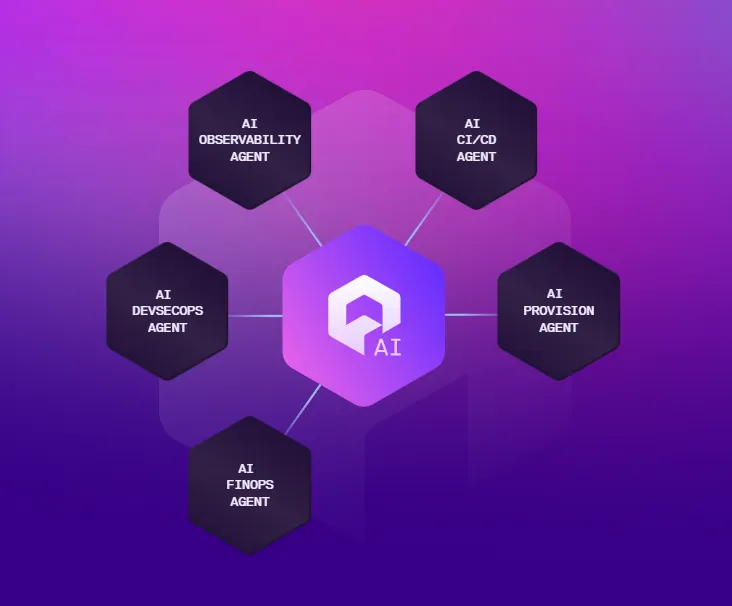
Furthermore, Qovery’s AI DevOps Copilot utilizes specialized agents to bridge the gap. The Provision Agent allocates GPU resources on demand via natural-language requests, while the FinOps Agent detects idle GPU environments and schedules shutdowns to prevent runaway costs.
Beyond the Shadow Stack: Governing the AI Fleet
AI workloads fail on traditional Kubernetes platforms because the management primitives were built for small, stateless, CPU-bound containers. Applying those primitives to GPU-dependent, stateful, long-running AI services produces predictable failures in image pulling, resource scheduling, and lifecycle management.
As models grow larger and GPU instances become pricier, this gap will continue to widen. Without a proper management layer, teams will increasingly rely on shadow infrastructure, fragmenting cost visibility and ballooning the operational surface area.
The fix is not to abandon Kubernetes, but to add an intelligent management layer. By automating GPU scheduling, build optimization, and ingress configuration, Qovery eliminates the friction pushing data scientists away. Organizations regain centralized cost control, security visibility, and deployment consistency across their entire engineering stack.
Frequently Asked Questions (FAQs)
Q: Why do AI workloads on Kubernetes often get stuck in CrashLoopBackOff?
A: Standard Kubernetes timeout windows are designed for small, fast-starting web services. AI workloads often use massive container images (10GB+) and require minutes to mount large persistent volumes for model weights. This causes Kubernetes to kill the pod for exceeding pull or liveness probe timeouts before the model even finishes loading into memory, triggering an endless CrashLoopBackOff cycle.
Q: How does standard Kubernetes scheduling struggle with GPU workloads?
A: Unlike CPU workloads that scale easily, AI and GPU workloads require strict hardware matching (e.g., specific NVIDIA GPU types and exact CUDA driver versions). Standard cluster autoscalers struggle to quickly identify and provision the exact node groups needed, often leaving pods in a perpetual pending state unless complex taints, tolerations, and affinity rules are manually configured.
Q: What is "shadow AI infrastructure" and why does it happen?
A: Shadow AI infrastructure occurs when data scientists bypass official IT and Kubernetes pipelines because standard deployment primitives repeatedly fail their massive, GPU-dependent models. To get their work done, they spin up unmanaged EC2 instances or third-party APIs, which destroys cost visibility, creates security blind spots, and balloons cloud spend.
Q: How does Qovery fix Kubernetes deployments for AI models?
A: Qovery adds an intelligent management layer over existing Kubernetes clusters that automates complex GPU scheduling, optimizes build pipelines with layer caching for massive images, and automatically adjusts ingress timeout thresholds specifically for AI inference endpoints. This allows teams to run AI workloads natively on Kubernetes without manual configuration nightmares.
Melanie leads content at Qovery. She covers platform engineering trends, Kubernetes operations, FinOps, and the tools that help engineering teams ship faster.
Next step
Agents ship fast. Guardrails keep them safe.
Qovery ensures every agent action is scoped, audited, and policy-checked. Start deploying in under 10 minutes.