Blog
Qovery
Community
Events
4
minutes

Qovery Demo Day Summary - June 2023

Join us for a recap of the latest updates from Qovery Demo Day, held on June 29th, 2023! Our event provides insight into what we accomplished in the past month and what's to come while showcasing some exciting new features with a special guest: Hamza, Senior Solution Engineer at Doppler. From our new deployment and audit logs to parallelize build and deployment and demos, get ready for an exciting look at what's new with Qovery and what’s next! ✨
September 26, 2025
Albane Tonnellier
Product Marketing Manager
Summary
Twitter icon
linkedin icon

Agenda

  • What we worked on last month
  • Qovery x Doppler partnership explained + Demo
  • What's coming next

What We Worked on Last Month

Deployment Logs

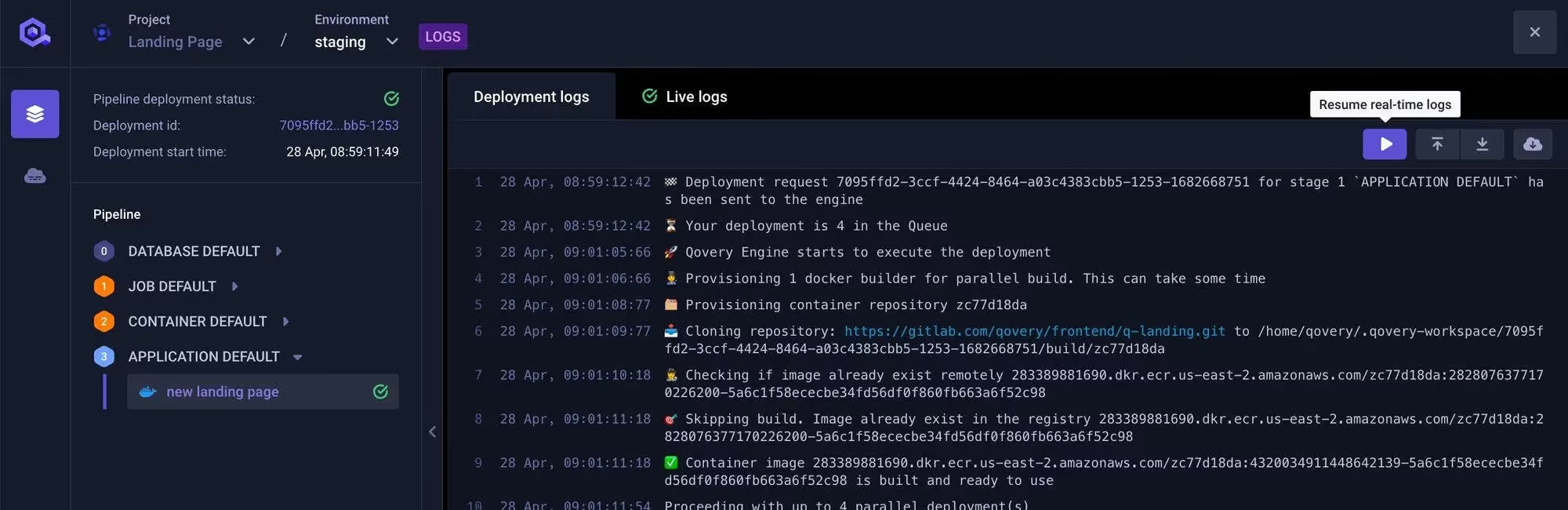
With the implementation of the parallelization for the build and deployment operations (i.e. we will parallelize and thus speed up your deployments), we had to work as well on a new Log interface capable of giving you a clean and nice view of what is happening during the deployment of your environments.

Every time a deployment is triggered, Qovery's DevOps automation software provides you with the log of its execution and as well with any error that might occur. Note: As of now, Qovery can provide you only the log of the latest deployment execution and more information on the documentation.

Deployment Logs

Parallelize Builds and Deployments

Thanks to the work we have done on the New Logs view and the Deployment Pipeline, we are now able to announce a new major feature: We have just rolled out the parallel service deployment, a fantastic new feature designed to make your deployments super fast! Before the release, every deployment operation was done sequentially; with this new feature, you can parallelize these operations and deploy up to 4 apps at once per stage. In short, this could make your deployment speed 2.5x faster on average. To read all the details, head to this forum thread; otherwise, you can find the feature in action below.

Audit Logs

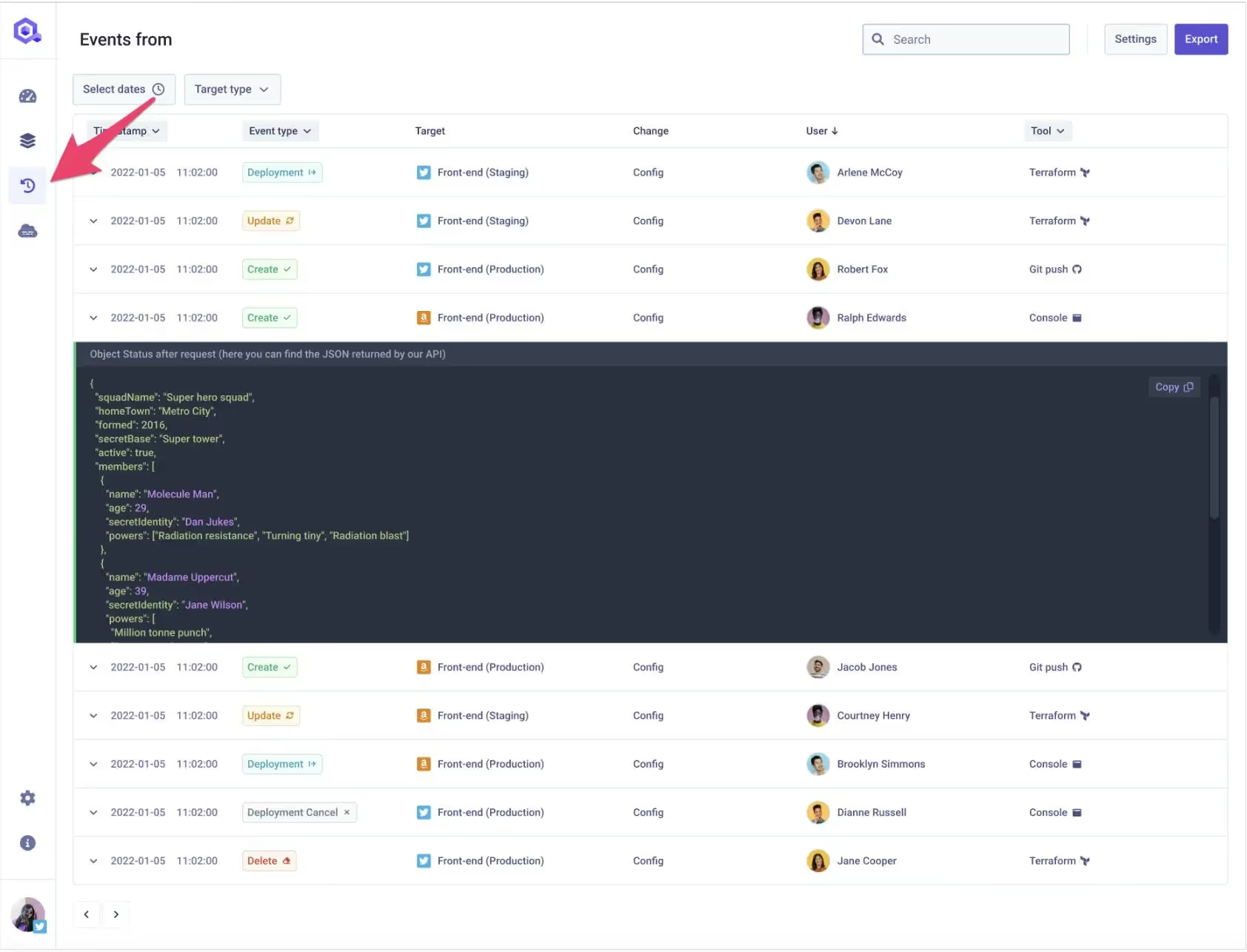
We are thrilled to announce that the audit logs feature is now available in a public beta. With audit logs, you can easily monitor all the actions taking place within your organization. This powerful tool provides a comprehensive view of any configuration changes, giving you the ability to answer questions like "Who did what, where, and when?". Whether you need to debug complex issues or track user activities, the audit logs section has got you covered. To learn more about this feature, please refer to our documentation here.

Audit Logs in the Qovery console

Qovery x Doppler Partnership

Started a few months ago with a blog post, the partnership between Qovery and Doppler rapidly transformed into an integration after high demand from our users. During our demo, we welcomed Hamza, Senior Solution Engineer at Doppler, who explained what Doppler was and showed us the integration between the two products.

The partnership between Qovery and Doppler is a strategic move to provide a comprehensive solution to developers and engineering teams to automate their deployment and manage secrets and environment variables more streamlined. To discover more and watch the demo, check the video below!

What's Coming Next

Terraform Provider Update

After the new V3 launched for everyone a few months ago, it was time to make sure that our Terraform Provider was as good as the UI, so our team is currently investing time and efforts to make it as similar as possible for that; we still need to: Support deployment rules for environment, Manage file as environment variables…

Service Catalog

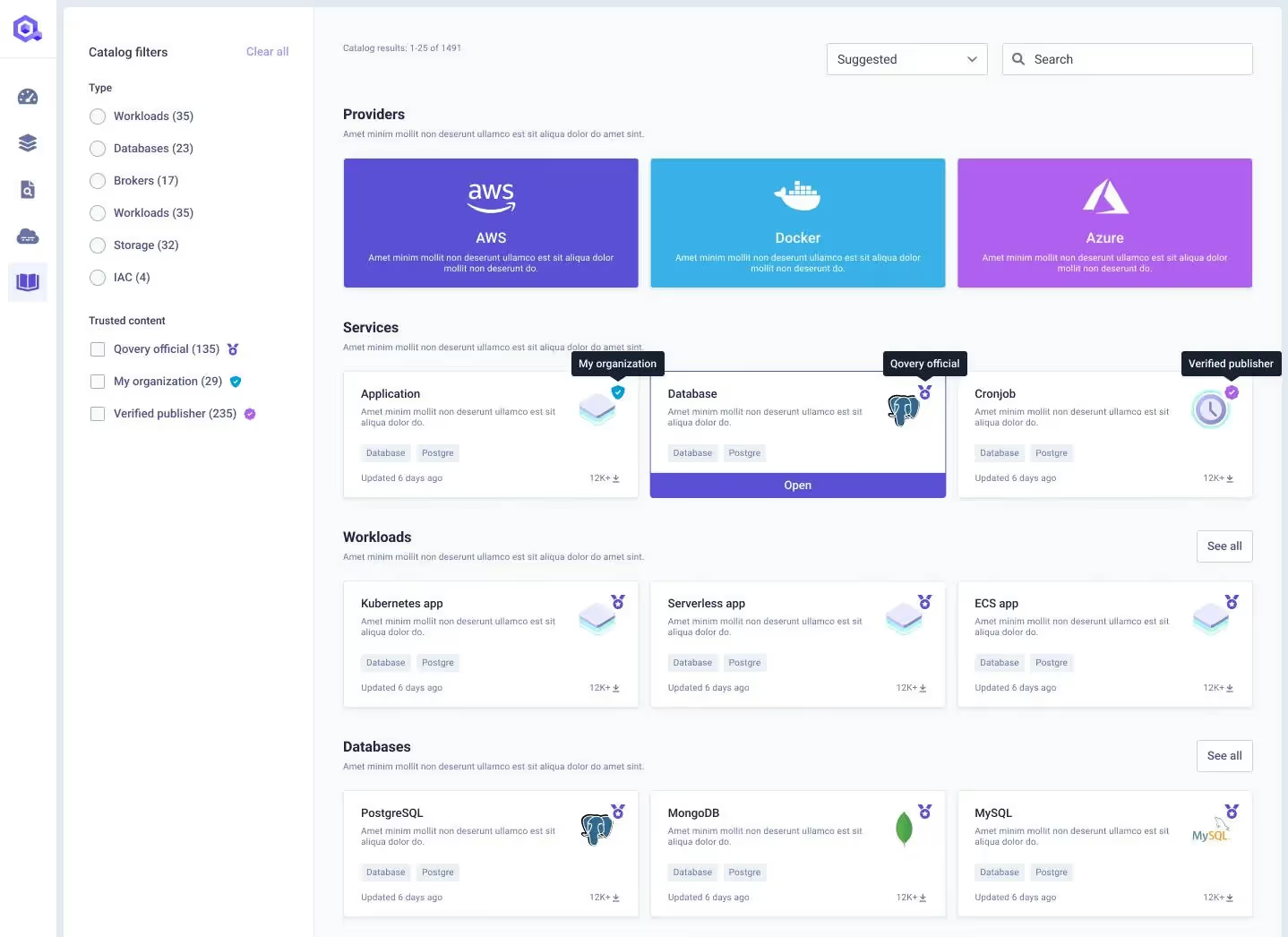
The goal is to create a service catalog that will guide you through the overall configuration of your service. Example: if you want to deploy a PostgreSQL, we will propose to you all the different options (container, managed RDS with the default setup, Aurora, etc..); here is the ticket on our public roadmap if you want to follow the progress of this feature.

Service Catalog Page

Wrapping up

Thank you again for joining us at this Demo Day and for your trust because our product, team, and vision would not be possible without your support. If you have questions, don’t hesitate to contact us on Forum or directly on the chat from our website.

We hope to see you at the next Qovery Demo Day and if you missed the live event, you can watch the replay below. 👇🏻

Share on :
Twitter icon
linkedin icon
Tired of fighting your Kubernetes platform?
Qovery provides a unified Kubernetes control plane for cluster provisioning, security, and deployments - giving you an enterprise-grade platform without the DIY overhead.
See it in action

Suggested articles

Kubernetes
 minutes
How to automate environment sleeping and stop paying for idle Kubernetes resources

Scaling your deployments to zero is only half the battle. If your cluster autoscaler does not aggressively bin-pack and terminate the underlying worker nodes, you are still paying for idle metal. True environment sleeping requires tight integration between your ingress layer and your node provisioner to actually realize FinOps savings.

Mélanie Dallé
Senior Marketing Manager
Kubernetes
DevOps
6
 minutes
10 best Kubernetes management tools for enterprise fleets in 2026

The biggest mistake enterprises make when evaluating Kubernetes management platforms is confusing infrastructure provisioning with Day-2 operations. Tools like Terraform or kOps are excellent for spinning up the underlying EC2 instances and networking, but they do absolutely nothing to prevent configuration drift, automate certificate rotation, or right-size your idle workloads once the cluster is actually running.

Mélanie Dallé
Senior Marketing Manager
DevOps
Kubernetes
Platform Engineering
6
 minutes
10 best Red Hat OpenShift alternatives to reduce licensing costs

For years, Red Hat OpenShift has been the safe choice for heavily regulated, on-premise environments. It operates as a secure fortress. But in the public cloud, that fortress acts as an expensive prison. Paying proprietary per-core licensing fees on top of your standard AWS or GCP compute bill is a redundant "middleware tax." Escaping OpenShift requires decoupling your infrastructure from your developer experience by running standard, vanilla Kubernetes paired with an agentic control plane.

Morgan Perry
Co-founder
AI
Product
3
 minutes
Qovery Skill for AI Agents: Deploy Apps in One Prompt

Use Qovery from Claude Code, OpenCode, Codex, and 20+ AI Coding agents

Romaric Philogène
CEO & Co-founder
Kubernetes
 minutes
Stopping Kubernetes cloud waste: agentic automation for enterprise fleets

Agentic Kubernetes resource reclamation is the practice of using an autonomous control plane to continuously identify, suspend, and delete idle infrastructure across a multi-cloud Kubernetes fleet. It replaces manual cleanup and reactive autoscaling with intent-based policies that act on business state, eliminating the configuration drift and cloud waste typical of unmanaged fleets.

Mélanie Dallé
Senior Marketing Manager
Platform Engineering
Kubernetes
DevOps
10
 minutes
What is Kubernetes? The reality of Day-2 enterprise fleet orchestration

Kubernetes focuses on container orchestration, but the reality on the ground is far less forgiving. Provisioning a single cluster is a trivial Day-1 exercise. The true operational nightmare begins on Day 2. Teams that treat multi-cloud fleets like isolated pets inevitably face crushing YAML configuration drift, runaway AWS bills, and severe scaling bottlenecks.

Morgan Perry
Co-founder
Kubernetes
DevOps
5
 minutes
Top 10 Rancher alternatives in 2026: beyond cluster management

Rancher solved the Day-1 problem of launching clusters across disparate bare-metal environments. But in 2026, launching clusters is no longer the bottleneck. The real failure point is Day-2: managing the operational chaos, security patching, and configuration drift on top of them. Rancher is a heavy, ops-focused fleet manager that completely ignores the application developer. If your goal is developer velocity and automated FinOps, you must graduate from basic fleet management to an intent-based Kubernetes Management Platform like Qovery.

Morgan Perry
Co-founder
AI
Compliance
Healthtech
 minutes
Agentic AI infrastructure: moving beyond Copilots to autonomous operations

The shift from AI copilots to autonomous agents is redefining infrastructure requirements. Discover how to build secure, stateful, and compliant Agentic AI systems using Kubernetes, sandboxing, and observability while meeting EU AI Act standards

Mélanie Dallé
Senior Marketing Manager

It’s time to change
the way you manage K8s

Turn Kubernetes into your strategic advantage with Qovery, automating the heavy lifting while you stay in control.