Blog
Product
2
minutes

One week before the launch of Qovery v2 beta - What's new?

It has been 6 months since our engineering team started to work on what we decided to call Qovery v2. But what makes this next release so cool? Here are the top 4 features that make this release so appealing.

September 26, 2025
Romaric Philogène
CEO & Co-founder
Summary
Twitter icon
linkedin icon
Qovery is the fastest way to deploy your apps in your AWS account

Mono repository support

The mono repository (or monorepo) support was the most common feature from our users for this release. The v2 supports it hassle-free. Here is a short video of a mono repository in action:

Faster app deployment

Our team built this release with Developer Experience obsession in mind. Our goal was to make you deploy your apps in less than 1 minute - with zero knowledge of Qovery. Here is a short video of a complete app deployment flow:

Web interface first

Our team has made a considerable investment to create a better experience using the web interface. This version fixes persistent bugs and slowness. The v2 is “web interface” first - meaning that the web interface is now the first way to interact with Qovery. It also tells that you no longer need to tweak a .qovery.yml file to configure your app - it has been removed.
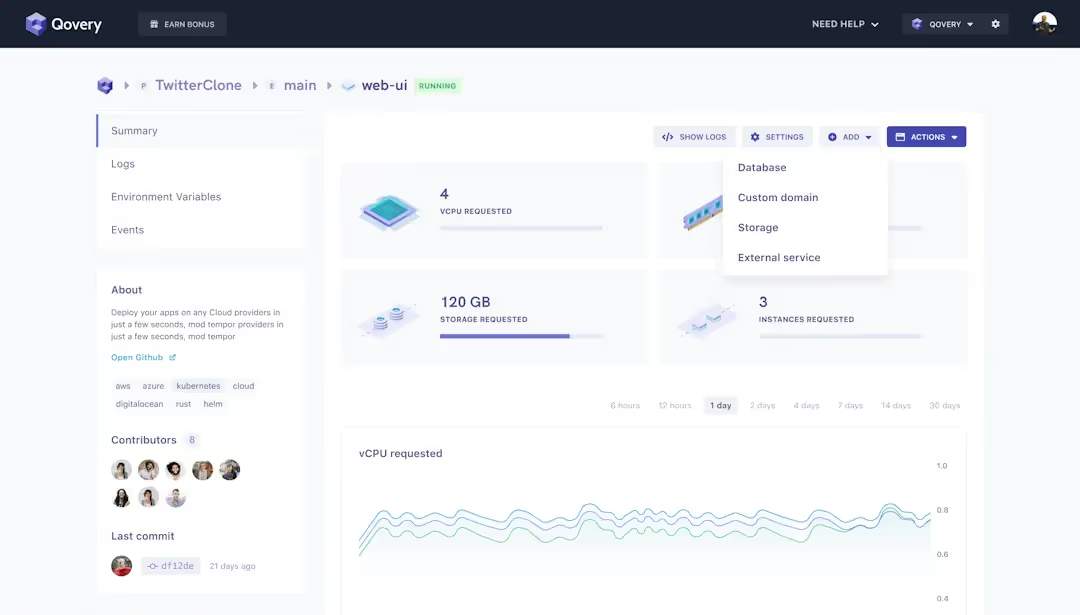
All in one interface to deploy your apps on your AWS account

Open API

Our new RESTful API has been designed to be easily usable by anyone. Automating any actions from your CI, scripts, or anything you want is now possible.
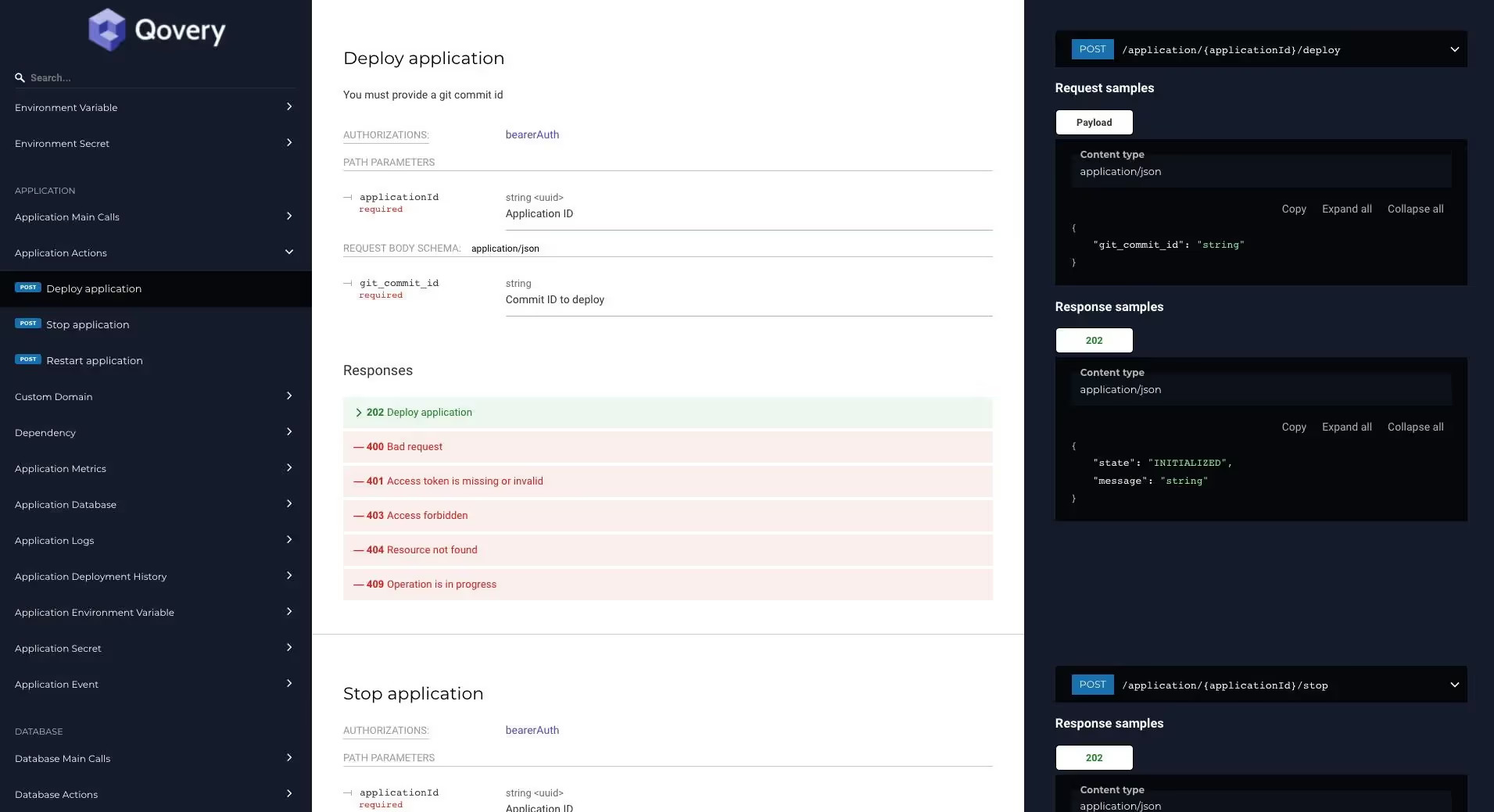
Qovery v2 API documentation

What’s next

This release is just the beginning; it put the foundation of our vision - making application deployment enjoyable and no longer a pain for any developer. Qovery is the simplest way for developers to deploy their apps in the Cloud.

Qovery v2 beta will be available to our registered users registered on the 22nd of June 2021. During the summer, our team will open the v2 to all users. You can expect a stable release in September 2021.

Next read: How Qovery billing works

Share on :
Twitter icon
linkedin icon
Tired of fighting your Kubernetes platform?
Qovery provides a unified Kubernetes control plane for cluster provisioning, security, and deployments - giving you an enterprise-grade platform without the DIY overhead.
See it in action

Suggested articles

Kubernetes
8
 minutes
Kubernetes management in 2026: mastering Day-2 ops with agentic control

The cluster coming up is the easy part. What catches teams off guard is what happens six months later: certificates expire without a single alert, node pools run at 40% over-provisioned because nobody revisited the initial resource requests, and a manual kubectl patch applied during a 2am incident is now permanent state. Agentic control planes enforce declared state continuously. Monitoring tools just report the problem.

Mélanie Dallé
Senior Marketing Manager
Kubernetes
6
 minutes
Kubernetes observability at scale: how to cut APM costs without losing visibility

The instinct when setting up Kubernetes observability is to instrument everything and send it all to your APM vendor. That works fine at ten nodes. At a hundred, the bill becomes a board-level conversation. The less obvious problem is the fix most teams reach for: aggressive sampling. That is how intermittent failures affecting 1% of requests disappear from your monitoring entirely.

Mélanie Dallé
Senior Marketing Manager
Kubernetes
 minutes
How to automate environment sleeping and stop paying for idle Kubernetes resources

Scaling your deployments to zero is only half the battle. If your cluster autoscaler does not aggressively bin-pack and terminate the underlying worker nodes, you are still paying for idle metal. True environment sleeping requires tight integration between your ingress layer and your node provisioner to actually realize FinOps savings.

Mélanie Dallé
Senior Marketing Manager
Kubernetes
DevOps
6
 minutes
10 best Kubernetes management tools for enterprise fleets in 2026

The structure, table, tool list, and code blocks are all worth keeping. The main work is fixing AI-isms in the prose, updating the case study to real metrics, correcting the FAQ format, and replacing the CTAs with the proper HTML blocks. The tool descriptions need the "Core strengths / Potential weaknesses" headers made less template-y, and the intro needs a sharper human voice.

Mélanie Dallé
Senior Marketing Manager
DevOps
Kubernetes
Platform Engineering
6
 minutes
10 best Red Hat OpenShift alternatives to reduce licensing costs

For years, Red Hat OpenShift has been the safe choice for heavily regulated, on-premise environments. It operates as a secure fortress. But in the public cloud, that fortress acts as an expensive prison. Paying proprietary per-core licensing fees on top of your standard AWS or GCP compute bill is a redundant "middleware tax." Escaping OpenShift requires decoupling your infrastructure from your developer experience by running standard, vanilla Kubernetes paired with an agentic control plane.

Morgan Perry
Co-founder
AI
Product
3
 minutes
Qovery Skill for AI Agents: Deploy Apps in One Prompt

Use Qovery from Claude Code, OpenCode, Codex, and 20+ AI Coding agents

Romaric Philogène
CEO & Co-founder
Kubernetes
 minutes
Stopping Kubernetes cloud waste: agentic automation for enterprise fleets

Agentic Kubernetes resource reclamation is the practice of using an autonomous control plane to continuously identify, suspend, and delete idle infrastructure across a multi-cloud Kubernetes fleet. It replaces manual cleanup and reactive autoscaling with intent-based policies that act on business state, eliminating the configuration drift and cloud waste typical of unmanaged fleets.

Mélanie Dallé
Senior Marketing Manager
Platform Engineering
Kubernetes
DevOps
10
 minutes
What is Kubernetes? The reality of Day-2 enterprise fleet orchestration

Kubernetes focuses on container orchestration, but the reality on the ground is far less forgiving. Provisioning a single cluster is a trivial Day-1 exercise. The true operational nightmare begins on Day 2. Teams that treat multi-cloud fleets like isolated pets inevitably face crushing YAML configuration drift, runaway AWS bills, and severe scaling bottlenecks.

Morgan Perry
Co-founder

It’s time to change
the way you manage K8s

Turn Kubernetes into your strategic advantage with Qovery, automating the heavy lifting while you stay in control.