The infrastructure platform for the agentic era.
AI agents now initiate more infrastructure operations than humans. But every platform they interact with - CI/CD, Kubernetes, Terraform, secrets, monitoring - was designed for a human at the keyboard. Qovery unifies the entire stack behind one API so agents can operate infrastructure, not just run code.
200+ companies in regulated industries run on Qovery
 4.8
4.8

 Case study coming soon - we'd love to feature you!
 Case study coming soon - we'd love to feature you!
 Case study coming soon - we'd love to feature you!
“Our engineers ship with AI every day. Qovery is what lets us move that fast without losing control - everything runs on our own infrastructure, scoped and fully auditable. It's the governance layer we'd otherwise have had to build ourselves.”

Every infrastructure platform was designed for humans. AI agents break them.
A modern infrastructure stack involves 5 to 8 separate systems - CI/CD, Kubernetes, Terraform, secrets, monitoring. Humans navigate this through muscle memory. Agents can't. The interface mismatch is now the primary bottleneck in AI-driven development.
Context fragmentation
Agents burn tokens navigating between CI/CD, Kubernetes, secret managers, monitoring, and Terraform - separate APIs, separate auth, separate data formats.
No environment primitive
Creating an isolated full-stack environment means orchestrating 5 systems. Agents need it in one API call. Without it, they write code they can't test.
No audit trail for agents
Every RBAC system was designed for human identities. When agents make infrastructure changes, attribution breaks. For regulated industries, that's a compliance failure.
Pipeline bottleneck
CI/CD was sized for human velocity - a few deploys per day. Agents generate 10-20x the volume. The pipeline chokes, and the speed advantage disappears.
One API. Every capability. Humans and agents.
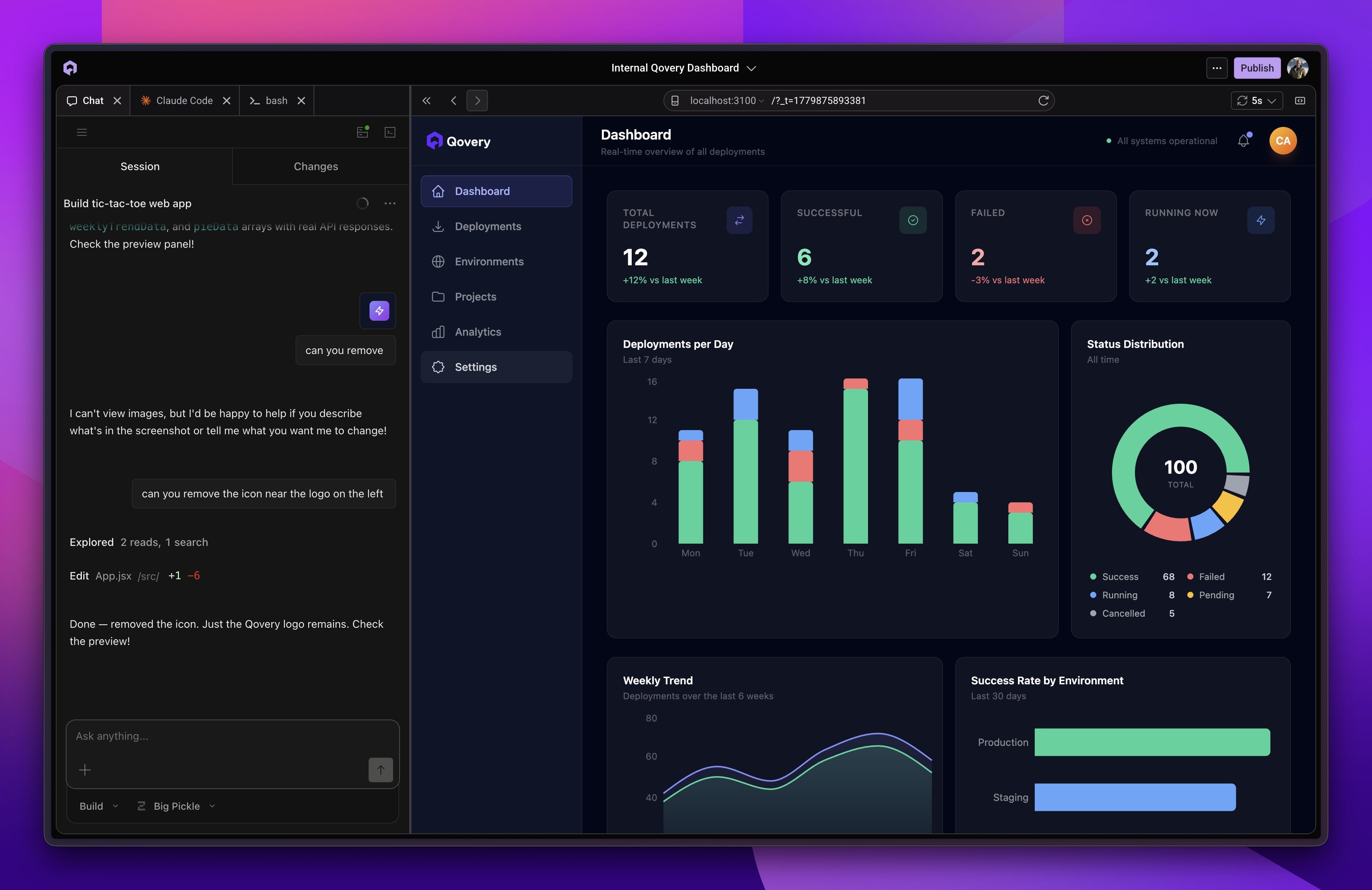
One API replaces the fragmented toolchain. Environments are a first-class primitive. Every action is governed. The pipeline scales with your agents.
10+ access tokens
1 access token
Three we built. Unlimited you can build.
These are examples, not a menu. Each one is built on the same Qovery primitives - so your platform team can compose any use case your company needs on top. And because Qovery is a control plane on your own cloud, the data never leaves your infrastructure.
Speed is easy. Governance is the hard part.
Anyone can spin up containers fast. The hard part is making sure agents don't break things. The companies that get governance right will scale AI-driven development - the ones that don't get a surprise bill.
in Claude credits burned in a single month. Nobody set a spending limit.
Read the storyearly - Uber exhausted its entire 2026 AI budget ahead of schedule.
Read the storyin breach data sold after an AI tool was granted full OAuth access and the vendor was compromised.
Read the storyGoverned by default.
Every failure above is a missing guardrail. Qovery installs them at the deployment level - so they apply to agents and engineers alike.
Same RBAC as your engineers
Agents inherit existing roles and permissions - no parallel access model to maintain.
Every action audited
Who (or what) did what, where and when - logged at the deployment level, queryable later.
Rollback built in
Any agent-initiated change can be reverted - the harness sits at the deployment level, not in the prompt.
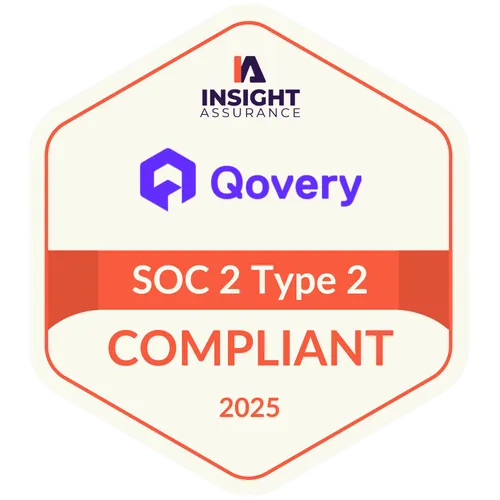
Built for regulated industries. Certified where it matters.
Your workloads never leave your VPC. Independently pen-tested, audited, and compliant with the frameworks your industry requires.





The numbers speak for themselves.
"Qovery lets us ship HIPAA workloads as fast as a startup - with a public company's audit trail."
"We went from gatekeeping to enabling overnight. Every deploy is policy-checked and audit-logged."

"Qovery tripled our development speed and got us to zero downtime. We ship with full confidence."

"Qovery gives us the compliance posture we need without slowing down engineering velocity."

"Qovery cut our compliance journey by weeks and gave our team the automation we needed."
"Qovery lets us ship HIPAA workloads as fast as a startup - with a public company's audit trail."
"We went from gatekeeping to enabling overnight. Every deploy is policy-checked and audit-logged."
"Qovery tripled our development speed and got us to zero downtime. We ship with full confidence."
"Qovery gives us the compliance posture we need without slowing down engineering velocity."
"Qovery cut our compliance journey by weeks and gave our team the automation we needed."
"Qovery lets us ship HIPAA workloads as fast as a startup - with a public company's audit trail."
"We went from gatekeeping to enabling overnight. Every deploy is policy-checked and audit-logged."
"Qovery tripled our development speed and got us to zero downtime. We ship with full confidence."
"Qovery gives us the compliance posture we need without slowing down engineering velocity."
"Qovery cut our compliance journey by weeks and gave our team the automation we needed."
Frequently asked questions
Everything you need to know about Qovery. Can't find the answer? Check the docs.
Both. Qovery operates on a split-plane architecture: the Qovery Control Plane manages orchestration via secure APIs, while the Data Plane (your Kubernetes clusters, VPCs, apps, and databases) can live wherever you need it. You can bring your own cloud account (AWS, GCP, Azure, Scaleway, and more) via BYOK (Bring Your Own Kubernetes), or let Qovery manage the cloud infrastructure for you. Either way, you retain full ownership of your data and underlying resources.
No, Qovery leverages them. Under the hood, Qovery uses Terraform/OpenTofu to provision infrastructure and translates your application configurations into native Kubernetes manifests. It acts as an automation layer on top of your cloud-native stack, providing a simplified workflow for developers without stripping away advanced Kubernetes capabilities.
Qovery unifies your entire stack - CI/CD, Kubernetes, Terraform, secrets, and monitoring - behind a single API, MCP (Model Context Protocol) Server, and Skills. Instead of juggling five disconnected tools, agents can provision, deploy, and manage full-stack isolated environments with a single call - operating infrastructure, not just writing code. Every action runs inside the same RBAC and audit guardrails as your engineers.
Guardrails live at the deployment level, so they apply to agents and engineers alike. Agents inherit your existing RBAC - a builder can deploy but can't touch cluster config or production. Every action is audited (who or what did what, where, and when), and any agent-initiated change is reversible with built-in rollback. No parallel access model to maintain, and no unattributed changes.
No. Because Qovery provisions industry-standard infrastructure using Terraform and native Kubernetes manifests on your own cloud account, you retain full ownership. If you ever stop using Qovery, your infrastructure keeps running natively on your cloud. You can take over the generated configurations without rebuilding your stack from scratch.
Qovery charges a predictable rate based on your chosen tier, which includes a specific allocation of team users, AI agent seats, managed clusters, and deployment minutes. You can review our full tier breakdown, add-on features, and enterprise options directly on our Pricing Page.
The infrastructure platform for
the agentic era.
Start in under 10 minutes. Deploy agents on your own cloud with full governance.
$ curl -fsSL https://skill.qovery.com/install.sh | bash