
Blog
Product
1
minutes

Product Update #36 - New app deployment flow 🔥

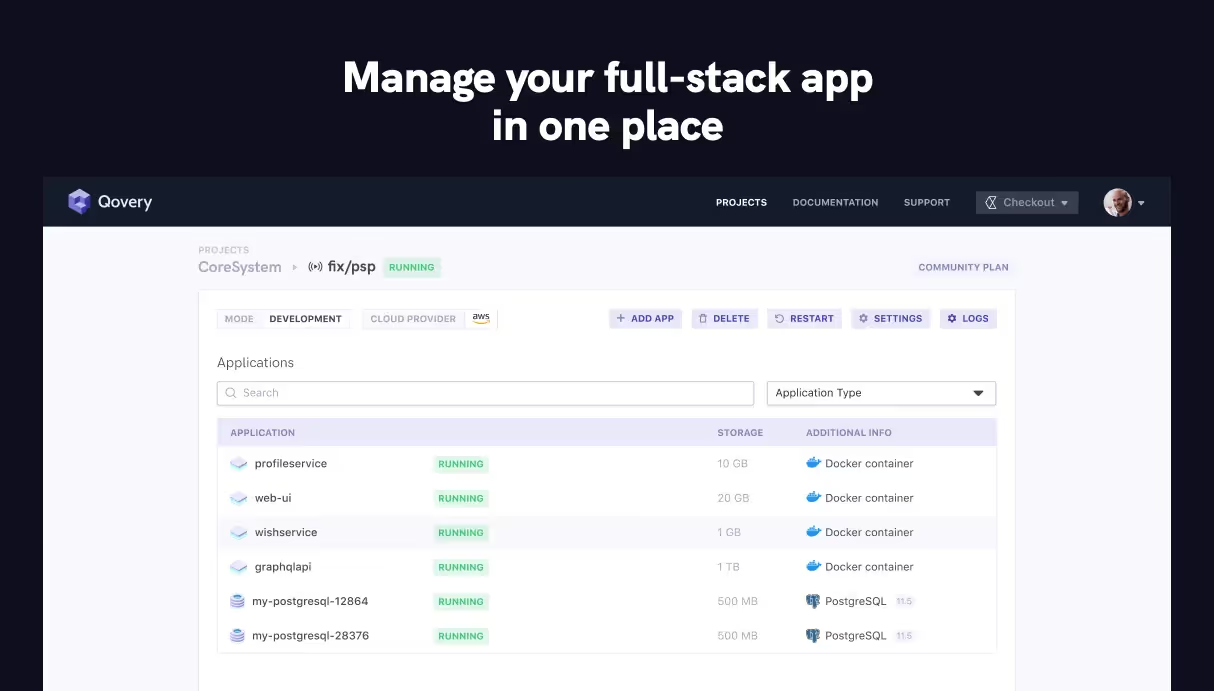
During the last 4 weeks, our team focused on improving the Developer Experience of Qovery. And here we are... We finally released our new app deployment flow. No more painful copy/paste .qovery.yml into your Git repository. In just a few clicks, you can deploy your apps with all the required services.
September 26, 2025
Romaric Philogène
CEO & Co-founder
Summary
Twitter icon
linkedin icon

Check out our updated guide on how to deploy your first app with Qovery (video).

New Features

Deploy templates

You can deploy open-source projects like Strapi, Hasura, n8n, and a few others via our web console. Using templates is great to experiment with new products and try out Qovery. We'll continue to add more of them in the coming days.
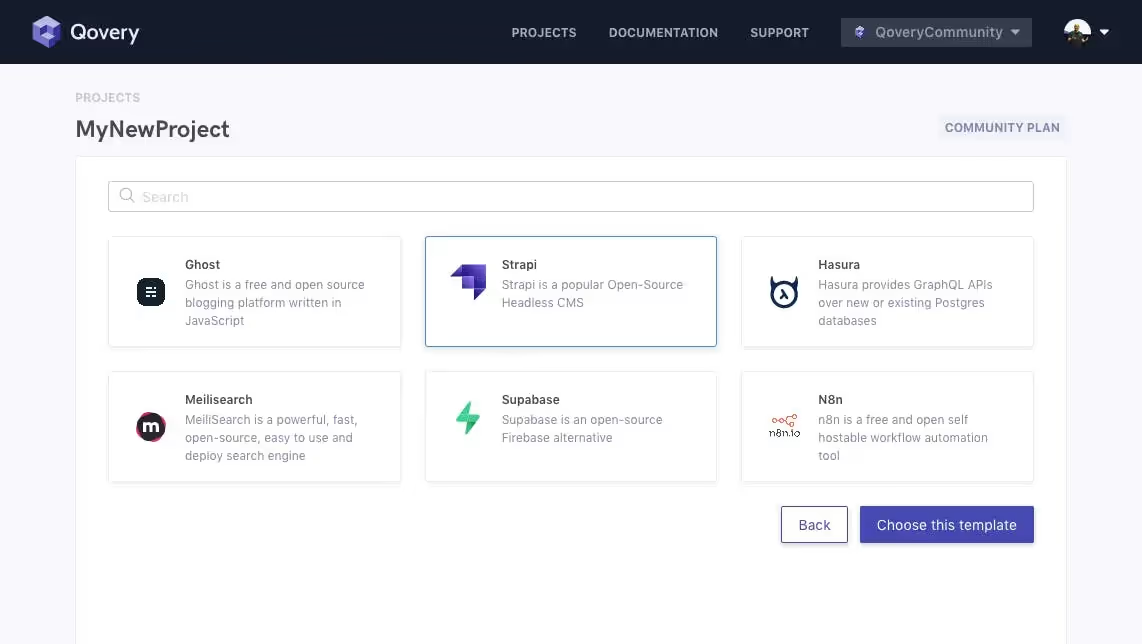
Deploy open-source projects from template with Qovery
Special note: Do you have an open-source project that you want to expose to our users? Contact-us.

Create an environment in one click

You can now create a staging or a dev environment directly from the web interface. Environments are convenient to develop features without breaking anything in your production environment. Remember: each git branch is an environment.

Improvements

  • Delete project: finally, you can now delete a project directly from the web console.

Jobs

We are hiring

Feel free to let us know what you think by contacting us.

The Qovery team

Share on :
Twitter icon
linkedin icon
Tired of fighting your Kubernetes platform?
Qovery provides a unified Kubernetes control plane for cluster provisioning, security, and deployments - giving you an enterprise-grade platform without the DIY overhead.
See it in action

Suggested articles

AI
Compliance
 minutes
Agentic AI infrastructure: moving beyond Copilots to autonomous operations

The shift from AI copilots to autonomous agents is redefining infrastructure requirements. Discover how to build secure, stateful, and compliant Agentic AI systems using Kubernetes, sandboxing, and observability while meeting EU AI Act standards

Mélanie Dallé
Senior Marketing Manager
Kubernetes
8
 minutes
The 2026 guide to Kubernetes management: master day-2 ops with agentic control

Effective Kubernetes management in 2026 demands a shift from manual cluster building to intent-based fleet orchestration. By implementing agentic automation on standard EKS, GKE, or AKS clusters, enterprises eliminate operational weight, prevent configuration drift, and proactively control cloud spend without vendor lock-in, enabling effective scaling across massive fleets.

Mélanie Dallé
Senior Marketing Manager
Kubernetes
 minutes
Building a single pane of glass for enterprise Kubernetes fleets

A Kubernetes single pane of glass is a centralized management layer that unifies visibility, access control, cost allocation, and policy enforcement across § cluster in an enterprise fleet for all cloud providers. It replaces the fragmented practice of switching between AWS, GCP, and Azure consoles to govern infrastructure, giving platform teams a single source of truth for multi-cloud Kubernetes operations.

Mélanie Dallé
Senior Marketing Manager
Kubernetes
 minutes
How to deploy a Docker container on Kubernetes (and why manual YAML fails at scale)

Deploying a Docker container on Kubernetes requires building an image, authenticating with a registry, writing YAML deployment manifests, configuring services, and executing kubectl commands. While necessary to understand, executing this manual workflow across thousands of clusters causes severe configuration drift. Enterprise platform teams use agentic platforms to automate the entire deployment lifecycle.

Mélanie Dallé
Senior Marketing Manager
Kubernetes
Terraform
 minutes
Managing Kubernetes deployment YAML across multi-cloud enterprise fleets

At enterprise scale, managing provider-specific Kubernetes YAML across multiple clouds creates crippling configuration drift and operational toil. By adopting an agentic Kubernetes management platform, infrastructure teams abstract cloud-specific configurations (like ingress controllers and storage classes) into a single, declarative intent that automatically reconciles across 1,000+ clusters.

Mélanie Dallé
Senior Marketing Manager
Kubernetes
Cloud
AI
FinOps
 minutes
GPU orchestration guide: How to auto-scale Kubernetes clusters and slash AI infrastructure costs

To stop GPU costs from destroying SaaS margins, teams must transition from static to consumption-based infrastructure by utilizing Karpenter for dynamic provisioning, maximizing hardware density with NVIDIA MIG, and leveraging Qovery to tie scaling directly to business metrics.

Mélanie Dallé
Senior Marketing Manager
Product
AI
Deployment
 minutes
Stop Guessing, Start Shipping. AI-Powered Deployment Troubleshooting

AI is helping developers write more code, faster than ever. But writing code is only half the story. What happens after? Building, deploying, debugging, scaling. That's where teams still lose hours.We're building Qovery for this era. Not just to deploy your code, but to make everything that comes after writing it just as fast.

Alessandro Carrano
Head of Product
AI
Developer Experience
Kubernetes
 minutes
MCP Server is the future of your team's incident’s response

Learn how to use the Model Context Protocol (MCP) to transform static runbooks into intelligent, real-time investigation tools for Kubernetes and cert-manager.

Romain Gérard
Staff Software Engineer

It’s time to change
the way you manage K8s

Turn Kubernetes into your strategic advantage with Qovery, automating the heavy lifting while you stay in control.