
Hey Team,
We just wrapped our Q1 2026 Demo Day, a LinkedIn Live session where we walked through everything that shipped this quarter, including live demos of the AI Copilot, MCP server, and our NGINX migration progress.
If you missed it, you can watch the full recording here. This release note covers what landed in the platform alongside that event.
🤖 Qovery Skill for AI Coding Agents
The AI coding assistant space has exploded. Claude Code, Cursor, Codex, Gemini CLI, and a dozen other tools can now generate production-ready applications in minutes. But there has always been a hard stop at the deployment layer: the moment your AI finishes writing the app, you are back to manually configuring Kubernetes manifests, wrestling with CI/CD pipelines, managing cloud credentials, and untangling Terraform state.
The Qovery Skill closes that gap. It is a complete integration layer that connects AI coding agents directly to Qovery's deployment infrastructure via our CLI/API and MCP. Your agent can now go from code to running service without handing off to a human for the infrastructure layer.
- Works with any agent that supports tool definitions (Claude Code, Cursor, and others)
- Handles the full deployment lifecycle: provisioning, environment config, service wiring
- No separate Kubernetes knowledge required on the agent side
Read the full announcement on the blog.
🗄️ AWS EFS Support
Qovery now supports EFS-backed storage for workloads that need shared, durable file storage across pods or availability zones.
When EFS is enabled on a cluster, Qovery automatically provisions everything required: the EFS CSI driver as a managed EKS add-on, an encrypted EFS file system, a security group allowing NFS traffic from the VPC, mount targets in each availability zone, the necessary IAM roles via IRSA, and a aws-efs StorageClass for dynamic provisioning.
This is currently available for services deployed via Helm charts. Support for other Qovery service types is in progress. See the cluster advanced settings documentation for configuration details.
🧩 Karpenter: Dedicated Node Pool for Cronjobs
Short-lived workloads like cronjobs have always been a scheduling headache. When a new node needs to be created to run a job, it lands in the same node pool as your long-running services, creating resource fragmentation and leaving stranded capacity after the job completes.
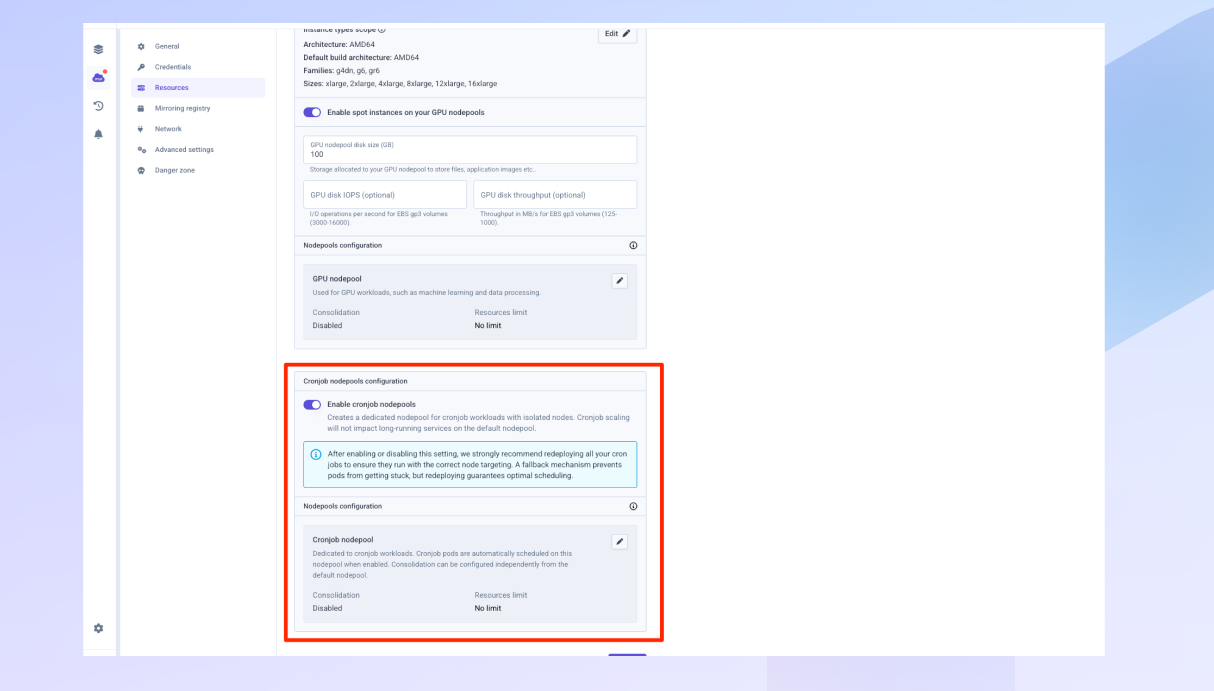
Qovery now manages a dedicated Karpenter node pool for short-lived workloads. If a cronjob can be scheduled on an existing node with available resources, it will be. If a new node is needed, it spins up in the dedicated pool, keeping your primary workload nodes clean and predictable.
🛠️ Minor updates
- Envoy: stream_idle_timeout configuration. As part of the ongoing NGINX to Envoy migration, you can now configure
stream_idle_timeoutdirectly, giving you finer control over long-lived connections like gRPC streams or SSE endpoints. - Terraform provider: env var as file support. You can now declare environment variables of type "file" in the Terraform provider, useful for workloads that expect credentials or config mounted as files rather than plain env vars.
The Qovery Skill is probably the highest-leverage thing to try if you work with AI coding assistants regularly. It is also a preview of where we are headed with MCP and agent-native workflows more broadly.
Talk soon,The Qovery Team 🚀