
Blog
Product
1
minutes

Preview Environment in Early Access

This is the most exciting feature we launched since Qovery v2 has been released - the Preview Environment feature!
September 26, 2025
Romaric Philogène
CEO & Co-founder
Summary
Twitter icon
linkedin icon

Have you ever wanted to test the changes in one of your teammate's pull requests? Validating this new feature that is about to be released? Or this urgent fix that you must apply before leaving the office?

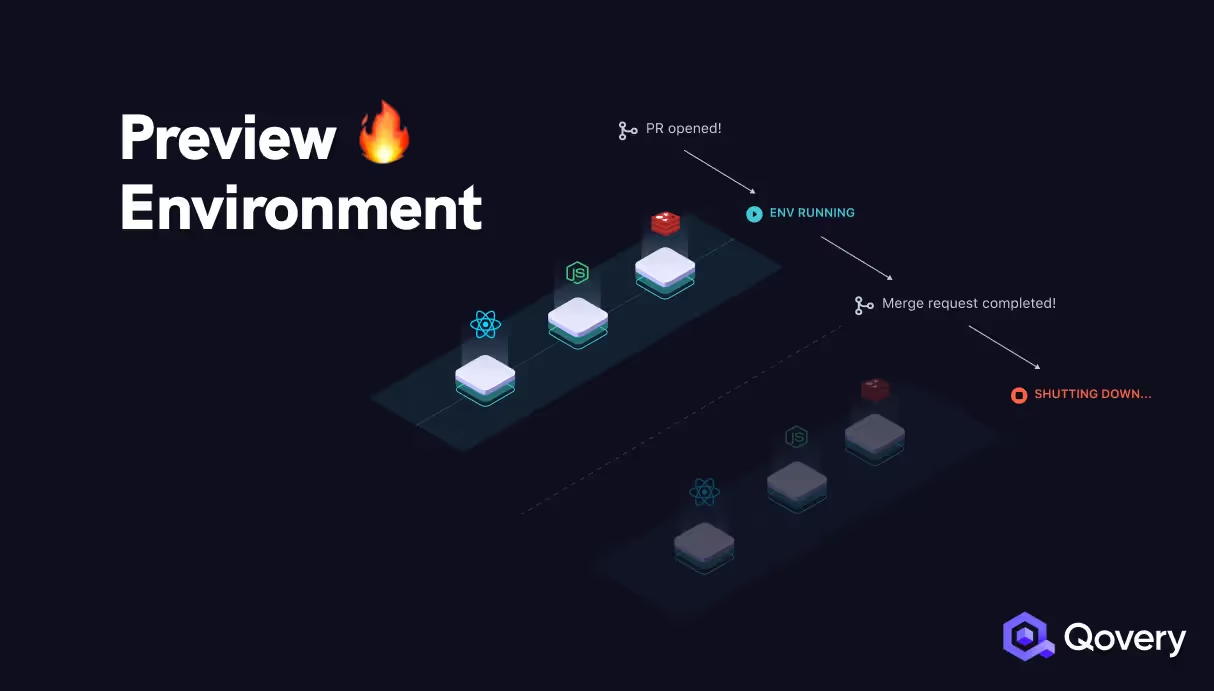
Preview Environment is the answer. A preview environment is an ephemeral environment associated with the life cycle of a pull request. Preview environments make it super simple to validate the changes in a pull request by anyone in your team - your Product Manager will love it! These changes are tested in isolation before merging the branch to the original one without polluting other integration environments.

Check out this quick record to take a look at how Preview Environment is powerful!

Be part of our first users to use the Preview Environment feature 🔥
Share on :
Twitter icon
linkedin icon
Tired of fighting your Kubernetes platform?
Qovery provides a unified Kubernetes control plane for cluster provisioning, security, and deployments - giving you an enterprise-grade platform without the DIY overhead.
See it in action

Suggested articles

Kubernetes
10
 minutes
How Kubernetes works at enterprise scale: mastering Day-2 operations

Kubernetes is a distributed orchestration engine that automates container deployment and scaling. At an enterprise level, its core mechanisms—control planes, schedulers, and worker nodes—provide foundational infrastructure resiliency. However, operating these components natively across thousands of clusters creates massive configuration drift, requiring intent-based control planes to manage Day-2 FinOps, RBAC, and multi-cloud abstraction globally.

Romaric Philogène
CEO & Co-founder
Engineering
DevOps
Platform Engineering
Kubernetes
10
 minutes
Everything you need to know about Kubernetes autoscaling and Day-2 FinOps

Kubernetes autoscaling relies on three dimensions: horizontal (pod count), vertical (resource size), and cluster (node count). While CPU-based scaling is standard, enterprise fleets require advanced Day-2 strategies (such as custom Prometheus metrics and priority-class overprovisioning) to prevent node boot delays and memory bottlenecks during severe traffic spikes.

Pierre Mavro
CTO & Co-founder
Kubernetes
 minutes
Stopping Kubernetes cloud waste: agentic automation for enterprise fleets

Agentic Kubernetes resource reclamation is the practice of using an autonomous control plane to continuously identify, suspend, and delete idle infrastructure across a multi-cloud Kubernetes fleet. It replaces manual cleanup and reactive autoscaling with intent-based policies that act on business state, eliminating the configuration drift and cloud waste typical of unmanaged fleets.

Mélanie Dallé
Senior Marketing Manager
Platform Engineering
Kubernetes
DevOps
10
 minutes
Kubernetes: the enterprise guide to day-2 operations and fleet management

Kubernetes is an open-source container orchestration engine. At enterprise scale, it abstracts infrastructure to automate deployment, scaling, and networking. However, managing hundreds of clusters introduces severe Day-2 operational toil, requiring agentic control planes to enforce global governance, security policies, and cost optimizations across multi-cloud fleets.

Morgan Perry
Co-founder
AI
Compliance
 minutes
Agentic AI infrastructure: moving beyond Copilots to autonomous operations

The shift from AI copilots to autonomous agents is redefining infrastructure requirements. Discover how to build secure, stateful, and compliant Agentic AI systems using Kubernetes, sandboxing, and observability while meeting EU AI Act standards

Mélanie Dallé
Senior Marketing Manager
Kubernetes
8
 minutes
The 2026 guide to Kubernetes management: master day-2 ops with agentic control

Effective Kubernetes management in 2026 demands a shift from manual cluster building to intent-based fleet orchestration. By implementing agentic automation on standard EKS, GKE, or AKS clusters, enterprises eliminate operational weight, prevent configuration drift, and proactively control cloud spend without vendor lock-in, enabling effective scaling across massive fleets.

Mélanie Dallé
Senior Marketing Manager
Kubernetes
 minutes
Building a single pane of glass for enterprise Kubernetes fleets

A Kubernetes single pane of glass is a centralized management layer that unifies visibility, access control, cost allocation, and policy enforcement across § cluster in an enterprise fleet for all cloud providers. It replaces the fragmented practice of switching between AWS, GCP, and Azure consoles to govern infrastructure, giving platform teams a single source of truth for multi-cloud Kubernetes operations.

Mélanie Dallé
Senior Marketing Manager
Kubernetes
 minutes
How to deploy a Docker container on Kubernetes (and why manual YAML fails at scale)

Deploying a Docker container on Kubernetes requires building an image, authenticating with a registry, writing YAML deployment manifests, configuring services, and executing kubectl commands. While necessary to understand, executing this manual workflow across thousands of clusters causes severe configuration drift. Enterprise platform teams use agentic platforms to automate the entire deployment lifecycle.

Mélanie Dallé
Senior Marketing Manager

It’s time to change
the way you manage K8s

Turn Kubernetes into your strategic advantage with Qovery, automating the heavy lifting while you stay in control.