Meet the Qovery Team: Julien, Technical Product Manager
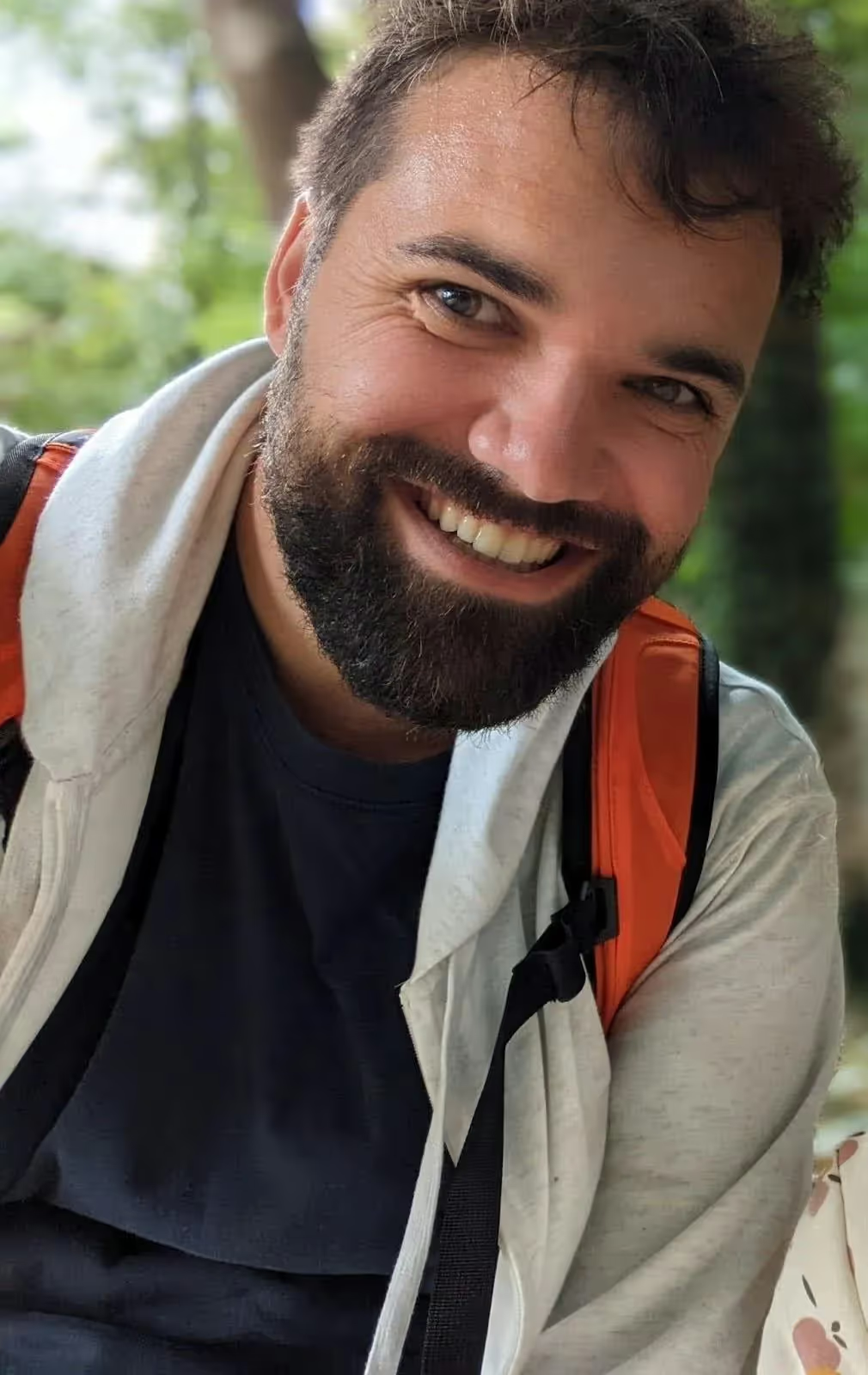
In today’s portrait, meet Julien, our Technical Product Manager at Qovery! He is responsible for driving the development and defining the requirements of our product. In the meantime, he loves traveling with his family in their van!
Please introduce yourself and describe your professional background briefly.
Bonjour 👋!
I am Julien Dan, a technical product manager based in Nantes since 2018. I grew up in Normandy 🐄 and moved to Paris in 2008 for my engineering studies.
I specialized in image processing and was able to work with the forensic police for my end-of-studies project.
Thanks to this project, my first professional experience was at Safran Morpho. I worked for 5 years on biometrics (facial recognition) and eSIM cards as a systems engineer and industrialization manager.
In 2018, I decided to leave Paris to discover another French city. I chose Nantes for its quality of life and proximity to the sea. Having worked in biometrics for 5 years, I was keen to discover other fields, especially the big world of data. Luckily, one of the leaders in this field has an R&D center in Nantes.
So, I joined a fantastic team at Talend! This team had only been there briefly, coming from a startup called Restlet, which had just been bought out. I took on the roles of product owner and quality engineer for products dedicated to APIs. That's when I realized how important it was to deliver a product with impeccable functionality and how important it was to be user-centric to achieve this goal.
During my 5 years at Talend, I also discovered Kubernetes and how laborious it is to deploy a development environment for our team.
So here I am, in the summer of 2023, wanting a new challenge. Remote work has spread all over the world. I'm discovering new companies, but I wanted to work in a start-up. That's how I found Qovery, which offers a product that really meets a need in the tech world.
Julien Dan, Technical Product Manager at Qovery
What is your role at Qovery, and what do you do?
I am the Technical Product Manager, driving the development and defining the requirements of our product.
I make sure everything is ready for development. This may involve reviewing Figma designs with the front-end team and our product designer.
I also make sure that the user's needs are clearly understood so that I can specify the best technical solution.
I also lead scrum ceremonies, whether daily, sprint planning, or retrospectives.
What do you like the most about working at Qovery?
Qovery is a young company with a lot of very experienced people. The cohesion is very strong between the different members and the founders.
The full remote policy gives me real freedom: I can work from anywhere and arrange my working hours with complete autonomy.
As far as the product made by Qovery is concerned, it meets a user's need, and that's what I was looking for more than anything else. The developments are progressing quickly, and that's great!
Agents ship fast. Guardrails keep them safe.
Qovery ensures every agent action is scoped, audited, and policy-checked. Start deploying in under 10 minutes.
In the morning, I first look at all the customer's feedback on Slack or our forum.
I look at the priorities regarding the specifications I need to work on.
This allows me to plan my day so I know what I will do.
Then, it's time for our daily scrum meeting. I ensure no one is blocked and everyone understands the priorities. It's also a time when we discuss various technical issues.
Afterwards, I read up on technical subjects and challenge users needs to get as much information as possible to work on a new feature.
I take the time to write the specifications in notions, specifying the evolutions on the backend, frontend, or even at the API level.
Once the specifications are ready, I create and schedule the JIRA tickets for the next sprints.
At the same time, I often work with Alessandro, our Lead Product Manager, to discuss our progress. This is also an opportunity to divide the workload and share our vision on different subjects.
How do you like to spend your free time when you are not working?
I play music, especially piano, guitar, and bass, in my spare time.
Twice a week, I go to the gym.
I spend a lot of time every evening cooking a good meal.
I love to travel around Europe in a van with my family.
And if I have time, I play video games :)
Do you have final advice for someone wanting to join Qovery?
Don't be afraid to join us because there's nothing more exciting than working on a valuable product in a cool atmosphere, all from wherever you want.