Meet the Qovery Team: Benjamin, Backend (Kebab) Engineer
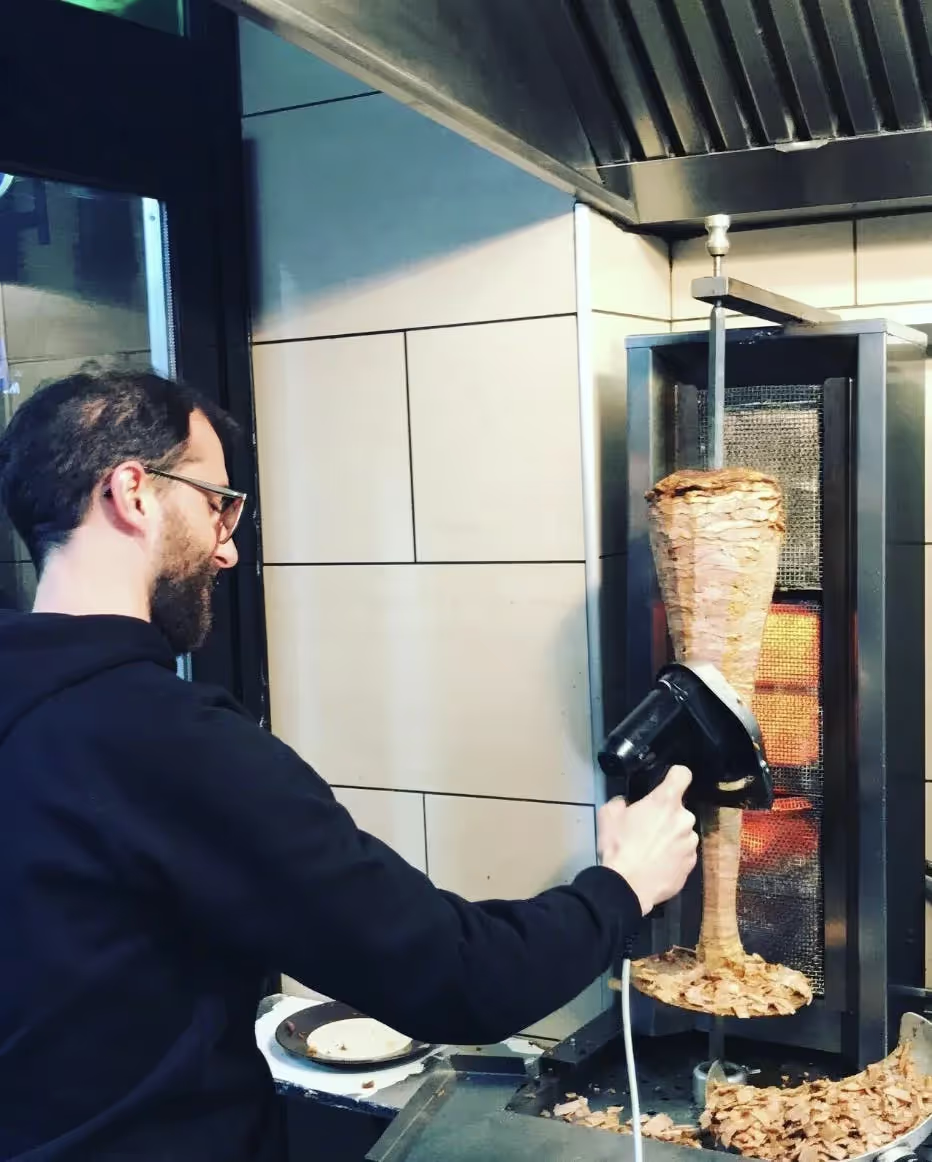
In today's portrait, meet Benjamin Chastanier, one of our Backend Engineers here at Qovery, which also cultivates a big hobby for the art of Kebabs. He's mainly responsible for the Qovery Engine, making the magic happen so you can deploy your infrastructure and applications! ✨
Moved to Lyon to complete an Engineering degree in computer science at CPE Lyon. I was not really willing at that time to spend 3 years of pure theory, which is why I chose to do it in sandwich courses: 1 week at school, 1 week in a company where you've signed a 3-year contract to work as a developer.
After engineering school and those 3 years of developer experience, I wanted to open my mind toward more business-oriented roles and projects and not doing pure engineering. Hence I did a business-oriented advanced master's degree at EM Lyon (willing to kick start an entrepreneur project, which I did for a bit).
Joined Ernst and Young as a consultant for 10 months, where I was doing mostly change management projects along with IT audits.
Then I got an opportunity to join Criteo as a Technical Account manager working in an international team on Criteo RTB product dealing directly with actors such as Facebook, Google, Yahoo, etc.
I cannot turn it down. Criteo was under my radar. It was just the perfect position at the perfect time; the role was a very good fit between pure engineering and business teams in a very dynamic space.
After two years, I joined Criteo R&D as a software engineer for 4 years, working mainly on real-time bidding.
Fun fact, when I joined Criteo, I was still living in Lyon and commuted from Lyon to Paris every day for almost 1 year before after work calling was too strong 🍻. It was a very nice experience; I know a lot about train seat layouts and which are the best picks.
After COVID, I was looking for new challenges and was willing to join a smaller team building a product having a strong meaning to me where I can have an impact and have some technical challenges.
I have been following Qovery for almost a year and was impressed with the product (especially the focus on user experience with a very nice front end).
When I decided to leave Criteo, Qovery sounded like an obvious choice for my next journey. I was hyped by:
The product (I can use every day for side projects)
The technical stack 🦀
The team (knew a couple of individuals)
The project ambition
Targeted functional domain being cloud infrastructure
Benjamin's side hustle as a "Maitre Kebabier"
What is your role at Qovery, and what do you do?
I am a senior backend engineer working mostly on the Qovery Engine, responsible for interacting with cloud providers and client clusters, allowing to deploy infrastructure and applications.
My role goes from integrating new features/cloud providers to our product; it goes from small plumbing to high-level design while keeping an eye on production along with helping customers to have the best experience possible on Qovery via the forum.
As a concrete example, my first big project was to integrate Scaleway as a cloud provider in the product, allowing users to deploy their apps on Scaleway.
Another project was to design and implement a DNS manager application responsible for allowing Qovery to scale no matter the number of clusters we are managing.
I also worked on implementing a better error/logging system in the Engine easing debugging and providing better error messages to users.
There is so much to be done; we have a lot of ideas to improve the Engine and the product; part of the job is also to be responsible and wisely pick tasks to be done (having the most impact).
Agents ship fast. Guardrails keep them safe.
Qovery ensures every agent action is scoped, audited, and policy-checked. Start deploying in under 10 minutes.
What do you like the most about working at Qovery?
I was not aware a couple years back how challenging and interesting cloud infrastructure was. I was working on companies having dedicated teams responsible for lighting up infrastructure and it was totally transparent to me.
It’s kind of an end game for me that our functional domain is cloud infrastructure as it’s a field I always wanted to dig more into (not being a field I don’t care of and won’t help me being a better developer over time such as Advertising 😛).
I like how people are all very involved and free to push for topics and work on it. Everyone is willing to improve the product or the company as a whole and feel responsible for it, which I really appreciate.
Qovery is investing a lot in providing very polished interfaces: UX is thought ahead of time and most of the time designed before the backend so we focus on user experience rather than shaky backend logic then mapped to the front leading to cardboard cut-out style UI.
What does your typical day look like?
Start my day a bit before 9 AM, reviewing overnight messages and alerts on Slack
Plan my day with tasks to be done / continued. If this is an *interrupt week, then I check our forum, and other communication channels to support customers along with spending some time on implementing improvements spotted during interrupt
Daily standup at 10AM
Focusing dev time
12 AM it’s time get get some fresh air and go for a 30-45 minutes walk, it allows me to discover new places and help me unlock me on some issues
Have lunch around 1PM
Focusing dev time
And then it’s kid after school time
*Interrupt week:
Every developer needs to take turns on one week customers and bugs support. It’s a very good exercise in the sense that we are faced with real world issues and it helps improve the product and user experience in the long run.
How do you like to spend your free time when you are not working?
Depends a lot, but when I have some free time, I usually try to meet some friends, go biking (Fontainebleau forest is a 30 minutes train away).
I also spend time on coding side projects, watching too many TV shows, and doing some home-improvement projects.
Do you have final advice to give to someone who wants to join Qovery?
One might think joining a startup means giving up free time, working crazy, shipping fast using questionable tech stacks and managing production deployment by hand via a mystical process involving FTP.
We have a lot of flexibility in our job and are able to have a deep impact quickly on the product which I really love !
The organization is very transparent and we are aware of everything happening on the business side of things, which is very motivating and makes delivery very concrete.
A lot of very interesting technical challenges are just waiting to be tackled.