What the Qovery audit log shows about AI Health Hack #2: 1,071 deployments, 204 preview environments, Git and coding agents doing most of the work, and the stacks teams picked.
At AI Health Hack #2, every team had one day to build a health AI app and put it online on AWS. Each team got a project on a shared Amazon EKS cluster run by Qovery, $150 of Claude on Amazon Bedrock, and the coding agent of its choice.
The numbers below come from the Qovery audit log of the hackathon organization for 28 November, and from the teams' public GitHub repositories.
One team, marmot2019, wrote a script that created environments and redeployed in a loop to climb the live leaderboard. It produced 3,267 deployment runs on its own, so we left those out of every number below unless we say otherwise.
30 minutes from "start building" to the first app on AWS
Building started at 10:00. The first team had an app live on AWS at 10:30.
Milestone
Time (Paris)
First successful deployment
10:30
5 teams live
11:53
10 teams live
13:15
20 teams live
16:48
In total, 20 teams deployed successfully at least once. Several started from a repository created that morning.
1,071 deployments, 81% successful
Over the day, teams ran 1,071 deployments on Qovery. 868 succeeded (81%) and 203 failed, usually followed by a fix and a new push.
The pace followed the day: a slow start while teams set up, a climb after lunch, and a peak between 15:00 and 16:00 with 400 deployments in one hour as teams got their demos ready. After submissions closed at 18:00, it dropped to almost nothing.
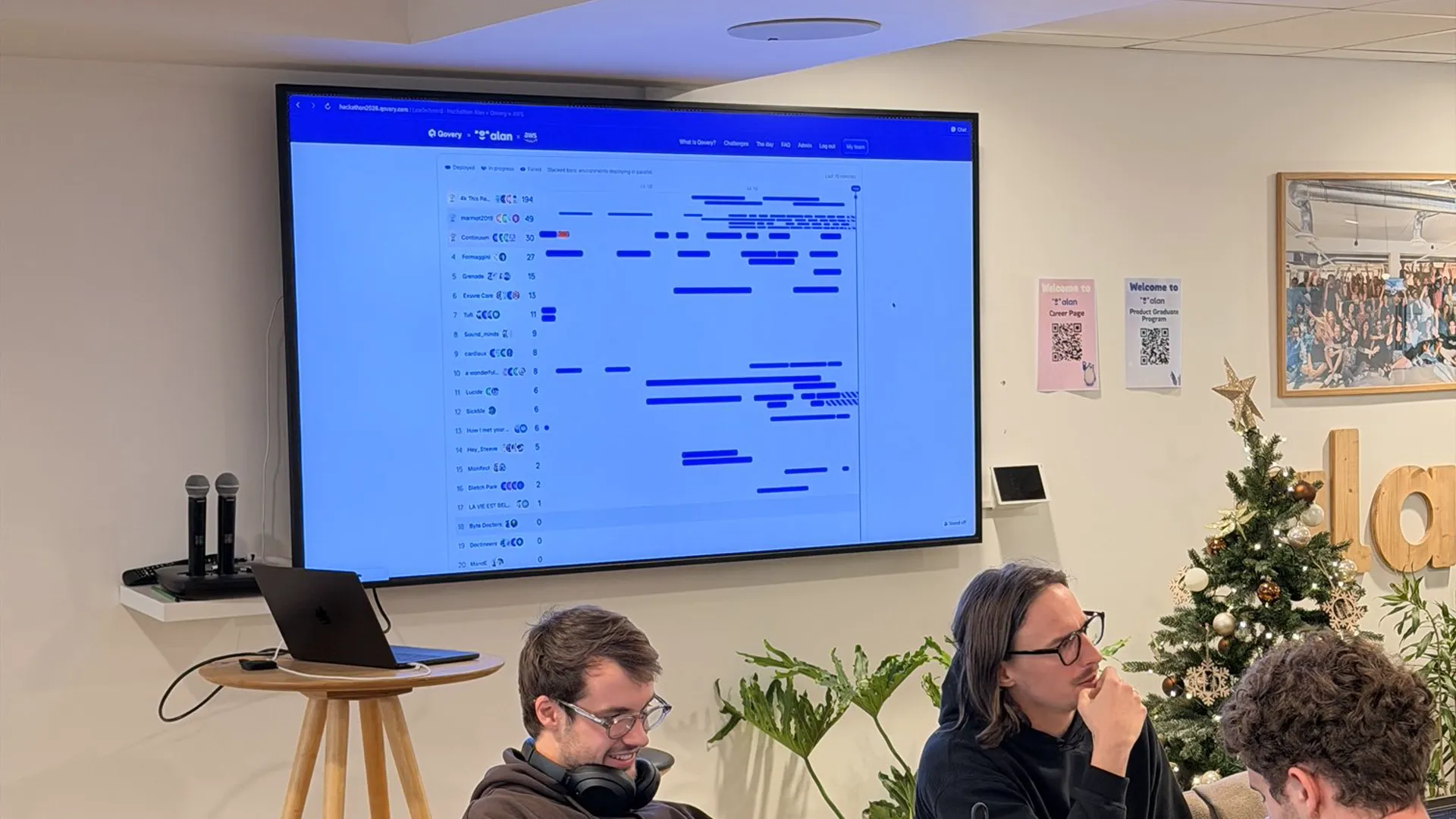
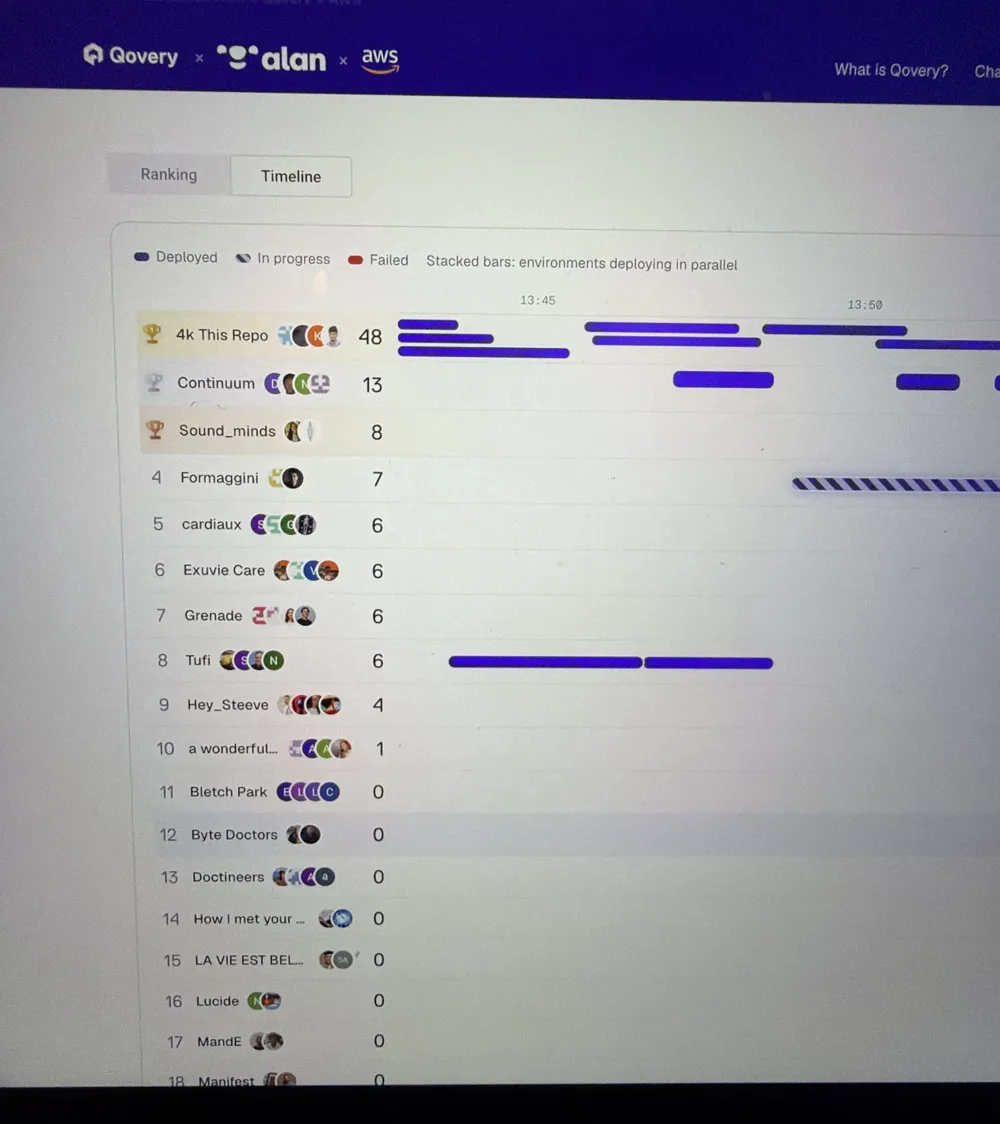
The live deployment board at 13:50, with each bar an environment deploying
Give every pull request its own environment.
Qovery, the Agentic DevOps platform, creates a preview environment for every pull request in your own AWS, GCP, Azure or Scaleway account. Start on the Free plan, no credit card.
Teams created 486 environments during the day. 204 of them were preview environments that Qovery created automatically for a pull request.
A coding agent opens a pull request, Qovery creates an environment for it on AWS with its own URL, the team tests the change there, and the pull request gets merged into production. One team ran that loop 123 times in a day. Another ran it 45 times and won the "Ship like a team" challenge.
Counting the team that gamed the board, the hackathon created 802 environments on one shared cluster.
Who pressed deploy
The audit log records where each deploy action came from. Out of 1,175 deploy actions:
Source
Share
A Git push or pull request
51%
The Qovery API
26%
The Qovery CLI
16%
The Qovery Console
4%
The Qovery skill in a coding agent
3%
The Console, our web dashboard, started 4% of deployments. Git, the API, the CLI and coding agents started the rest. Environments follow the same pattern: teams created 7 of the 486 by hand in the Console.
What they deployed
Teams created 171 applications, 50 containers, 9 databases, 5 jobs and 3 Terraform services.
Databases: all 9 were PostgreSQL (8 on version 16, 1 on version 17), running as containers in the team's environment.
Git: every team used GitHub, with 20 repositories connected to Qovery.
Builds: where the build mode was recorded, apps were built from a Dockerfile. The most common ports were 8080, 3000 and 8000.
The stacks
Twelve of the 20 repositories are public, and we only describe those.
Languages. TypeScript came first, Python second, and one service ran in Go. Several teams paired a TypeScript front end with a Python API.
Frameworks.
React in most projects, with Next.js in about five.
Expo and React Native in about five, for mobile apps.
FastAPI with Pydantic and Uvicorn in about five, for the Python APIs.
NestJS, Hono, Express, Vite, Tailwind, Drizzle, SQLAlchemy and three.js each showed up in one or two projects.
Calling Claude. Most teams used the Anthropic SDK, about five in TypeScript and two in Python. One used the OpenAI SDK format, and one called Bedrock with boto3. Claude Sonnet, Claude Haiku, Claude Opus and Amazon Titan embeddings were all available through the hackathon's AI gateway on Bedrock.
Containers. Base images were mostly node:22 and node:24 (Alpine or slim) and python:3.11-slim or python:3.12-slim. Some teams shipped distroless images, and two built on PyTorch CUDA images.
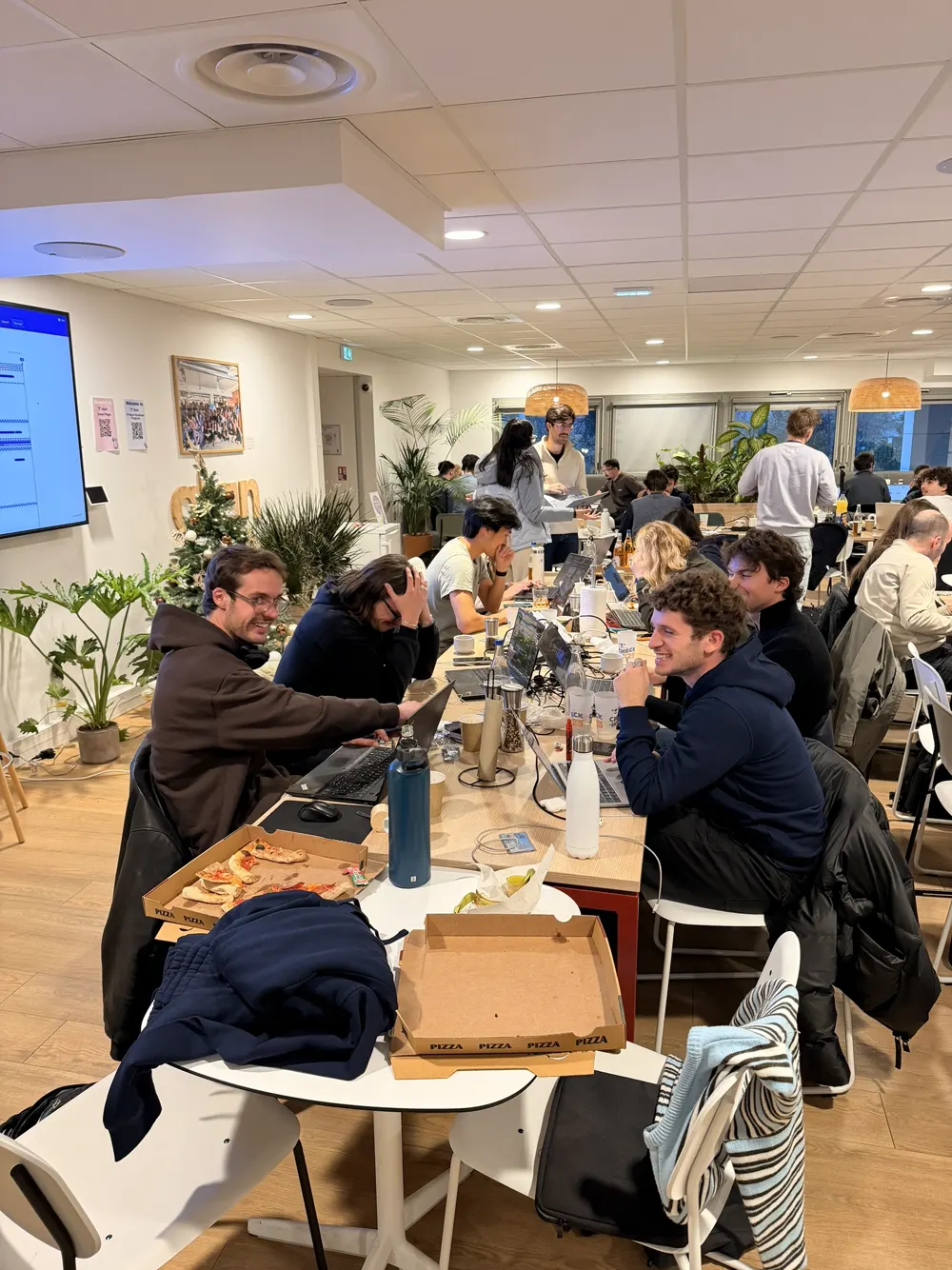
Teams at work during the afternoon peak
What we learned
Coding agents need an environment per change. One team opened 123 preview environments in a day. When an agent opens pull requests, each one needs somewhere to run, created and cleaned up without anyone asking.
Leaderboards get gamed, so count what matters. By the end of the day the board only counted deployments that shipped new code, with at most one point per team every two minutes.
One shared cluster held up. 802 environments and more than 4,000 deployment runs went through one Amazon EKS cluster, with every team isolated in its own project.
Romaric founded Qovery to make Kubernetes accessible to every engineering team. He writes about platform strategy, developer experience, and the future of cloud infrastructure.
Next step
Give every pull request its own environment.
Qovery, the Agentic DevOps platform, creates a preview environment for every pull request in your own AWS, GCP, Azure or Scaleway account. Start on the Free plan, no credit card.