
Hey Team,
This release focuses on long term platform reliability and giving you more control over how your environments and cloud resources behave.
Let’s start with an important infrastructure update.
🔄 NGINX deprecation timeline and migration to Envoy
As previously announced, the community NGINX Ingress Controller will reach end of maintenance by March 2026. After that date, no new patches will be released, including potential security fixes. That means future CVEs could remain unresolved.
To protect your production workloads and keep your routing layer future proof, Qovery is migrating from the NGINX Ingress Controller, based on Kubernetes Ingress, to Envoy Gateway built on the Kubernetes Gateway API.
This is a significant architectural change, but we are handling the complexity for you. The migration is being carefully orchestrated to avoid downtime and service disruption.
We prepared a dedicated changelog page that explains the timeline and any required actions on your side
If you are curious about the technical details and what happened behind the scenes, we also published a deep dive on the migration process
⏭️ Skip services in the environment deployment pipeline
You can now skip specific services in your environment deployment pipeline.
This is particularly useful when certain services or jobs should run only on demand instead of being automatically deployed every time the environment is deployed or cloned.
Simply drag the service into the “Skipped” stage of the deployment pipeline. It will remain part of the environment but will not be automatically deployed during full environment operations.
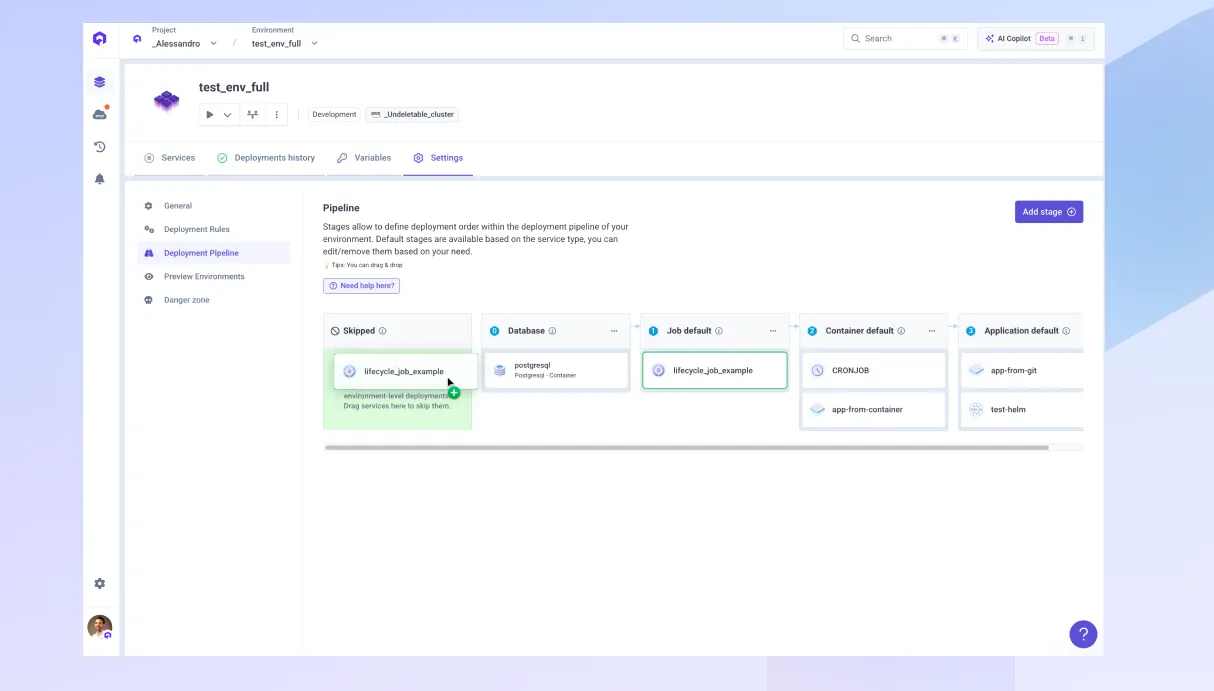
This gives you finer control over complex environments without splitting them into multiple projects.
🏷️ Customize tags for cluster resources
We added the ability to customize tags assigned to cluster resources created in your cloud account, including clusters, compute instances, and related infrastructure across AWS, GCP, Azure, and Scaleway.
This is especially useful for cost tracking and internal reporting.
You can define a label or tag group with the values you care about, then assign it to one or more clusters. Qovery will automatically propagate those tags to the underlying cloud resources.
🛠️ Minor updates
- MCP improvement: permissions are now aligned with organization level maximum permissions, and you can enforce write mode via a specific parameter in the MCP URL
- Terraform provider: added support for custom VPC on GCP
- Karpenter: added `consolidateAfter` configuration in the nodepool settings
That is it for this release. As always, thank you for trusting Qovery to run your production workloads.
Talk soon,
The Qovery Team 🚀