The fastest way to K8s: how Qovery builds self-service environments in minutes
Slash Kubernetes provisioning time from days to minutes. Discover how Qovery’s self-service ephemeral environments automate infrastructure, eliminate bottlenecks, and accelerate developer velocity.
The New Bottleneck is Infrastructure: While modern tools have sped up coding, deployment velocity is stalled by complex, manual environment provisioning (Terraform, K8s manifests, and networking) that forces developers to wait days for testing infrastructure.
The Power of Ephemeral Environments:Self-service ephemeral environments (isolated, full-stack copies created on-demand) eliminate these delays. They enable developers to spin up production-like environments for every Pull Request and automatically tear them down when finished.
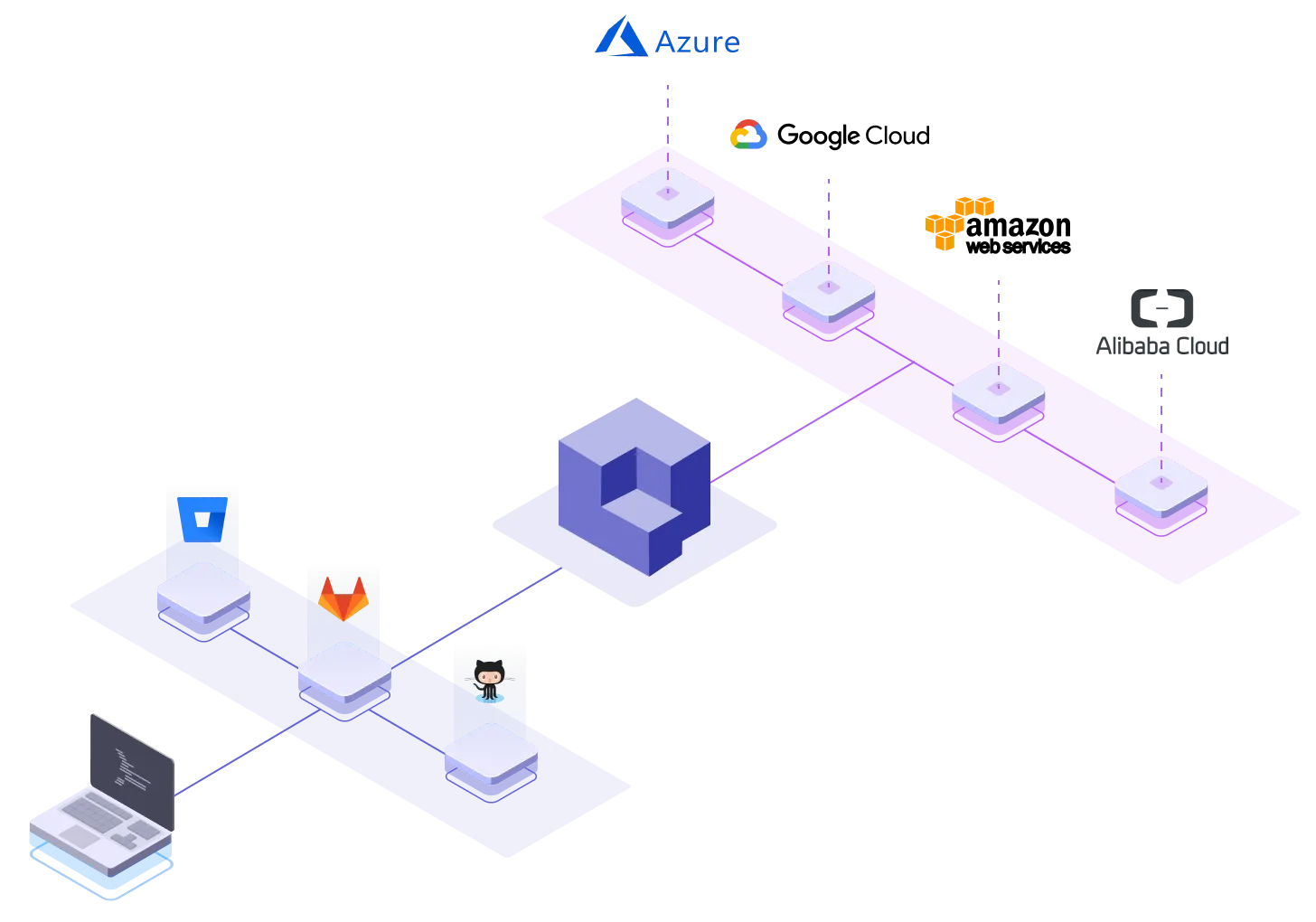
Automated by Qovery: Qovery automates the entire lifecycle by integrating directly with Git. It handles the heavy lifting of cloud infrastructure (AWS/GCP/Azure), Kubernetes configuration, and database provisioning, allowing platform engineers to focus on governance rather than ticket fulfillment.
Engineers are writing code faster than ever, yet they spend more time waiting than shipping. Why? Because while IDEs and AI assistants have accelerated development, infrastructure provisioning has become the new bottleneck.
When a simple test environment takes days to configure (requiring manual Terraform runs, complex Kubernetes manifests, and networking glue code) Pull Requests sit idle and QA cycles drag on. The gap between code completion and validation is where velocity dies.
This guide explores how to close that gap. We look at why traditional provisioning is so slow and how self-service ephemeral environments can slash wait times from days to minutes, putting infrastructure control directly in developers' hands.
The Anatomy of a Slow Environment Build
Traditional environment provisioning involves multiple systems, teams, and manual steps that accumulate into long turnaround times.
1. Infrastructure as Code Complexity
Provisioning a new environment starts with infrastructure. VPCs, subnets, security groups, user roles, and Kubernetes clusters require Terraform or similar tooling. Even with mature infrastructure as code practices, creating environment-specific configurations demands engineering effort.
Teams maintain separate Terraform modules for each environment type. Variables differ between development, staging, and production. Someone must create the configuration files, run the plans, review the output, and apply the changes. Each step requires attention from engineers with infrastructure expertise.
For organizations without dedicated platform teams, infrastructure provisioning responsibility falls to application developers who have to context-switch from feature work. The overhead of switching between application code and Terraform modules slows both activities down.
2. Kubernetes Configuration Overhead
After infrastructure is provisioned, applications need Kubernetes resources created. Deployments, Services, Ingresses, ConfigMaps, and Secrets require YAML manifests tailored to each environment.
Environment-specific configurations multiply the maintenance burden. Development environments use smaller resource allocations, and staging environments require production-like settings for realistic testing. Each variation requires separate manifest files or complex templating with Helm or Kustomize.
Networking configuration presents particular challenges. Ingress rules, TLS certificates, and DNS records require creation for each environment. Teams either automate these through additional tooling or handle them manually for each new environment.
Database provisioning adds another dimension. Test environments require databases with appropriate schemas and seed data. Connecting applications to databases requires secrets, network policies, and service discovery configuration, as each environment needs its own isolated data layer.
3. CI/CD Pipeline Gaps
Build and deployment pipelines typically optimize for the main deployment path. Deploying to the primary staging or production environment works smoothly. Creating an entirely new environment often falls outside pipeline scope.
Teams wanting environment-per-branch workflows discover their pipelines lack the necessary logic. Triggering infrastructure provisioning from pull requests requires custom integration work. Cleaning up environments when branches merge demands additional automation.
The glue code connecting infrastructure provisioning, Kubernetes deployment, and CI/CD systems becomes its own maintenance burden. Scripts that coordinate across tools generate technical debt for the engineering organization.
The Solution: Self-Service Ephemeral Environments
Ephemeral environments eliminate the provisioning bottleneck by making environment creation instant, automatic, and developer-controlled.
What Ephemeral Environments Provide
An ephemeral environment is a complete, isolated copy of an application stack created on demand and destroyed when no longer needed. Each environment includes the application code from a specific branch, supporting databases and services, networking configuration, and realistic data for testing.
The environment exists only as long as required. When a pull request merges or closes, the environment disappears automatically. No orphaned resources accumulate, and no manual cleanup is required.
1. Fully Self-Service
Self-service means developers create environments without platform team's involvement, fully autonomously.
A developer pushes a branch and receives a complete environment minutes later. They test changes in isolation, share preview URLs with stakeholders, and iterate without affecting anyone else. When finished, the environment is decommissioned automatically.
This model changes the traditional relationship between developers and infrastructure. Instead of infrastructure constraining development, infrastructure adapts instantly to development needs.
2. The Quality Impact
Ephemeral environments improve code quality by enabling comprehensive testing before merging. Every pull request receives production-like infrastructure, leading to early detection of integration issues or bugs within code change.
Product managers and other stakeholders can preview features before they reach staging. QA tests also run in isolated environments without interference from other work in progress.
The feedback loop shortens and accelerates as issues get discovered quickly after pushing code. This lets engineers iterate quickly on their work, improving the delivery schedule and code quality organization-wide.
Qovery's Automation Engine: The Technical Breakdown
Qovery provisions managed Kubernetes clusters on EKS, AKS, or GKE using Terraform and OpenTofu. The platform generates infrastructure code automatically based on environment requirements.
When creating a new environment, Qovery handles VPC configuration, subnet allocation, security group rules, and role policies without manual intervention. The generated Terraform runs on your cloud account, creating resources you own and control.
Networking is configured automatically, with each environment receiving appropriate ingress rules, TLS certificates, and DNS records. What normally requires infrastructure engineering expertise runs seamlessly and without fail.
2. Kubernetes Abstraction
Developers interact with Qovery through Git, CLI, or web interface. They onboard applications through a simplified interface, while the platform generates Kubernetes manifests automatically.
Deployments, Services, and Ingresses are created without needing any manual YAML creation. Resource allocations are configured using a simple interface rather than verbose manifest files. Similarly configured, environment variables are then injected securely without ConfigMap and Secret management.
Database provisioning integrates into the same workflow. A few clicks provision a new database, configured to be accessible to other services within the same environment.
3. Git-Triggered Workflows
Qovery integrates directly with the company’s Git repositories. Pushing to a branch triggers environment creation or update. Merging or closing pull requests deployment updates and cleanups where required.
This Git-centric workflow requires no changes to developer habits. The same push that triggers code review also provisions infrastructure. The feedback comes faster because environment creation starts immediately rather than waiting for manual intervention.
Ephemeral environments attach to pull requests automatically. Each PR receives a preview URL where reviewers access running applications containing the updated code.
The Impact: Velocity and Quality
Self-service ephemeral environments produce measurable improvements across delivery metrics, for all members of an organization.
4. Faster Feedback Loops
The time between pushing code and receiving test results determines a developer’s velocity. When environments are delivered in minutes rather than days, developers test more frequently and catch issues earlier.
Deployment frequency increases as friction to deploy decreases. Teams that previously deployed weekly can evolve to daily or continuous deployment. Each deployment carries less risk because it contains fewer changes, which improves drastically the service quality for users.
Lead time for changes, the time it takes to take an idea to production, drops as teams benefit from shortened deployment time. Features move from development to production faster because environment availability no longer bottlenecks the pipeline.
5. Production Parity
Ephemeral environments can match production configuration precisely. The same container images, resource allocations, and networking configurations can be applied across all environments.
This parity reduces the likelihood of bugs staying undetected and only appearing in production. Integration issues can surface early during preview environments rollout, and performance can be tested in production-like environments. The gap between development and production shrinks, making testing more critical and valuable.
Teams gain confidence in deployments when working in these conditions. Code that works in ephemeral environments works in production, and the anxiety around releases diminishes when testing happens in realistic conditions.
6. Reduced Burden and Cost
The self-service model shifts environment creation and ownership from platform teams to developers. Platform engineers are not required to manage environment creation and focus on improving the platform itself.
The relationship between platform and development teams improves when requests and queues disappear. Platform teams become enablers rather than gatekeepers, while developers appreciate infrastructure that responds to their needs instantly.
Maintenance costs decrease when environments manage themselves. Ephemeral environments require no manual cleanup and don’t suffer from configuration drift as they are provisioned fresh from current specifications every time.
7. Internal Developer Platform Delivery
Qovery provides the self-service abstraction layer that defines Internal Developer Platforms. Platform engineers configure guardrails and policies while developers consume infrastructure through simple interfaces. The platform enforces organizational standards while enabling developer autonomy.
This model lets platform teams scale their impact. One platform team serves hundreds of developers through self-service rather than manual provisioning. The leverage of platform engineering multiplies when developers help themselves.
Agents ship fast. Guardrails keep them safe.
Qovery ensures every agent action is scoped, audited, and policy-checked. Start deploying in under 10 minutes.
Environment provisioning has become the bottleneck that determines delivery velocity. Teams waiting days for infrastructure cannot compete with teams that provision them in minutes.
The solution requires automating the entire environment lifecycle: infrastructure provisioning, Kubernetes configuration, application deployment, and resource cleanup. Manual processes and fragmented tooling cannot achieve the speed that modern development demands.
Qovery transforms environment creation from a complex, multi-day task into a simple, Git-triggered event. Developers push code and receive complete, production-like environments in minutes. Platform engineers focus on platform improvement rather than provisioning requests. Organizations ship faster because infrastructure no longer constrains delivery.
Melanie leads content at Qovery. She covers platform engineering trends, Kubernetes operations, FinOps, and the tools that help engineering teams ship faster.
Next step
Agents ship fast. Guardrails keep them safe.
Qovery ensures every agent action is scoped, audited, and policy-checked. Start deploying in under 10 minutes.