The GPU Waste Problem: Kubernetes natively assigns whole physical GPUs to single pods. For lightweight workloads like AI inference, this results in massive financial waste since you pay for 100% of the GPU but only utilize a fraction of it.
The Orchestration Barrier: While NVIDIA’s Multi-Instance GPU (MIG) technology hardware-partitions GPUs, teaching Kubernetes to recognize and schedule these slices requires a complex, fragile stack of DaemonSets, node labels, taints, and affinity rules.
Automated Abstraction: As a comprehensive kubernetes management platform, Qovery bridges this gap by translating complex K8s YAML and MIG profiles into a simple developer interface. This maximizes GPU density and ROI without burdening platform teams with endless configuration toil.
Kubernetes was built for CPU and memory, assuming resources are easily divisible. GPUs break this model entirely. When a pod requests a GPU, Kubernetes natively assigns the entire physical card to that container, even if your AI inference workload only uses 15% of it.
This architectural mismatch creates a compounding financial drain:
Massive waste: You pay for 100% of an A100 card, driving effective compute costs to $15-$25 per hour for low-utilization tasks.
The hardware is ready: NVIDIA’s Multi-Instance GPU (MIG) technology solved physical partitioning years ago.
The software is lacking: Kubernetes does not natively understand GPU sub-allocation.
This guide explores how to teach Kubernetes to schedule and isolate GPU slices, the operational toll this takes on platform engineers, and how modern automation makes high-density GPU scheduling effortless.
Teaching Kubernetes to Count
Reducing GPU waste requires work at two distinct layers: the hardware layer, where physical partitioning creates the slices, and the orchestration layer, where Kubernetes learns to schedule containers onto those slices. The hardware side is mostly solved by NVIDIA already, however the orchestration side is where the real work begins.
Hardware Creates the Slices
NVIDIA's Multi-Instance GPU technology, available on A100, H100, H200, and B200 GPUs, partitions a single physical card into up to seven isolated instances. Each MIG slice receives dedicated streaming multiprocessors, memory, and cache. The isolation is enforced at the hardware level, meaning a workload running on one slice cannot access the memory or compute of another.
MIG profiles follow the format `[compute]g.[memory]gb`. An A100 with 40GB of memory can be partitioned into seven `1g.5gb` slices (each with 1/7th of compute and 5GB of memory) or two `3g.20gb` slices (each with 3/7ths of compute and 20GB of memory). The partitioning itself is configured at the node level using `nvidia-smi` or the `nvidia-mig-parted` tool for declarative configuration across a fleet.
Kubernetes Management Makes Them Usable
Three components must be installed, configured, and maintained to bridge the gap between hardware slices and schedulable Kubernetes resources.
The NVIDIA device plugin runs as a DaemonSet on every GPU node. When configured for MIG, it discovers the available slices and registers them with the kubelet as extended resources. Instead of advertising a single `nvidia.com/gpu`, the node exposes resources like `nvidia.com/mig-1g.5gb: 7`, telling the scheduler that seven small GPU slices are available.
NVIDIA’s GPU Feature Discovery, another DaemonSet, automatically generates labels for each node based on its GPU hardware and MIG configuration. These labels allow the scheduler to differentiate between nodes with different partition profiles. Without accurate labels, the scheduler cannot distinguish a node offering seven small inference slices from one offering two large training partitions.
Platform engineers must install these DaemonSets, keep them versioned alongside the GPU driver, and ensure they restart correctly when nodes cycle.
Operators also need to configure taints on MIG nodes so that only GPU-aware workloads land there. Tolerations on pod specs allow specific containers to schedule on tainted nodes. Node affinity rules can direct heavy training jobs to full GPUs while routing inference workloads to MIG slices.
The Management Toil
Each of these components requires independent maintenance. Changing a MIG profile requires draining the node, reconfiguring the GPU, and rescheduling workloads. The device plugin and GPU Feature Discovery DaemonSets must be updated when NVIDIA releases new driver versions. Node labels and taints must stay consistent across the fleet as nodes are added, removed, or replaced.
The YAML that developers must write to target a specific MIG profile is also nontrivial. A pod requesting a `1g.5gb` slice needs the correct resource limit, a toleration for the GPU node taint, and a node affinity rule to ensure it lands on a MIG-enabled node.
This configuration is error-prone and requires knowledge that most application developers do not have. Every deployment that targets a GPU slice needs precise configuration, and a mistake in any field can result in failed scheduling or misplaced workloads.
Slash Cloud Costs & Prevent Downtime
Still struggling with inefficiency, security risks, and high cloud bills? This guide cuts through the complexity with actionable best practices for production Kubernetes environments.
With GPU partitioning in place, three operational strategies determine how effectively your cluster utilizes its hardware:
Bin Packing: The default K8s scheduler spreads pods out, which wastes expensive GPU nodes. Bin packing reverses this: it packs as many workloads as possible onto a single GPU node (e.g., 21 inference services on just three A100s) before allocating a new one.
Hardware Isolation: MIG provides hardware-level memory and compute isolation between slices. A crash or memory leak in slice 0 cannot destabilize a neighboring container in slice 1, eliminating noisy neighbor problems in multi-tenant clusters.
Resource Quotas: To prevent resource hoarding, Kubernetes ResourceQuota objects cap the total number of MIG slices a specific namespace (e.g., ML inference vs. Training) can request, ensuring fair access across teams.
Qovery: The Scheduler You Do Not Have to Write
While it requires a lot of setup and maintenance by platform operators, the architecture described above works. However, for most mid-size teams, this configuration toil is the primary barrier to adopting GPU partitioning.
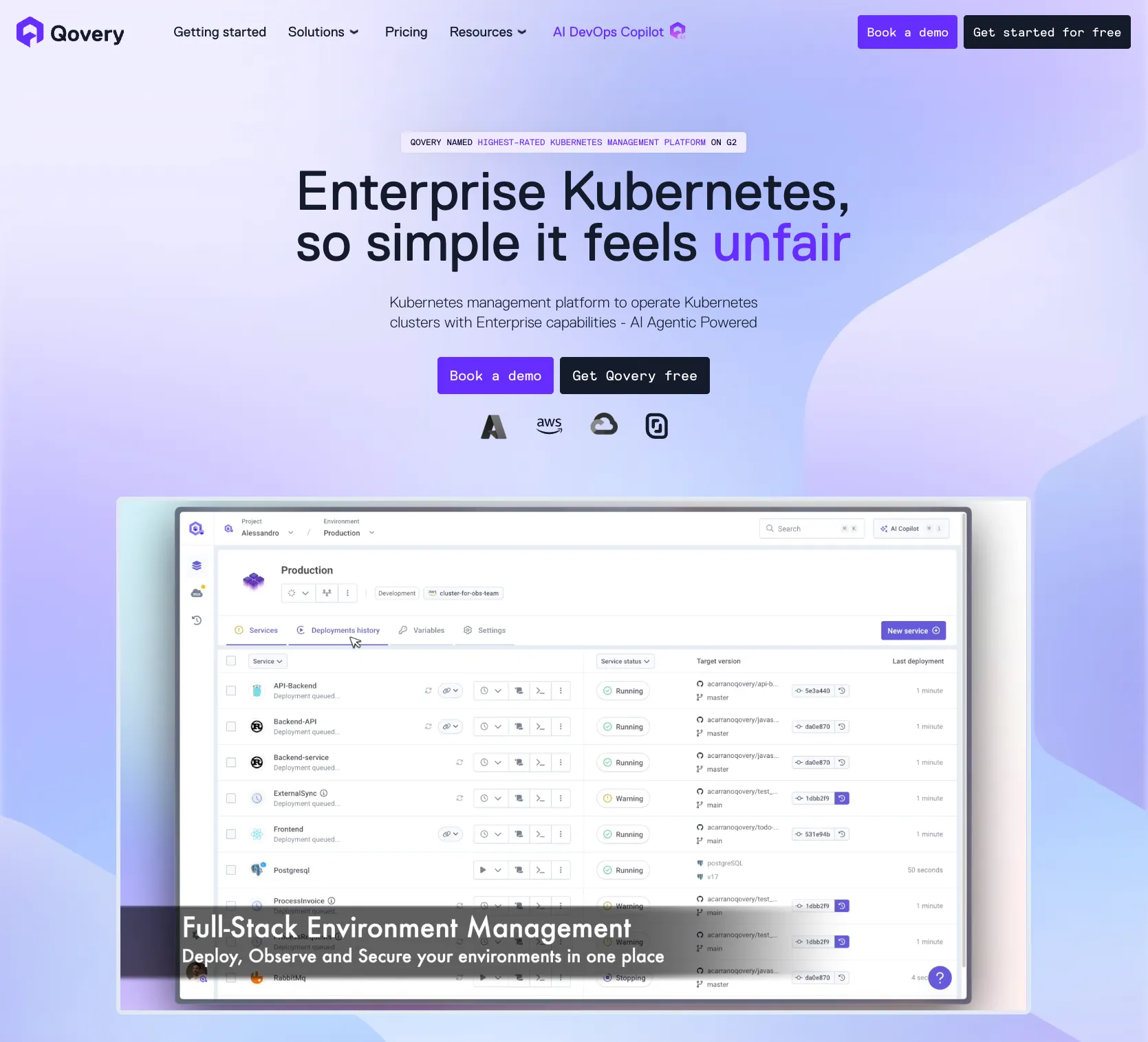
Qovery is a Kubernetes management tool that translates hardware capabilities into developer experience. For GPU workloads, this means converting the complexity of MIG profiles, node affinity, and tolerations into a resource selection that developers can use without Kubernetes scheduling expertise.
Instead of writing the YAML block above to request a `mig-1g.5gb` slice with the correct tolerations and affinity rules, developers select a simplified resource class through Qovery's interface. Qovery automatically injects the correct `nodeAffinity`,`tolerations`, and resource limits into the Kubernetes pod spec, ensuring the container lands on the right partition every time.
Developers describe what their workload needs, and Qovery generates the scheduling configuration that Kubernetes requires. The device plugin discovery, node labeling, and taint management still happen at the cluster level, but developers never interact with these layers directly. The platform abstracts the complexity while preserving the underlying infrastructure control that platform teams need.
Qovery also handles the Day 2 operations that make GPU management sustainable at scale. Infrastructure provisioning through the platform includes automated cluster configuration and environment management, so teams can deploy GPU workloads to ephemeral environments for testing without manually configuring MIG profiles on test clusters.
For organizations managing Kubernetes across multiple environments, the platform becomes an interface for operators to trust and developers to adopt. Qovery handles the ongoing orchestration between application deployments and GPU hardware. Teams get maximum density from their GPU investment without writing or maintaining the scheduling logic themselves.
Conclusion
GPU partitioning with NVIDIA MIG creates the potential for massive infrastructure savings, reducing per-workload GPU costs by up to 85%. But the barrier isn't the hardware, it’s the complex Kubernetes orchestration required to expose partitions, enforce isolation, and maintain quotas across a production cluster.
Qovery provides the kubernetes management platform that makes GPU partitioning practical. By abstracting complex scheduling configurations into simple resource selections, Qovery injects the correct K8s manifests automatically and enforces governance. Your organization gets maximum GPU density with zero scheduling complexity, allowing developers to stay focused on building AI applications.
Frequently Asked Questions (FAQs)
Q: Why does Kubernetes waste GPU resources for AI workloads?
A: Natively, Kubernetes assigns an entire physical GPU to a single container (pod). For lightweight AI workloads like model inference, the application might only use 15% of the GPU's capacity. Because the rest of the GPU cannot be shared by default, organizations end up paying for 100% of an expensive card (like an A100) while wasting the vast majority of its compute power.
Q: What is NVIDIA MIG and how does it reduce AI infrastructure costs
A: NVIDIA's Multi-Instance GPU (MIG) technology hardware-partitions a single physical GPU into up to seven fully isolated slices. Each slice gets its own dedicated compute, memory, and cache. This allows teams to run multiple AI workloads safely on a single GPU, maximizing density and reducing per-workload infrastructure costs by up to 85%.
Q: Why is it difficult to schedule partitioned GPUs in Kubernetes?
A: While NVIDIA handles the hardware partitioning, teaching Kubernetes to recognize and schedule those slices is highly complex. It requires platform engineers to install and constantly maintain a fragile stack of NVIDIA device plugin DaemonSets, custom node labels, taints, and complex pod affinity rules to ensure workloads land on the correct GPU slice.
Q: How does Qovery simplify Kubernetes GPU partitioning?
A: Qovery acts as an intelligent Kubernetes management layer that completely abstracts the complexity of GPU scheduling. Instead of forcing developers to write complex YAML with specific node affinities and tolerations, Qovery provides a simple interface to select a GPU slice (like a 1g.5gb MIG profile) and automatically generates the correct Kubernetes configurations under the hood.
Melanie leads content at Qovery. She covers platform engineering trends, Kubernetes operations, FinOps, and the tools that help engineering teams ship faster.
Next step
Agents ship fast. Guardrails keep them safe.
Qovery ensures every agent action is scoped, audited, and policy-checked. Start deploying in under 10 minutes.