Top Mirantis alternatives that developers actually love
Explore the top 10 alternatives to Mirantis. Compare pros and cons of modern Kubernetes platforms like Qovery, Rancher, and OpenShift to find your best fit.
Legacy Drift: Many organizations using Mirantis are doing so because of legacy Docker Swarm roots, but modern Kubernetes needs have outpaced these older paradigms.
Platform vs. Infrastructure: The shift in 2026 is away from heavy "container clouds" toward lightweight Kubernetes Management Platforms that sit on top of managed clouds (EKS/GKE).
Developer Experience: Tools like Qovery are winning against Mirantis by focusing on the application developer's experience rather than just the sysadmin's control plane.
Mirantis has long been a staple in the container world, particularly for enterprises that transitioned from the original Docker Enterprise suite. However, as we move through 2026, the landscape of Kubernetes management has shifted dramatically.
Organizations are increasingly finding that the "heavy lifting" approach of platforms like Mirantis Container Cloud (which often requires significant operational overhead to maintain) is slowing them down. Modern engineering teams are looking for alternatives that offer agility, better developer self-service, and freedom from complex licensing models.
In this guide, we explore the top 10 alternatives to Mirantis, focusing on tools that modernize your stack and reduce the "ticket ops" friction between Dev and Ops.
Comparison: Top 10 Mirantis Alternatives
Tool
Best For
Key Advantage over Mirantis
1. Qovery
Modern DevOps Teams
Better Developer Experience & Automation
2. Rancher
Ops-Heavy Teams
Open Source & Vendor Neutrality
3. OpenShift
Regulated Enterprises
Larger Ecosystem & Support
4. Tanzu
VMware Users
Integration with Hypervisor
5. Portainer
Small/Med Teams
Simplicity & Low Overhead
6. EKS/AKS/GKE
Cloud Native
Zero Control Plane Maintenance
7. Rafay
Platform Engineers
Advanced Fleet Governance
8. Spectro Cloud
Edge Computing
Decentralized Management
9. Platform9
SaaS Operations
SLA on Bare Metal
10. Canonical
Bare Metal / OpenStack
Cost-Effective Model-Driven Ops
1. Qovery
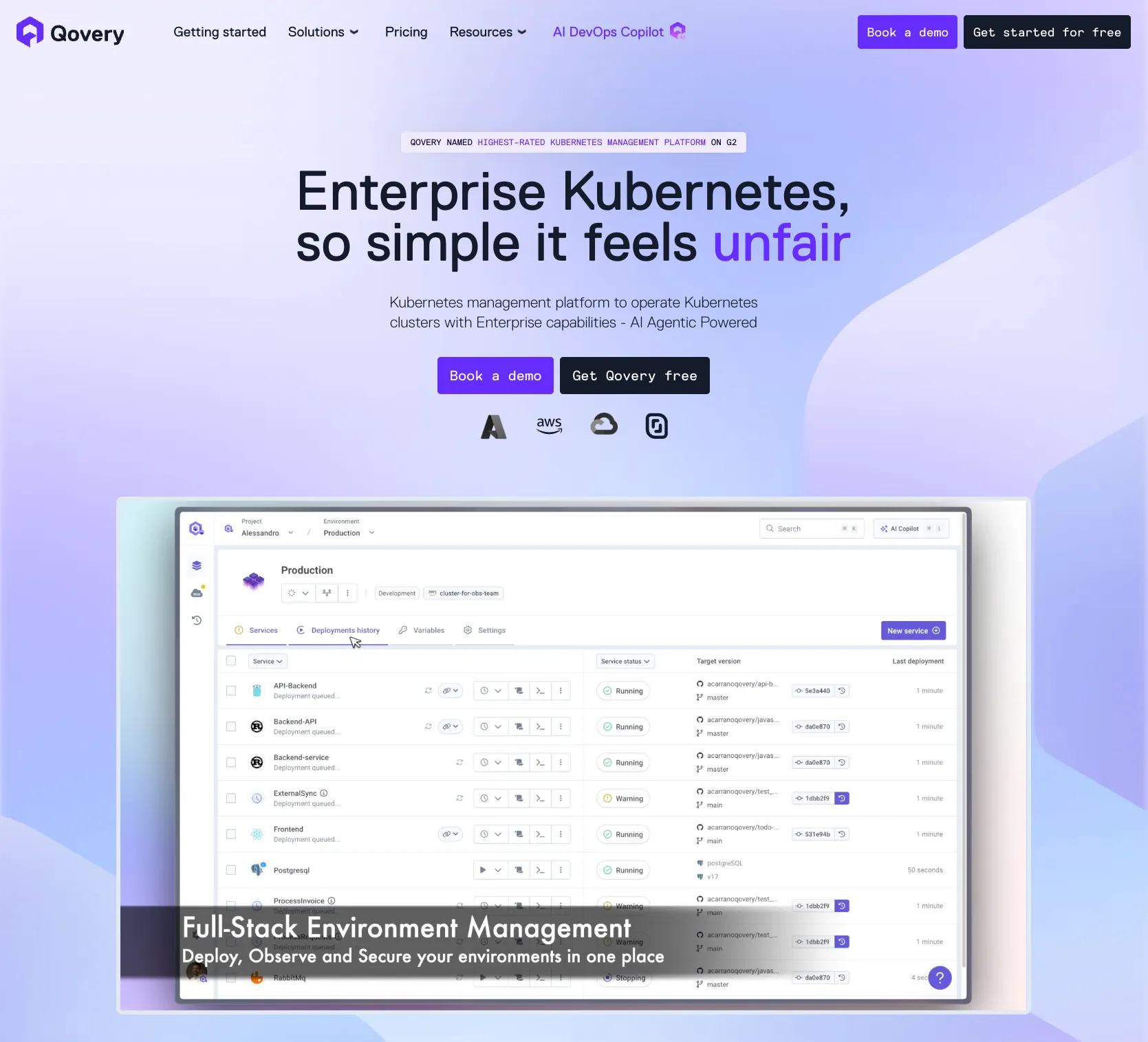
Qovery is the antithesis of the "heavy" legacy container platform. While Mirantis often focuses on managing the deep infrastructure layer, Qovery acts as a pure Kubernetes Management Platform that sits on top of your cloud (AWS, Azure, GCP).
It abstracts the complexity of Kubernetes, effectively giving your developers a self-service experience on your own infrastructure without the operational burden of a legacy control plane.
Pros:
Developer Autonomy: Engineers can deploy and debug applications without waiting for Ops.
Zero Maintenance: Delivered as a SaaS, so there is no management server to patch or upgrade.
Cons:
Abstraction Limits: Platform engineers cannot tweak the underlying Kubernetes control plane components (e.g., etcd flags) as easily as with Mirantis.
Cloud Dependency: Requires an underlying cloud provider; it does not provision bare metal servers from scratch.
2. SUSE Rancher
For teams that want to move away from Mirantis but keep deep administrative control, Rancher is the natural successor. It offers a centralized management plane that is strictly open-source and widely adopted.
Pros:
Vendor Neutral: Manages any Kubernetes distribution (EKS, AKS, GKE, RKE) equally well.
Massive Community: The largest open-source community for Kubernetes management ensures plenty of support and plugins.
Cons:
Resource Heavy: The management server itself is resource-intensive and requires careful architectural planning to avoid becoming a single point of failure.
Complexity: The UI exposes nearly every Kubernetes concept, which can be overwhelming for developers who aren't Kubernetes experts.
3. Red Hat OpenShift
If you chose Mirantis for its "Enterprise Support" and strict security, OpenShift is the most direct parallel. It provides a hardened, secure-by-default environment favored by government and banking sectors.
Pros:
Security First: Comes with strict security policies and integrated registry scanning out of the box.
Full PaaS Experience: Includes built-in CI/CD, monitoring, and developer tools, offering a complete "batteries included" platform.
Cons:
Vendor Lock-in: Highly opinionated workflows make it difficult to migrate workloads away from OpenShift later.
High Cost: Licensing fees are significant, often charged per core, making it one of the most expensive options on the market.
4. VMware Tanzu
For organizations running Mirantis on-premise on top of VMware, Tanzu is the logical consolidation play. It integrates Kubernetes directly into the vSphere hypervisor.
Pros:
Admin Familiarity: Allows vSphere administrators to manage Kubernetes using the same vCenter interface they use for VMs.
Integration: Seamlessly integrates with existing VMware networking (NSX) and storage (vSAN) investments.
Cons:
Ecosystem Island: Best suited only for existing VMware shops; it offers little value if you are moving toward a cloud-native or multi-cloud strategy.
Complexity: The product portfolio is vast and often confusing, with frequent rebranding causing implementation challenges.
Agents ship fast. Guardrails keep them safe.
Qovery ensures every agent action is scoped, audited, and policy-checked. Start deploying in under 10 minutes.
If Mirantis feels like "overkill" for your needs, Portainer is the remedy. It is a lightweight management UI that runs as a container and simplifies basic cluster operations.
Pros:
Simplicity: Extremely easy to install (one Docker command) and intuitively designed for non-experts.
Lightweight: Consumes negligible resources compared to the heavy management planes of Mirantis or Rancher.
Cons:
Limited Scale: Lacks the deep fleet management and policy enforcement features required for managing hundreds of enterprise clusters.
Basic Governance: RBAC and audit logging features are less granular than those found in enterprise-grade alternatives.
6. Amazon EKS / Azure AKS / Google GKE
The biggest competitor to Mirantis is simply "going native." By 2026, the managed Kubernetes offerings from the big cloud providers have become so robust that third-party management layers are often unnecessary.
Pros:
Lowest Overhead: The cloud provider manages the control plane, backups, and patching entirely.
Deep Integration: Native hooks into cloud services (ALB, IAM, KMS) offer better performance and security than overlay networks.
Cons:
Cloud Lock-in: Heavy reliance on proprietary add-ons makes it difficult to move workloads to a different cloud provider.
Hidden Costs: While the control plane is cheap, costs for NAT gateways, egress, and logs can spiral quickly without visibility.
7. Rafay
Rafay represents the next generation of operations platforms, focusing on automation and "fleet management" rather than just cluster administration.
Pros:
SaaS Delivery: Delivered as a service, meaning you never have to upgrade or patch the management platform itself.
Drift Detection: Excellent capabilities for ensuring configuration consistency across thousands of clusters.
Cons:
Learning Curve: The sophisticated policy and blueprinting engine requires time to master.
Overkill for Small Teams: The feature set is designed for large enterprises and may be too complex for teams with fewer than 10 clusters.
8. Spectro Cloud (Palette)
For Mirantis users managing distributed edge locations (retail, telco), Spectro Cloud offers a more modern, decentralized architecture.
Pros:
Full Stack Profiles: Manages the OS, Kubernetes, and application layers as a single atomic unit, ideal for edge devices.
Decentralized: Clusters can continue to operate and self-heal even if they lose connection to the central management plane.
Cons:
Market Maturity: A newer player with a smaller community ecosystem compared to Rancher or OpenShift.
Pricing: Can be expensive for smaller deployments, as it targets high-value enterprise edge use cases.
9. Platform9
Platform9 offers a similar promise to Mirantis (managed Kubernetes on any infrastructure) but delivers it as a pure SaaS with an SLA.
Pros:
Operational SLA: They guarantee the uptime of your control plane, effectively acting as an extension of your Ops team.
Works Anywhere: Provides a consistent "cloud-like" experience on your existing bare metal servers.
Cons:
Connectivity Requirement: As a SaaS-managed control plane, it requires persistent connectivity to the Platform9 cloud to function fully.
External Dependency: You are reliant on a third-party vendor for the stability of your control plane.
10. Canonical (Charmed Kubernetes)
For teams running Mirantis on bare metal or OpenStack, Canonical is the direct open-source competitor.
Pros:
Model-Driven Ops: Uses "Juju" charms to automate complex operational tasks like upgrades and integrations.
Cost Effective: Generally offers a more competitive pricing model for large bare-metal estates than Mirantis.
Cons:
Niche Tooling: Requires learning Juju and the charm ecosystem, which are not standard in the broader Kubernetes world.
Steep Learning Curve: Setting up and debugging Charmed Kubernetes requires significant specialized knowledge.
Conclusion
Leaving Mirantis is often a choice to embrace modern, cloud-native workflows. If your goal is to empower developers and move fast, Qovery provides the best bridge to the future.
Melanie leads content at Qovery. She covers platform engineering trends, Kubernetes operations, FinOps, and the tools that help engineering teams ship faster.
Next step
Agents ship fast. Guardrails keep them safe.
Qovery ensures every agent action is scoped, audited, and policy-checked. Start deploying in under 10 minutes.