Atmosly alternatives: The best tools for scaling teams
Hit the ceiling with Atmosly? Discover the top 10 Kubernetes management alternatives for 2026. From Qovery’s developer-centric platform to Rancher’s operations control, find the right tool to scale your infrastructure.
Visual vs. GitOps: While Atmosly excels at visual, "no-code" pipelines, mature DevOps teams often hit a ceiling with its abstractions. Scaling requires GitOps-native tools that respect standard engineering workflows.
The "Black Box" Problem: Senior engineers often find Atmosly’s AI and automated wizards obscure the underlying Kubernetes primitives, making debugging complex failures difficult.
Qovery as the Logical Step Up: Qovery offers a similar "Developer Experience" to Atmosly but retains full access to the underlying cluster, making it the preferred choice for enterprises that need both speed and control.
Atmosly has gained traction by promising an "AI-first" and highly visual approach to Kubernetes. For early-stage startups or teams without a dedicated DevOps engineer, its "drag-and-drop" CI/CD builders and chatbots are a game-changer.
However, as engineering organizations mature (50+ employees), the requirements shift. "Ease of access" becomes less important than reliability, reproducibility, and standard compliance.
Platform Architects and CTOs often find that "No-Code" abstractions become a bottleneck. When a production cluster is acting up, you don't want an AI chatbot; you want direct, transparent access to your infrastructure. You need tools that adhere to GitOps standards, where configuration lives in code, not in a proprietary dashboard.
If you are looking for a platform that prioritizes engineering rigor over visual flair, here are the top 10 alternatives to Atmosly.
Platform
Category
Target Audience
Why it beats Atmosly
Qovery Top Pick
IDP / App Mgmt
Scaling Engineering Teams (10-500+)
Offers Atmosly-like "Developer Experience" but retains full GitOps control and auditable infrastructure.
Rancher
Cluster Ops
SysAdmins & Ops Leads
Superior for managing multi-cluster fleets and hybrid (on-prem + cloud) environments.
Humanitec
Orchestrator
Platform Engineers
Uses the "Score" standard for workload definitions, preventing vendor lock-in.
Release
EaaS
QA & Enterprise Testing
Specialized in complex data seeding for ephemeral environments.
Rafay
K8s Ops
Large Enterprises (Fortune 500)
Deep governance & compliance features for zero-trust fleet management.
Spectro Cloud
Full Stack
Edge / Bare Metal Teams
Manages the entire stack (OS + K8s) tailored for edge computing and private data centers.
Portainer
Visual UI
Small Teams / Internal Tools
Much lighter footprint; installs in minutes for simple visual management.
Argonaut
Infra Auto
Early-Stage Startups
Better "Day 0" wizards for setting up AWS/GCP accounts from scratch.
Loft
Virtualization
Platform Teams
Provides virtual clusters for hard isolation between developers without cost overhead.
Okteto
Remote Dev
Individual Developers
Moves the coding environment into the cluster, eliminating local resource bottlenecks.
1. Qovery
Best For: Teams wanting the ease of Atmosly but with the engineering rigor of a standard Kubernetes setup.
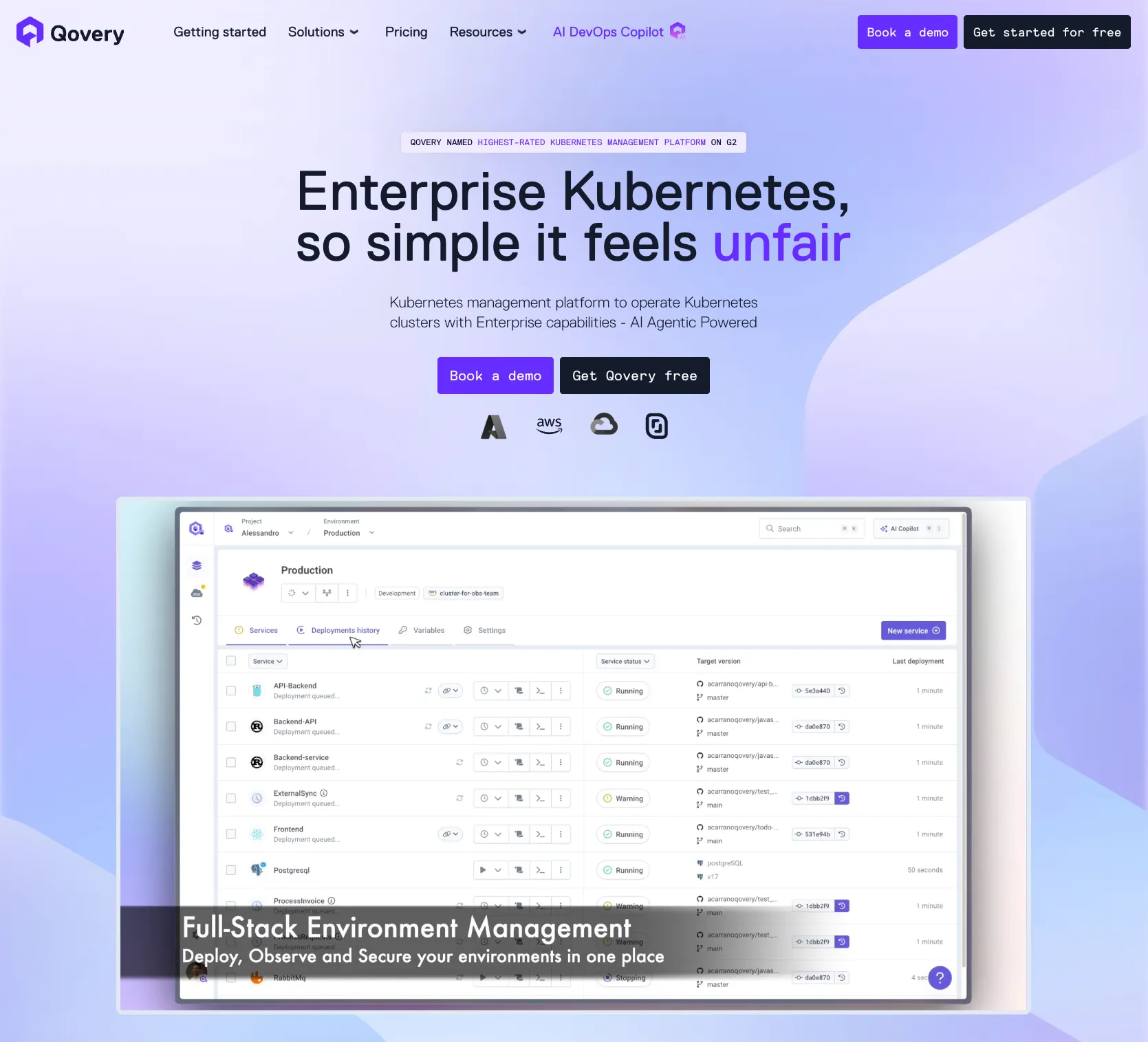
Qovery is the closest direct alternative to Atmosly in terms of "Developer Experience," but it takes a fundamentally different architectural approach. While Atmosly tries to hide Kubernetes behind a visual abstraction, Qovery tames it.
Qovery connects to your Git repository and deploys directly to your Kubernetes cluster (EKS, GKE, AKS) using standard Helm charts and Terraform. It provides a "Golden Path" for developers to self-serve infrastructure (like spinning up ephemeral preview environments) without Ops tickets, but it never blocks the Ops team from dropping down into kubectl to debug or optimize.
Pros:
GitOps Native: Unlike Atmosly’s visual builders, Qovery treats configuration as code. Your infrastructure state is version-controlled, reproducible, and audit-ready (SOC2/HIPAA).
Production-Grade Reliability: Qovery is designed for "Day 2" operations. It handles complex ingress rules, certificate management, and resource scaling automatically, but transparently.
Ephemeral Environments: Best-in-class support for spinning up full-stack preview environments for every Pull Request, including database cloning.
Cons:
Opinionated Workflows: To achieve its ease of use, Qovery makes architectural decisions for you (e.g., how Ingress or Cert-Manager is configured). While efficient for 95% of use cases, porting highly non-standard legacy configurations may require adapting to "The Qovery Way."
What Users Are Saying:
Qovery is currently rated 4.7/5 on G2, with users specifically praising its Ephemeral Environments and AWS integration.
Best For: Ops teams managing multiple clusters across hybrid environments (On-prem + Cloud).
If Atmosly is "too soft" for your needs, Rancher is the "hard" alternative. It is the industry standard for pure Kubernetes cluster management. It doesn't focus on the "Developer Experience" of deploying an app; it focuses on the "Operator Experience" of keeping the cluster alive.
Pros:
Multi-Cluster Management: Manage EKS, GKE, and bare-metal clusters from a single pane of glass.
Security Policy: Centralized RBAC and security policies that apply across your entire fleet.
Cons:
High Complexity: It exposes the full complexity of Kubernetes. It is not a tool for developers; it is a tool for the people who manage the developers' platform.
3. Humanitec
Best For: Platform Engineers building a bespoke IDP from scratch.
Humanitec is an "Orchestrator." It allows Ops teams to define "Resource Definitions" (e.g., how a Postgres DB is provisioned via Terraform) and lets developers request them via a standardized file (Score). It is less of a "product" than Atmosly and more of a framework.
Pros:
Standardization: Uses the "Score" open standard for workload specification, preventing vendor lock-in.
Flexibility: Can orchestrate any resource (RDS, S3, DNS) if you write the drivers for it.
Cons:
High Setup Effort: Requires a dedicated Platform Engineering team to configure and maintain the "glue" code.
4. Release (Release.com)
Best For: Enterprises focused specifically on complex testing environments and data seeding.
Release doubles down on one specific Atmosly feature: Preview Environments. It excels at taking complex docker-compose files and turning them into full Kubernetes environments for testing.
Pros:
Data Seeding: Powerful native tools for sanitizing production data and injecting it into ephemeral test environments.
Isolation: strict namespace isolation for every PR environment.
Cons:
Narrow Scope: It handles environments well but is not a full infrastructure management solution for production clusters.
🚀 Case Study: From "Days" to "30 Minutes"
Nextools, a high-performance e-commerce startup, struggled with multi-cloud complexity across AWS and GCP. By switching to Qovery, they eliminated the need for dedicated DevOps specialists and achieved:
Best For: Large enterprises requiring strict governance and fleet management.
Rafay is a heavy-duty alternative to Rancher. It focuses on the "lifecycle management" of Kubernetes clusters, offering deep automation for upgrades, blueprints, and security policies across hundreds of clusters.
Pros:
Zero-Trust Access: deeply integrated features for secure developer access to clusters without VPNs.
Fleet Automation: Apply a standard "blueprint" (monitoring + logging + security) to 50 clusters at once.
Cons:
Overkill for Mid-Market: Designed for the Fortune 500; likely too complex and expensive for a 50-person engineering team.
6. Spectro Cloud (Palette)
Best For: Managing "bare metal" and edge Kubernetes deployments alongside cloud.
Spectro Cloud’s "Palette" platform treats the entire Kubernetes stack (OS, K8s layer, add-ons) as a single profile. It is vastly more powerful than Atmosly for teams running K8s in difficult places (like edge devices or private data centers).
Pros:
Full Stack Control: Manages the OS and the K8s layer together, preventing compatibility drift.
Edge Capabilities: Excellent for decentralized infrastructure.
Cons:
Ops-Heavy: Like Rancher, this is a tool for the infrastructure team, not the application developers.
7. Portainer
Best For: Smaller teams or internal tools where "Lightweight" is the priority.
Portainer is the "light" alternative. If Atmosly feels too opinionated, and Rancher feels too heavy, Portainer is the middle ground. It provides a visual UI for your cluster without adding a massive amount of complexity.
Pros:
Simplicity: Can be installed in minutes; very low resource footprint.
Visual Management: Excellent for visualizing namespaces, volumes, and basic deployments.
Cons:
Lack of Governance: Lacks the deep policy-as-code and audit features required by larger enterprises.
8. Argonaut
Best For: Startups needing a "DevOps in a Box" setup for AWS/GCP.
Argonaut is similar to Qovery but focuses heavily on the initial infrastructure provisioning (creating the VPCs and clusters). It bridges the gap between Terraform (hard) and Heroku (rigid).
Pros:
Day 0 Setup: Excellent wizards for setting up a brand-new cloud account with best practices.
Cost Management: Built-in tools to track Kubernetes spend.
Cons:
Maturity: A newer player with fewer integrations than Qovery or Rancher.
9. Loft (vCluster)
Best For: Platform teams who want to give every developer their own "Virtual Cluster."
Loft is not a direct Atmosly competitor, but an alternative way to solve the "Developer Access" problem. Instead of a visual dashboard, Loft lets you spin up "Virtual Clusters" inside a real cluster.
Pros:
Hard Isolation: Developers get Admin access to their virtual cluster without breaking the real cluster.
Cost Efficiency: Cheaper than spinning up real clusters for every team.
Cons:
Requires Tooling: You still need a way to deploy apps into the vClusters (e.g., ArgoCD or Qovery).
10. Okteto
Best For: Solving the "Inner Loop" (coding phase).
Okteto moves the development environment directly into the cluster. While Atmosly focuses on "Deploying," Okteto focuses on "Coding" inside Kubernetes to eliminate local resource bottlenecks.
Pros:
Instant Sync: Code changes on your laptop are instantly synced to the container in the cluster.
No "Works on My Machine": Dev environment is identical to prod.
Cons:
Niche Focus: It’s a development tool, not a production management platform.
Agents ship fast. Guardrails keep them safe.
Qovery ensures every agent action is scoped, audited, and policy-checked. Start deploying in under 10 minutes.
The Situation: A Fintech startup has successfully graduated from Heroku to AWS. They now have 40 engineers and 150 microservices running on EKS.
The Problem: The "Ops" team is drowning in tickets. Developers are scared to deploy because the Terraform scripts are brittle.
Why they leave Atmosly: They initially tried Atmosly for the "easy visual builder." However, as compliance requirements (SOC2) grew, the Ops team needed to audit exactly how secrets were injected. Atmosly’s "AI magic" became a black box that auditors couldn't verify.
Why they choose Qovery: Qovery allowed the Platform Architect to define a standard helm chart for all services. Developers got a simple UI to deploy, but under the hood, everything was standard, auditable Kubernetes code. The "magic" was removed, but the velocity remained.
Conclusion: Control vs. Magic
The choice to move away from Atmosly usually comes down to a need for control.
For pure Operations control: Choose Rancher or Rafay.
For specific testing environments: Choose Release.
For the perfect balance of Developer Experience and Engineering Standards: Choose Qovery.
Melanie leads content at Qovery. She covers platform engineering trends, Kubernetes operations, FinOps, and the tools that help engineering teams ship faster.
Next step
Agents ship fast. Guardrails keep them safe.
Qovery ensures every agent action is scoped, audited, and policy-checked. Start deploying in under 10 minutes.