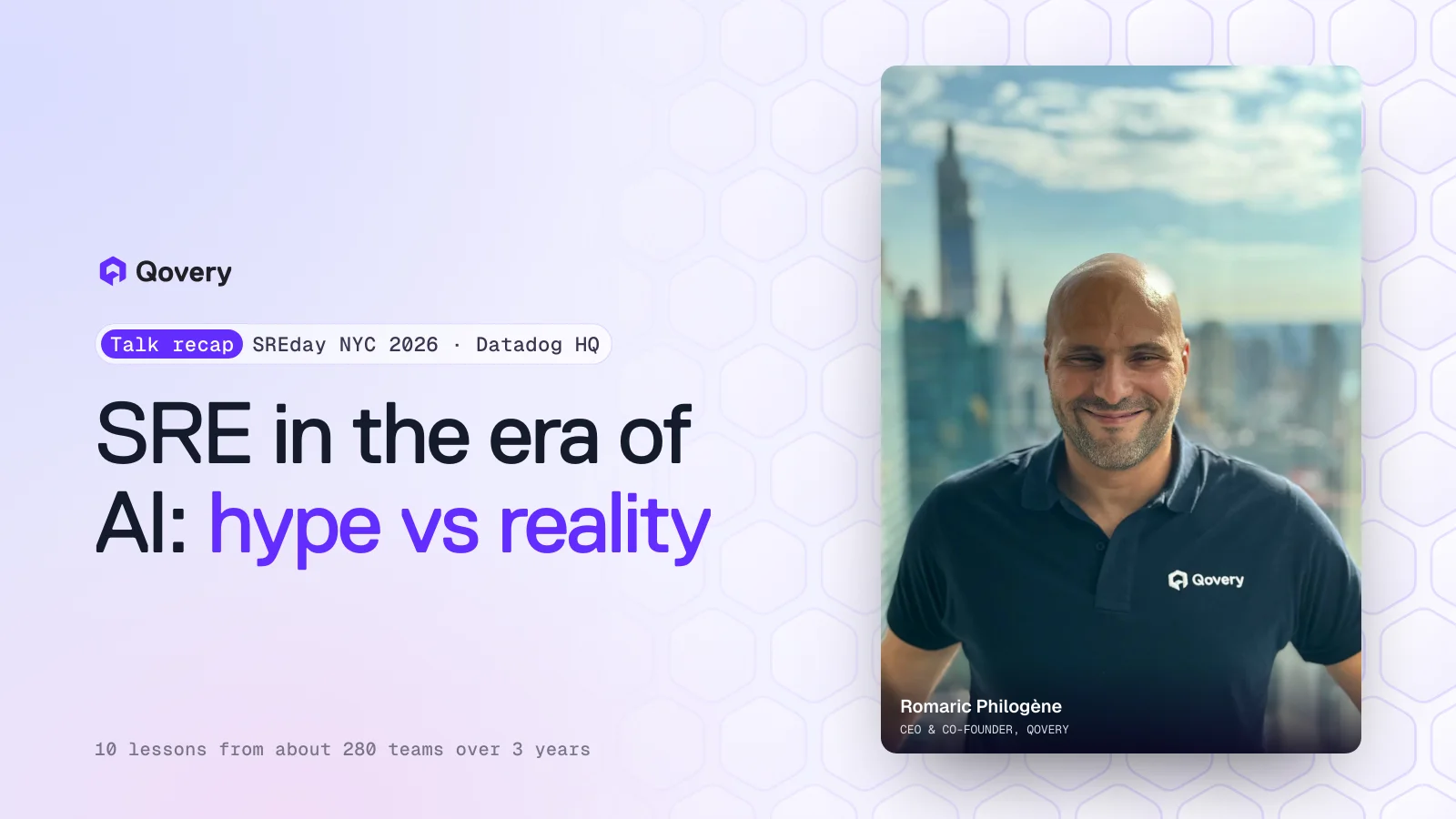
SRE in the Era of AI: Hype vs Reality, My SREday NYC Talk at Datadog HQ
At SREday NYC, hosted at Datadog HQ, I asked a room of SREs to vote hype or reality on ten claims about AI and their job. Here are the ten lessons, backed by about 400 conversations with about 280 teams over three years, and what to do about them on Monday.
The SRE job did not change. Keep production up, make change safe, keep cost in check, keep it secure, hold the knowledge. 123 of the teams we talked to described work that AI has not changed, against 92 that said AI changed something.
Humans stay in the loop on purpose. Of 91 teams that talked about agents, 2 let them change production with no human. About 20 insisted on a human gate. The teams that use AI the most are the strictest about approvals.
AI helps most at the start of an incident. 21 teams said AI changed how they respond to incidents, mostly with triage before a human is paged. Agents that try to fix an incident alone in one shot got dropped.
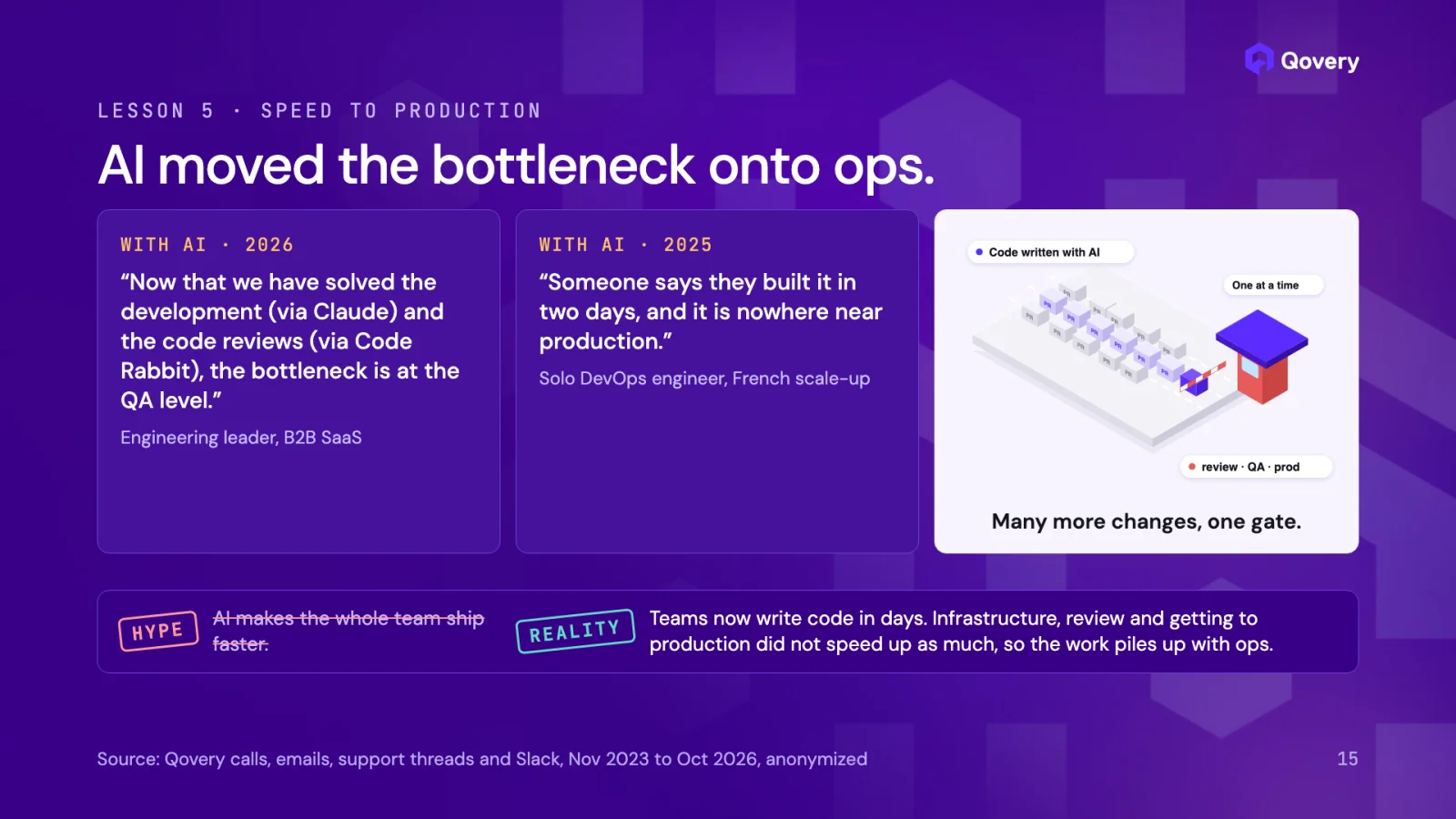
The bottleneck moved onto ops. Code gets written in days. Review, QA, infrastructure and the path to production did not speed up as much.
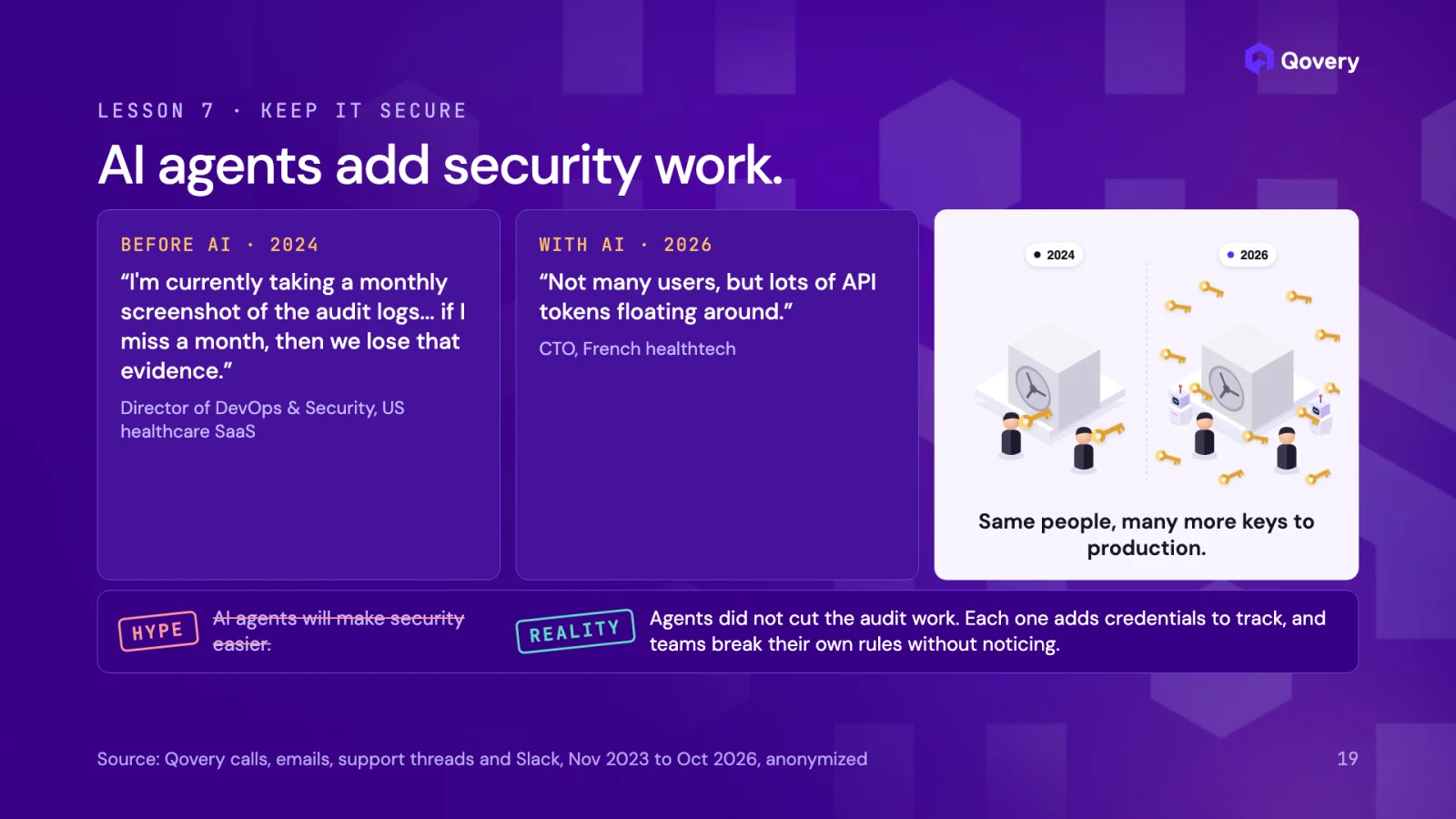
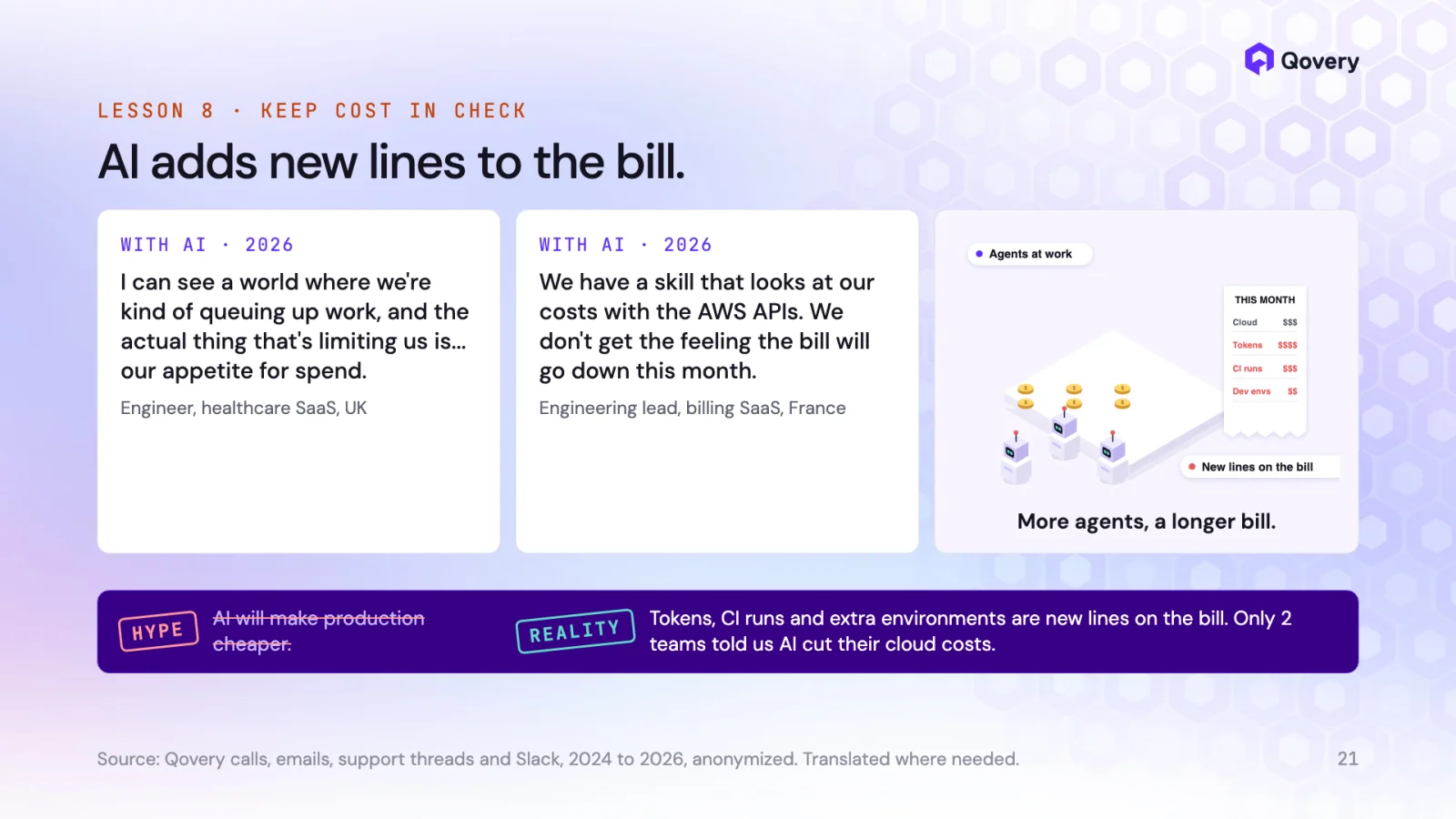
Agents add security work and new lines to the bill. 21 teams told us about new keys, tokens and access to track. 14 said AI added costs; 2 said it cut their cloud bill.
Three things to do on Monday: write everything down, gate every write to production, and track every agent action with its credentials and its cost.
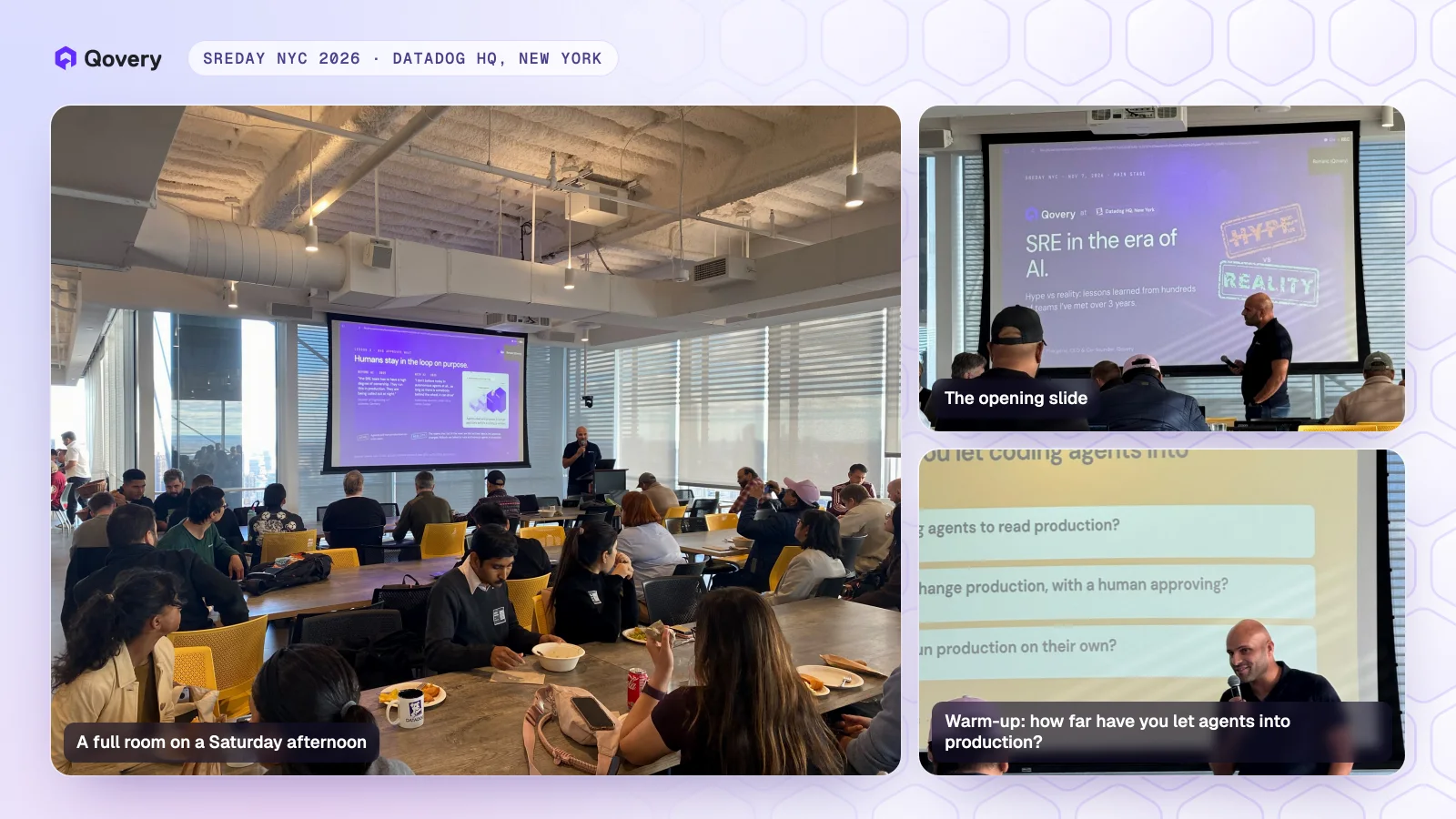
On Saturday, November 7, I spoke on the main stage of SREday NYC, hosted at Datadog's headquarters in New York. My slot was at 2 PM. The room was full of people who carry a pager: SREs, platform engineers, DevOps leads.
SREday NYC at Datadog HQ: a full room, the opening slide, and the warm-up question on screen
The title was "SRE in the era of AI: hype vs reality". I did not want to give one more talk with my opinion on AI. Everybody has one. So I went back to what the people running production told us, and I turned the talk into a quiz: ten questions, and for each one the room votes, hype or reality, before I show what the data says.
This post is the written version, with the slides, the numbers and the photos from the day.
How the talk was built
Qovery is a fully remote company, so every conversation we have with a customer or a prospect leaves a written trace: call transcripts, emails, support tickets and Slack threads.
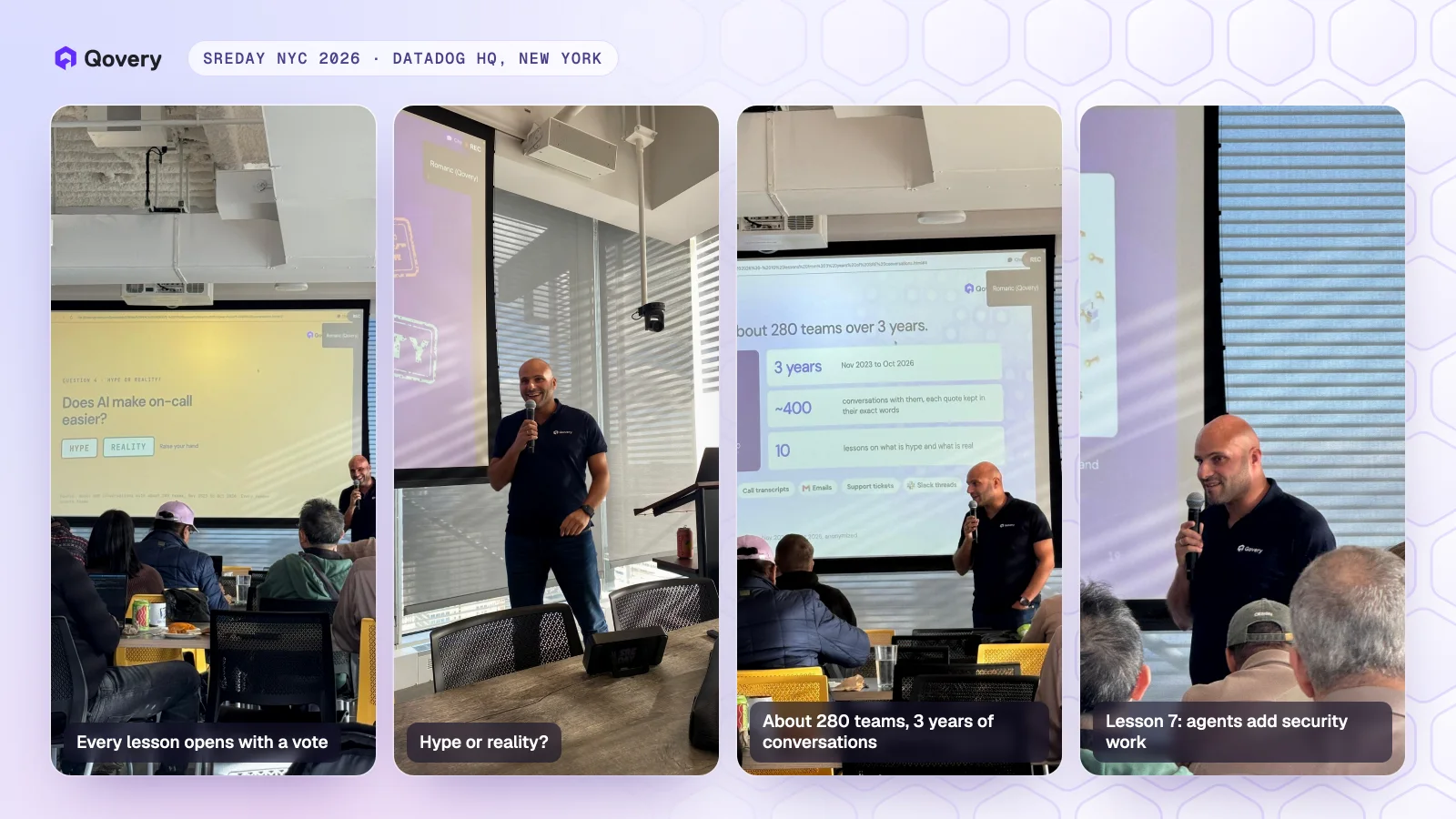
I went back through three years of it, from November 2023 to October 2026. That is about 400 conversations with about 280 teams of SREs, DevOps and platform engineers. From those, we pulled every passage where someone described how they run production, about 1,100 of them, each kept in the speaker's exact words. We tagged each one by theme (incidents, approvals, cost, security, knowledge, toil), matched them by keyword, then checked every match by hand. Every number in this post counts distinct teams, not messages, so read them as rounded figures.
Names and companies are removed. When a teammate relayed what a customer told them, I say so and leave out the quotation marks.
One caveat: we only started recording calls in September 2025, so the "before AI" side comes from emails, tickets and Slack.
The format: a quiz
Each lesson opened with a question on screen and two stamps, HYPE and REALITY. The room voted with raised hands, then one click dropped the answer with the number of teams behind it. Then came the evidence: a quote from before AI, a quote from 2026, and what the conversations showed.
The room played along from the first question. Hands went up on every vote, and several people shared what they see in their own teams, during the talk and after it.
The quiz format: a hype or reality question on screen, the room voting, and the data behind each answer
The warm-up
Before the first question, I asked the room three things with a show of hands:
Who uses coding agents to read production? Logs, metrics, audits.
Who lets them change production, with a human approving?
Who lets them run production on their own, with no human in the loop?
Ask your own team the same three questions. Lesson 3 shows what three years of conversations say about the answers.
Lesson 1: The job never changed
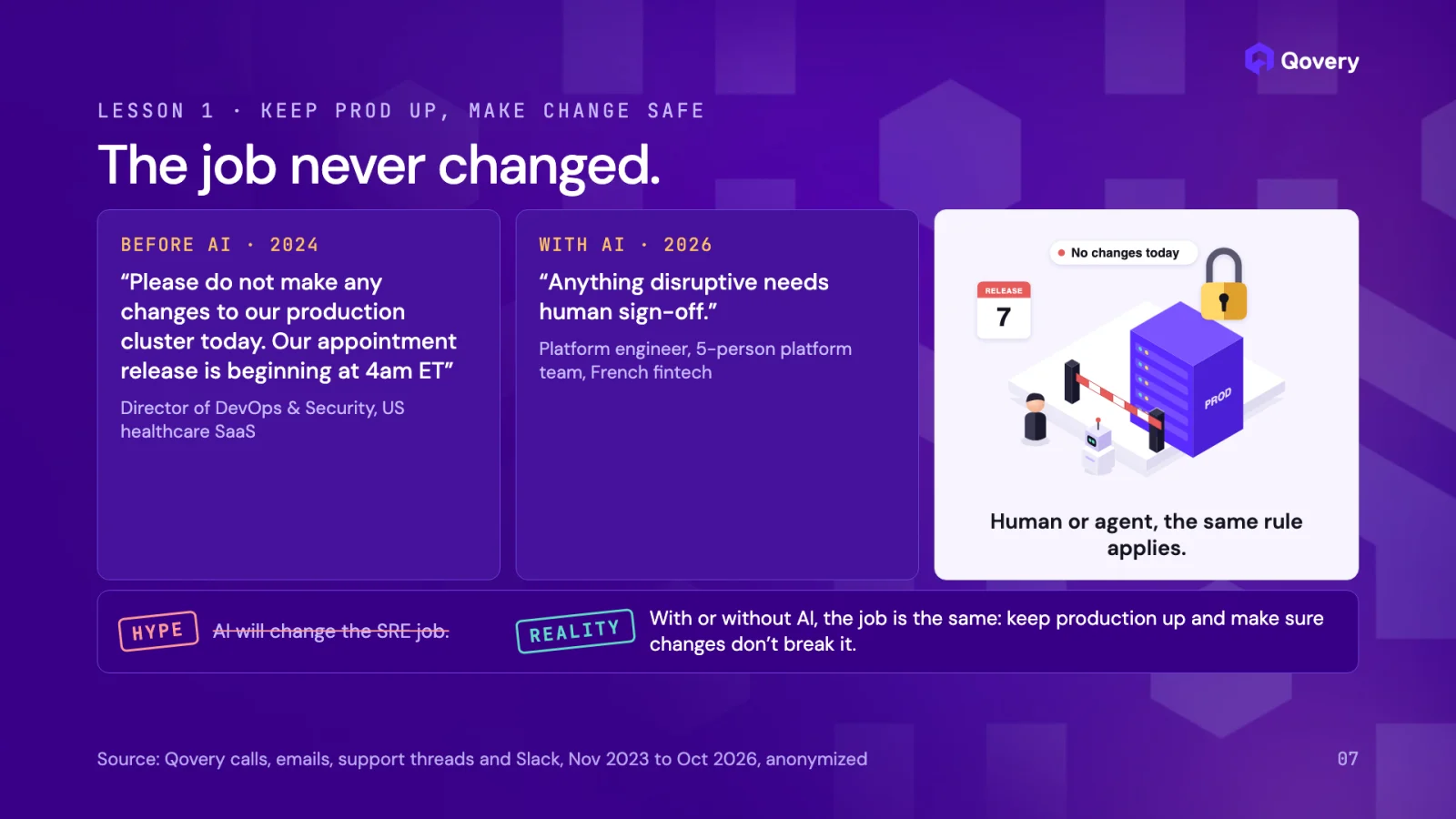
Question: Did AI change the SRE job? Verdict: hype.
123 teams described work that AI has not changed. 92 said AI changed something.
Lesson 1 slide: The job never changed
The two quotes on the slide are two years apart and state the same rule. With or without AI, the job is to keep production up and make sure changes don't break it. The rituals are older than the tools: freeze windows, a manual lock the night before a release, root cause found before Thursday's rollout. In 2026 the actor typing the command changed. The sign-off rule did not.
A head of platform at a Nordic payments company told us: "We're a financial based company. If we can't process transactions for our customers, we are done."
Lesson 2: The single point of failure is a person
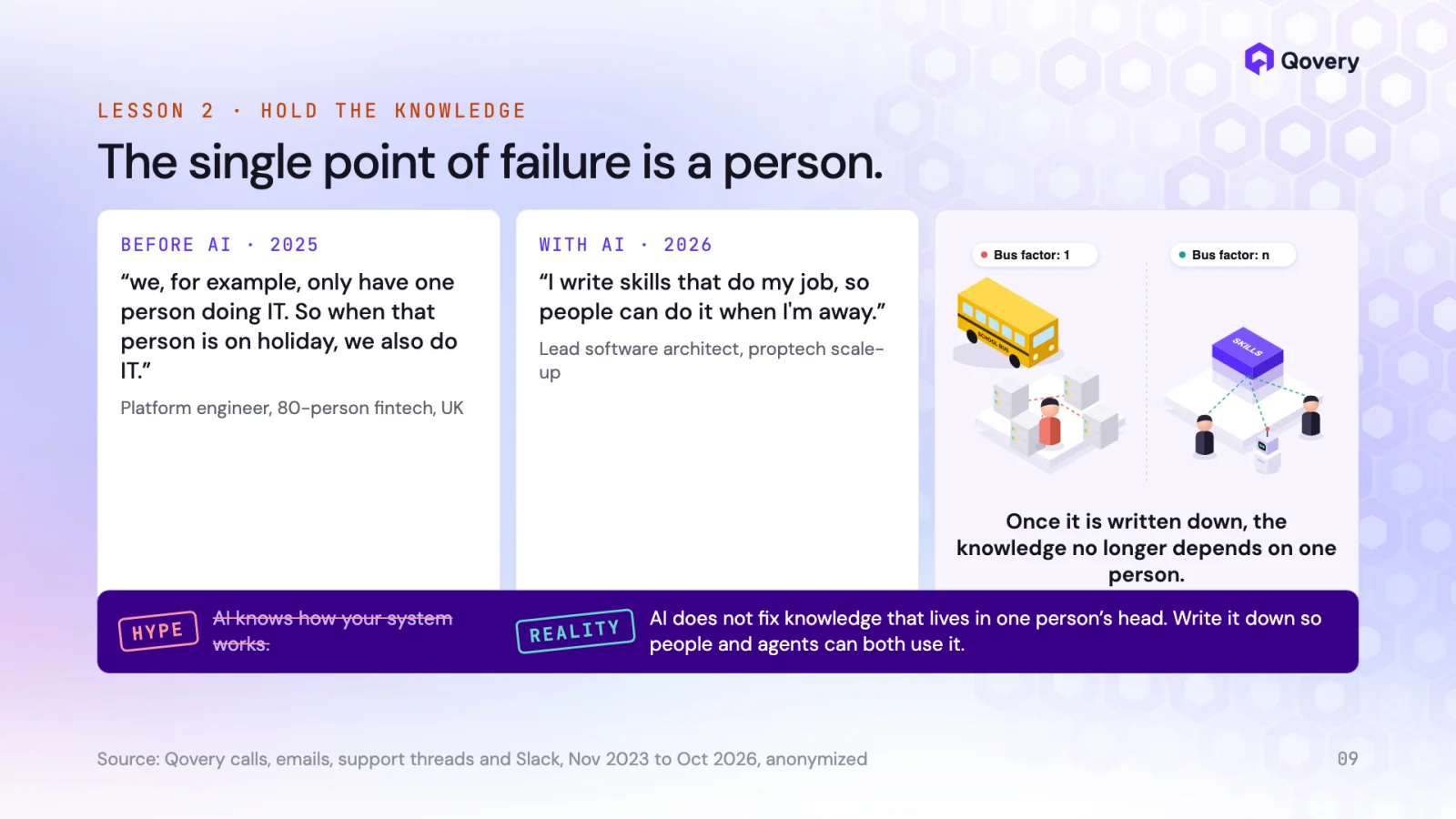
Question: Is the single point of failure still a person? Verdict: reality.
At least 13 teams told us one person holds all their infrastructure knowledge.
Lesson 2 slide: The single point of failure is a person
Before AI, infrastructure knowledge lived in one or two heads. When they left, the team froze. One insurtech stopped touching its Karpenter setup in 2026 because both people who built it had left.
AI does not know how your system works. The useful question is where that knowledge is written down, so people and agents can both use it. The proptech architect on the slide also told us: "Your source of truth is no longer the code, it's the docs."
Lesson 3: Humans stay in the loop on purpose
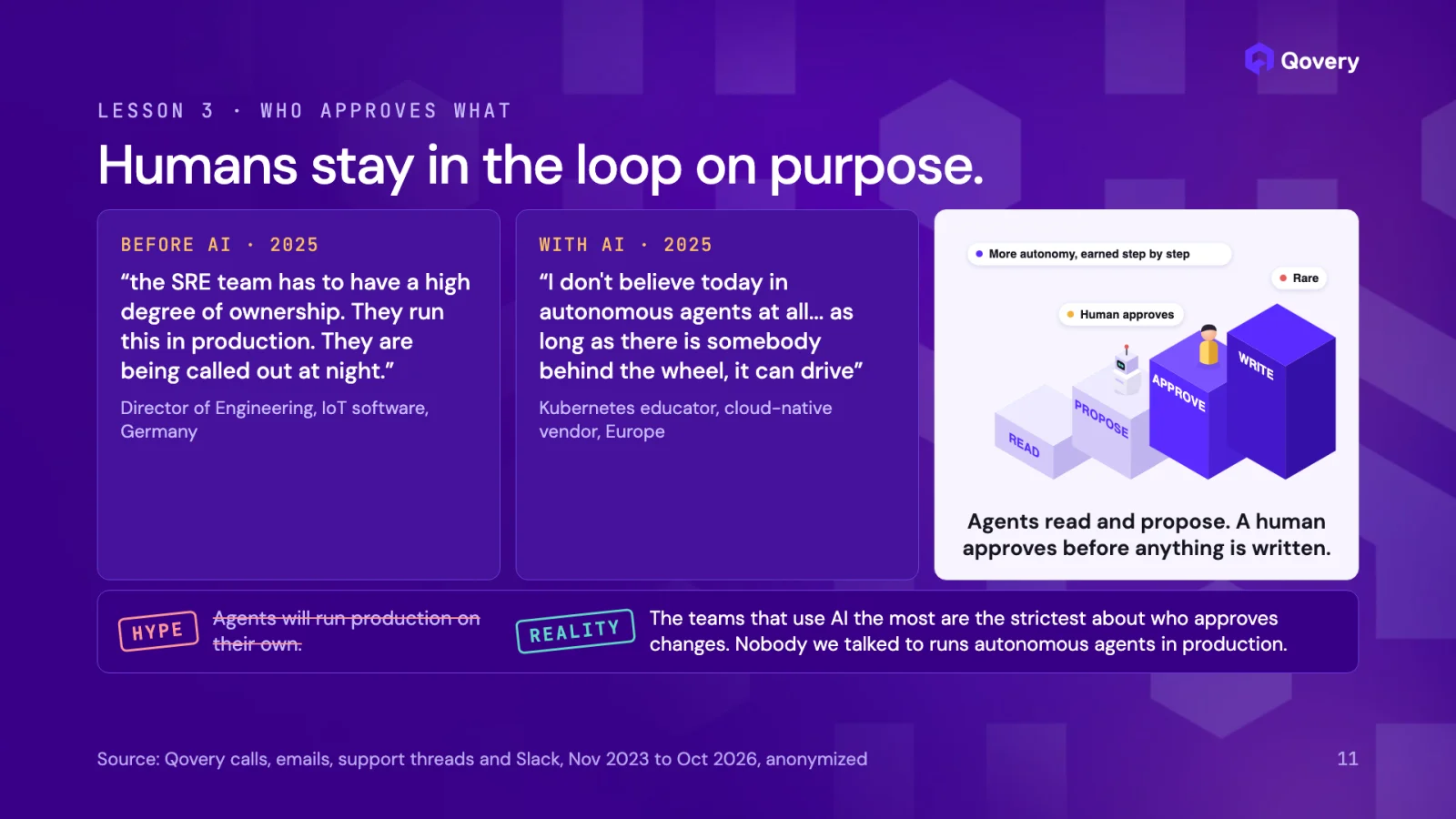
Question: Do most teams let agents run production on their own? Verdict: hype.
Out of 91 teams that talked about agents, 2 let them change production with no human. About 20 insisted on a human gate.
Lesson 3 slide: Humans stay in the loop on purpose
The senior people we talked to do not want full autonomy, now or later. We heard it from a head of security who will never let a chatbot spin up environments, a senior engineer who will never accept AI-generated commands blindly, and a regulated fintech that must put a human stamp on changes by law. A platform and security leader at a global bank told us: "So you're not gonna give agents, like, free rein to access everything."
The pattern is a ladder. Agents read and propose. A human approves before anything is written. The teams that use AI the most are the strictest about who approves changes.
Lesson 4: AI makes on-call easier, starting with triage
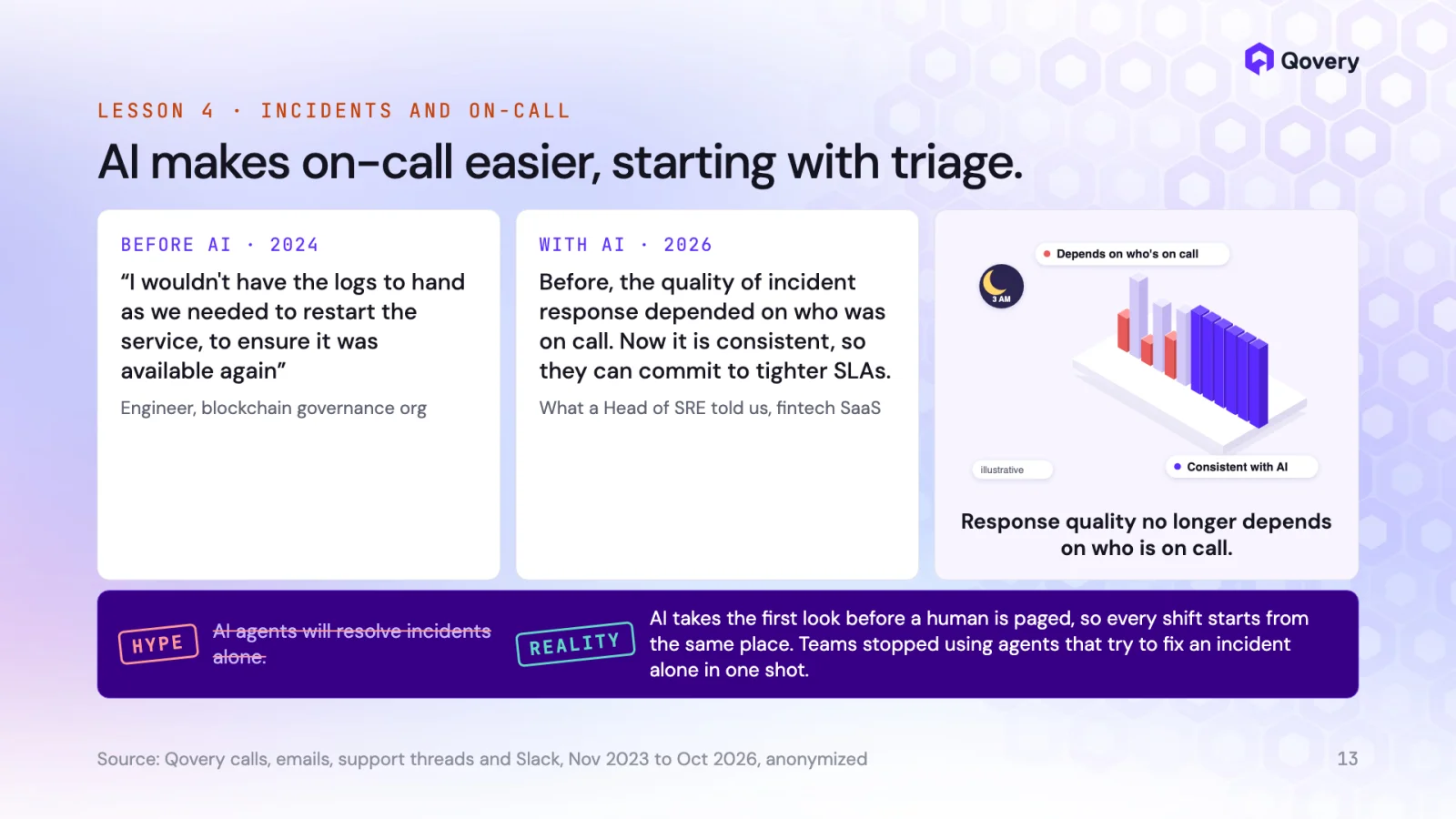
Question: Does AI make on-call easier? Verdict: reality.
21 of the 76 teams that talked about incidents say AI changed how they respond. Mostly, it takes the first look before a human is paged.
Lesson 4 slide: AI makes on-call easier, starting with triage
A Head of SRE at a fintech SaaS told us that the quality of their incident response used to depend on who was on call. Now it is consistent, so they can commit to tighter SLAs. With 180 apps and 10 people, humans only ever covered the critical ones. AI now covers the long tail. And the first question everyone asks is still the old one: why did my last build fail?
The hype version is the agent that resolves incidents alone. Teams tried it and stopped. A US health-tech team told us most incidents take several rounds of back and forth, so their engineers dropped the AI incident agent and iterated in their own Claude session instead.
Let agents read production. Keep humans on the writes.
Qovery runs Kubernetes in your own cloud account, with audit logs of every change and API tokens you can scope down to exactly what an agent needs.
Question: Did AI make the whole team ship faster? Verdict: hype.
9 teams said the bottleneck moved past coding to review, QA or infrastructure. Only 1 said it had not.
Lesson 5 slide: AI moved the bottleneck onto ops
An ad-tech principal engineer called it human lag: code in a day or two, infrastructure still takes several days. A regulated fintech calls it the productivity wall: pull requests nobody wants to read, so they get reviewed lightly. That last one is the dangerous version of this lesson.
Platform work was already the queue nobody timeboxed. A UK head of DevOps told us in 2024: "Platform work... There are no timelines for this as its marked as platform improvement for us, while the product work is timeboxed." AI multiplied the number of changes waiting at that gate.
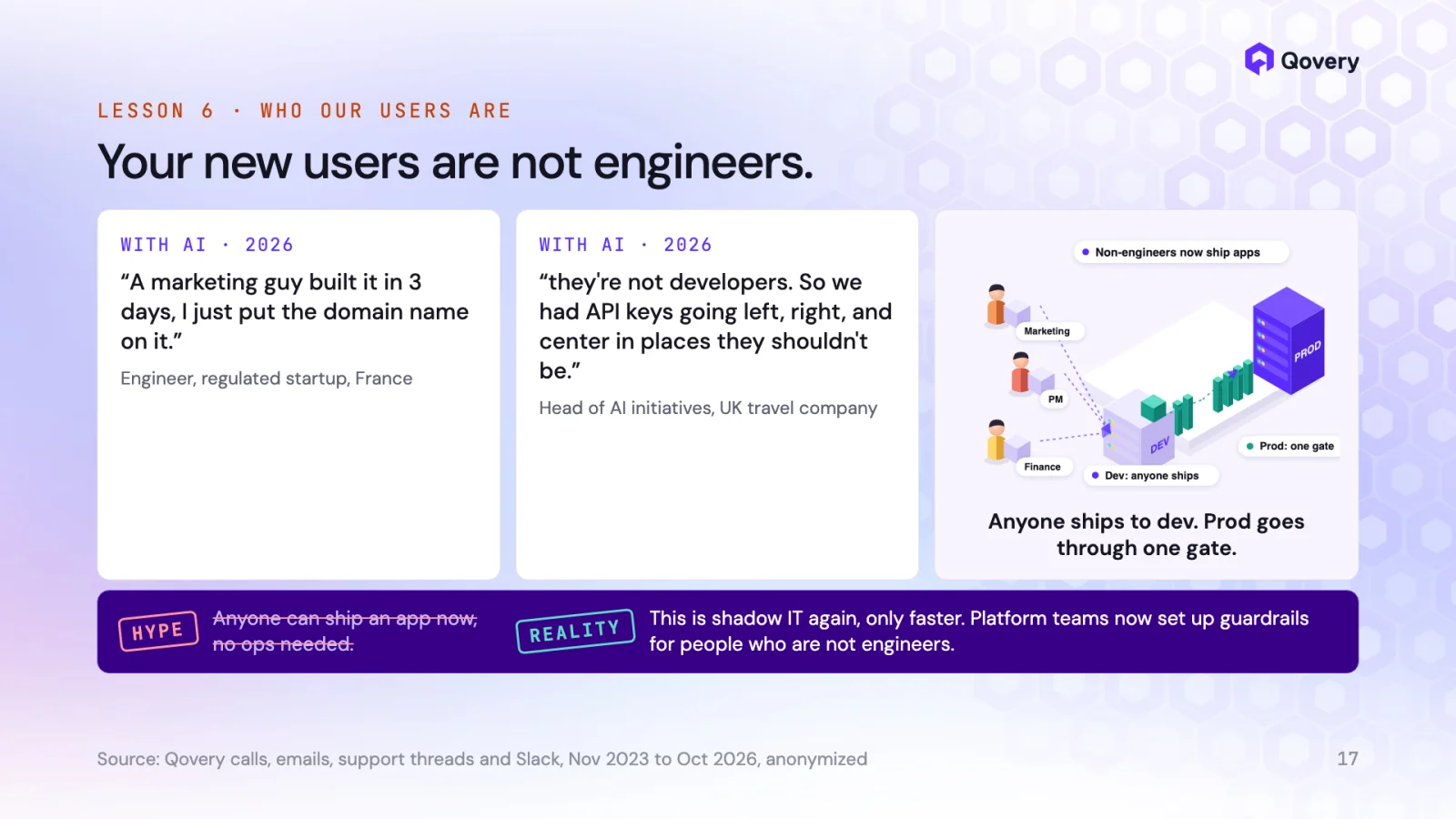
Lesson 6: Your new users are not engineers
Question: Do people outside engineering now ship apps to production? Verdict: reality.
18 teams told us non-engineers now build apps with AI and want them in production.
Lesson 6 slide: Your new users are not engineers
Marketers, product managers and analysts now build apps and want a URL. This is shadow IT again, only faster. Today the guardrail is often an engineering manager gatekeeping production by hand. One staff SRE told us that the experience for non-developers decided their platform choice, because their main use case is non-developers shipping vibe-coded apps.
The answer we heard most: anyone can ship to a dev environment, and production goes through one gate. A CTO at a French insurance group told us: "without process, AI has nothing to hold on to."
Lesson 7: AI agents add security work
Question: Do AI agents make security easier? Verdict: hype.
21 teams told us agents brought new security work: more keys and tokens to track, more access to limit.
Lesson 7 slide: AI agents add security work
Least privilege, audit trails and secrets were the dull core of the job long before AI. Agents did not cut that work. Each one adds credentials to track, and teams break their own rules without noticing. One company has an internal rule against using Claude in production, and people use it anyway. A software vendor blocked Claude Code entirely for that reason. Another team is not worried yet, because they have not had an incident yet.
A platform engineer at a drone logistics company described the right reflex: "I want to ensure that that agent has reduced capability."
Lesson 8: AI adds new lines to the bill
Question: Does AI make running production cheaper? Verdict: hype.
14 teams told us AI added new costs: tokens, CI runs, extra environments. Only 2 said it cut their cloud bill.
Lesson 8 slide: AI adds new lines to the bill
The stories on the cost side: one team burned EUR 5,000 of tokens in a single day. Another said a useful agent costs close to a salary. Pull request volume from agents made one team's CI cost more than its production. Agents that run forever. Vibe-coded apps that nobody shuts down.
The two savings stories were real: an agent that cleared out old infrastructure and cut the bill by 8%, and an AI right-sizing tool. Another team's AI right-sizing had to be rolled back the next day.
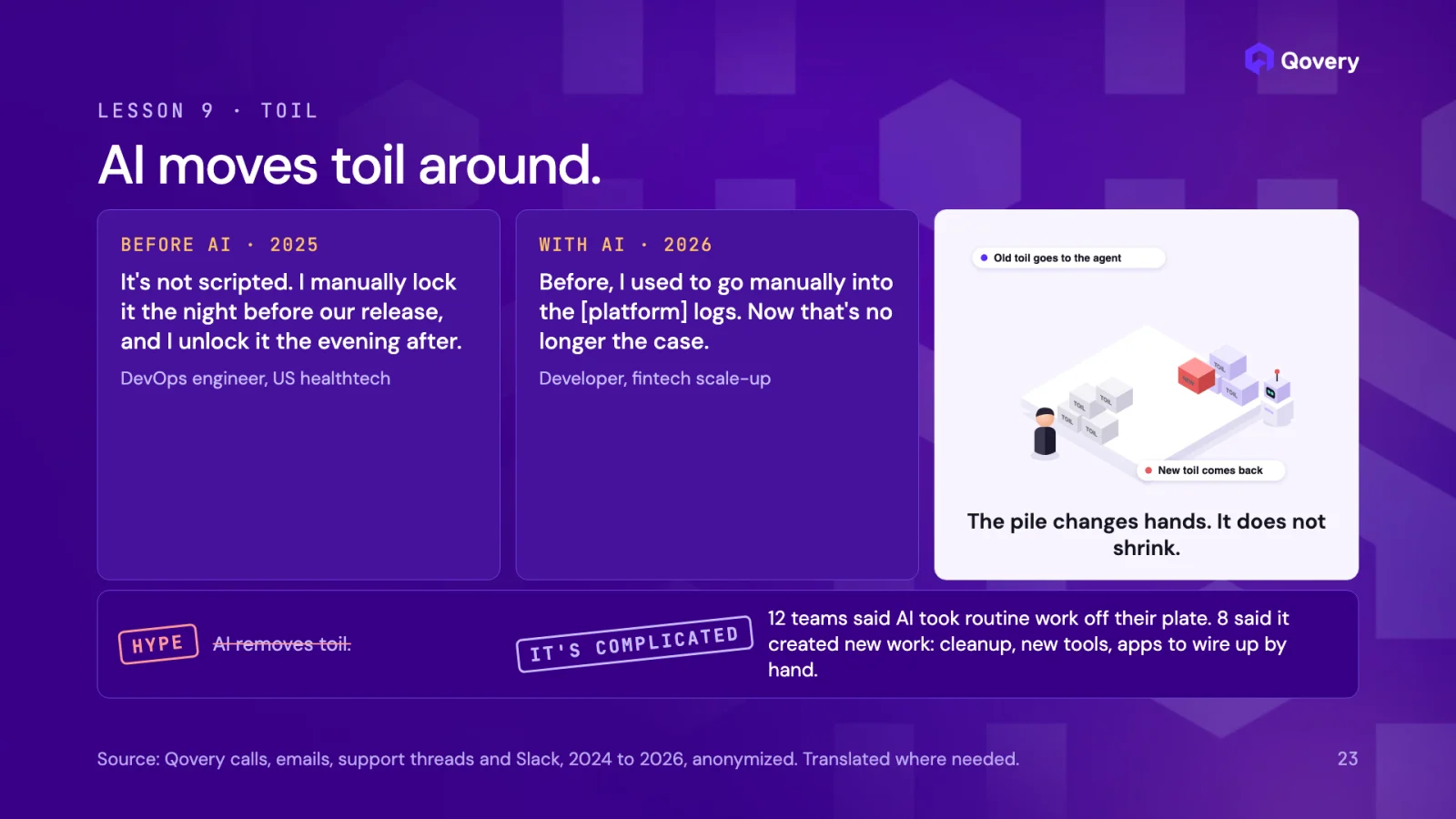
Lesson 9: AI moves toil around
Question: Does AI remove toil? Verdict: it's complicated.
This was the one where the stamp said neither hype nor reality. Like a relationship status: it's complicated. 12 teams said AI took routine work off their plate. 8 said it created new work.
Lesson 9 slide: AI moves toil around
On the plus side: nightly agent reviews of production, a first pass on incident analysis, support triage, glue scripts, fetching deploy logs. One platform engineer said their job moved from doing to directing and reviewing.
On the minus side: cleaning up what earlier AI produced in a rush, a new AI tool to evaluate every month with Helm charts that are not fit for production, vibe-coded apps that land on an engineer to wire up by hand, and code that ships in a day while the infrastructure pipeline takes a week.
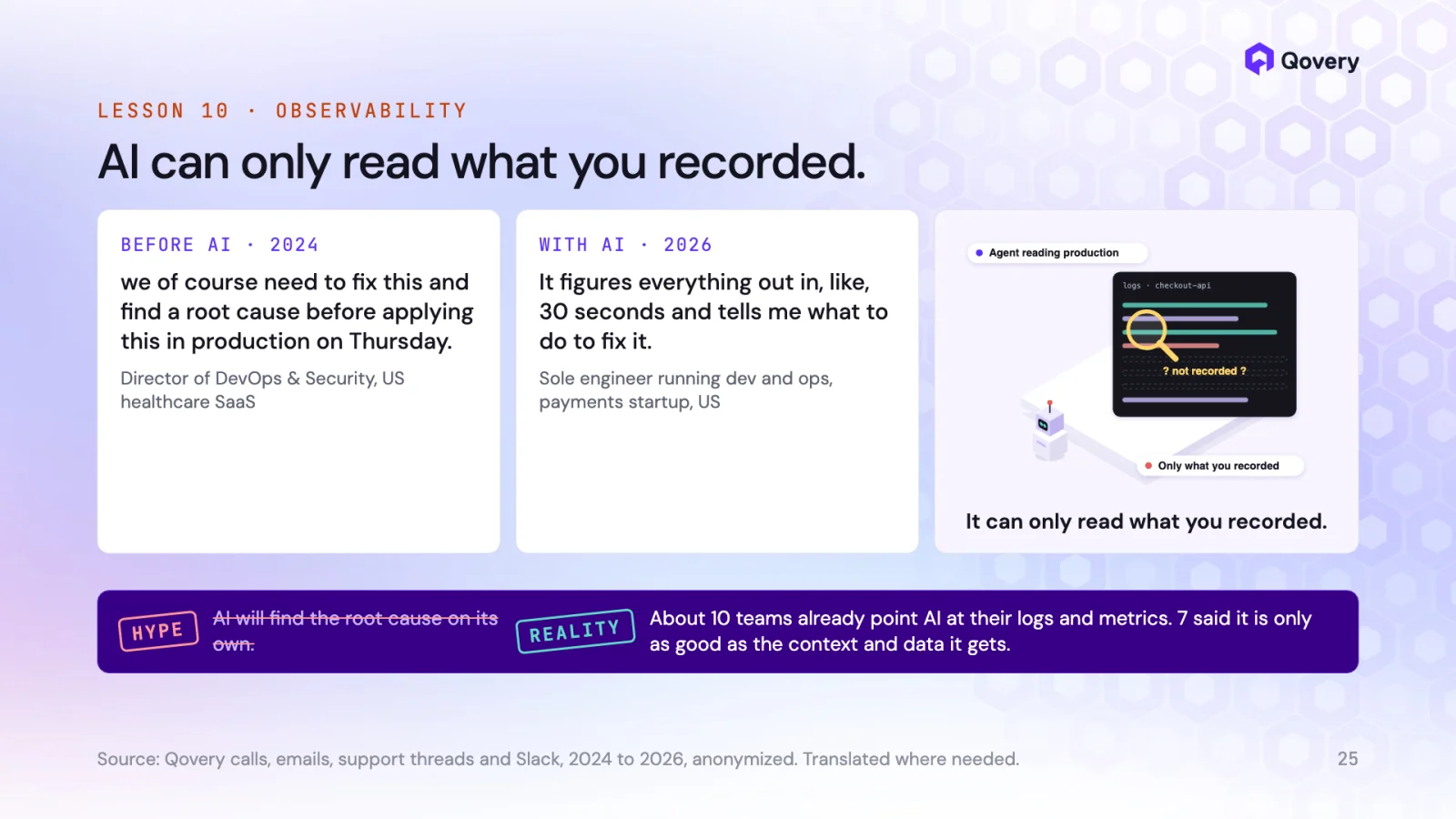
Lesson 10: AI can only read what you recorded
Question: Can AI find the root cause on its own? Verdict: hype.
About 10 teams already point AI at their logs and metrics. 7 said it is only as good as the context and data it gets.
Lesson 10 slide: AI can only read what you recorded
This lesson is about data quality (lesson 4 covered incident response). The 7 teams described AI that lacks infrastructure context and is sometimes wrong, that needs a human to steer it to the right data, that gives different answers to the same question, that repeats the error message back, or that was so noisy the team went back to doing it by hand.
Even in the 30-second diagnosis on the slide, the agent says what to do and the engineer decides. And it can only read what you recorded, so a log line you never kept is a root cause nobody will find.
What to do on Monday
The goal of the SRE job did not change. The way we do it did. More than half of what people told us describes the same work as before AI. What changed is who types the command, how much one team can run, and where the work piles up.
So the old principles matter even more now:
Principle
What it means
Lessons
1. Write it down
Document everything, so people and agents can both read it.
1, 2
2. Gate every write
A human signs off on anything that changes production. Agents read and propose.
3, 4
3. Track every agent action
Know which agent did what, with which credentials, and what it cost.
6, 7, 8
Lessons 9 and 10 are the reason the first two matter: AI moves work to wherever the knowledge and the data are missing.
If you want the "how" behind principle 2, I'm giving a follow-up talk at Agents in production: beyond the demo, at Alan in Paris on November 12, with Alan and AWS.
The rest of the day
SREday is a community conference, and Datadog hosted it in their New York office, with a view over Manhattan and the Hudson. Earlier in the day, Cedric Clyburn from Red Hat spoke about observing AI agents in production. That is lesson 10 from the other side: if you can't see what an agent did, you can't trust it with more.
By the evening I had 17 new LinkedIn invitations from people in the room.
The quiz format went down well, and I'd like to run it again with other communities. If you organize a meetup or a conference and want this talk, or want to compare what your teams see with what our data shows, message me on LinkedIn.
Thank you to Datadog for hosting us, and to the SREday organizers for a great event.
Romaric founded Qovery to make Kubernetes accessible to every engineering team. He writes about platform strategy, developer experience, and the future of cloud infrastructure.
Next step
Let agents read production. Keep humans on the writes.
Qovery runs Kubernetes in your own cloud account, with audit logs of every change and API tokens you can scope down to exactly what an agent needs.