Agentic AI infrastructure: moving beyond Copilots to autonomous operations
The shift from AI copilots to autonomous agents is redefining infrastructure requirements. Discover how to build secure, stateful, and compliant Agentic AI systems using Kubernetes, sandboxing, and observability while meeting EU AI Act standards
In the last 18 months, the industry has focused on "Copilots" tools that provide suggestions within a human-controlled loop. But for leaders in highly regulated sectors like Fintech and Healthtech, the conversation has shifted. The goal is now Agentic AI: autonomous systems capable of using tools, executing code, and making decisions.
Deploying a chatbot is easy. Building the infrastructure to support a fleet of autonomous agents that interact with production databases, while remaining compliant with the EU AI Act, is a different beast entirely.
The shift: from stateless inference to stateful agents
Standard LLM applications are often stateless. You send a prompt, you get a response. Autonomous agents, however, are long-lived, stateful, and resource-intensive. They require "sandboxes" where they can execute code without compromising the host cluster.
This means moving away from simple Pod deployments toward Agentic Control Planes, which extends Kubernetes by orchestrating agent lifecycle, sandboxing, permissions, and observability as first-class primitives.
1. The sandbox challenge: secure execution
Autonomous agents often generate and execute their own Python or SQL code to solve problems. In a regulated environment, you cannot allow an LLM-generated script to run with the same permissions as your microservices.
The Technical Fix: Infrastructure must provide isolated, short-lived "Agent Sandboxes." Leveraging Kubernetes primitives like vcluster or the new custom CRDs or controllers for sandbox orchestration allows you to spin up hardened, ephemeral environments where agents can fail (or hallucinate) safely without lateral movement risks.
2. Workflow-Integrated Autonomy
Copilots wait for a user to click a button. Agents are integrated directly into your DevOps workflows. When a "Health Check" fails in a Healthtech app, an Agentic system shouldn't just alert a human; it should be triggered via your management layer to autonomously spin up a diagnostic pod, correlate logs, and identify the failing dependency.
Governance as Code: meeting EU AI Act requirements
The EU AI Act (specifically requirements coming into force in 2026) demands high-risk AI systems maintain rigorous documentation, logging, and human oversight. For autonomous agents, "black box" operations are a legal liability.
Under the Act, you must document the "architecture, design, and development" of the AI system. By using GitOps for your agentic infra, your documentation is your code. Every change in an agent’s prompt configuration, tool-set, or resource limit is version-controlled and auditable.
The "traceability" mandate
Article 12 of the AI Act requires "logging of events" to ensure traceability. In an agentic world, you need more than just stdout. You need Agentic Observability:
Tool-use logs: Exactly which API was called and what was the payload?
Execution traces: Why did the agent choose that specific tool?
Resource attribution: Which agent consumed $500 of GPU time in ten minutes?
Agents ship fast. Guardrails keep them safe.
Qovery ensures every agent action is scoped, audited, and policy-checked. Start deploying in under 10 minutes.
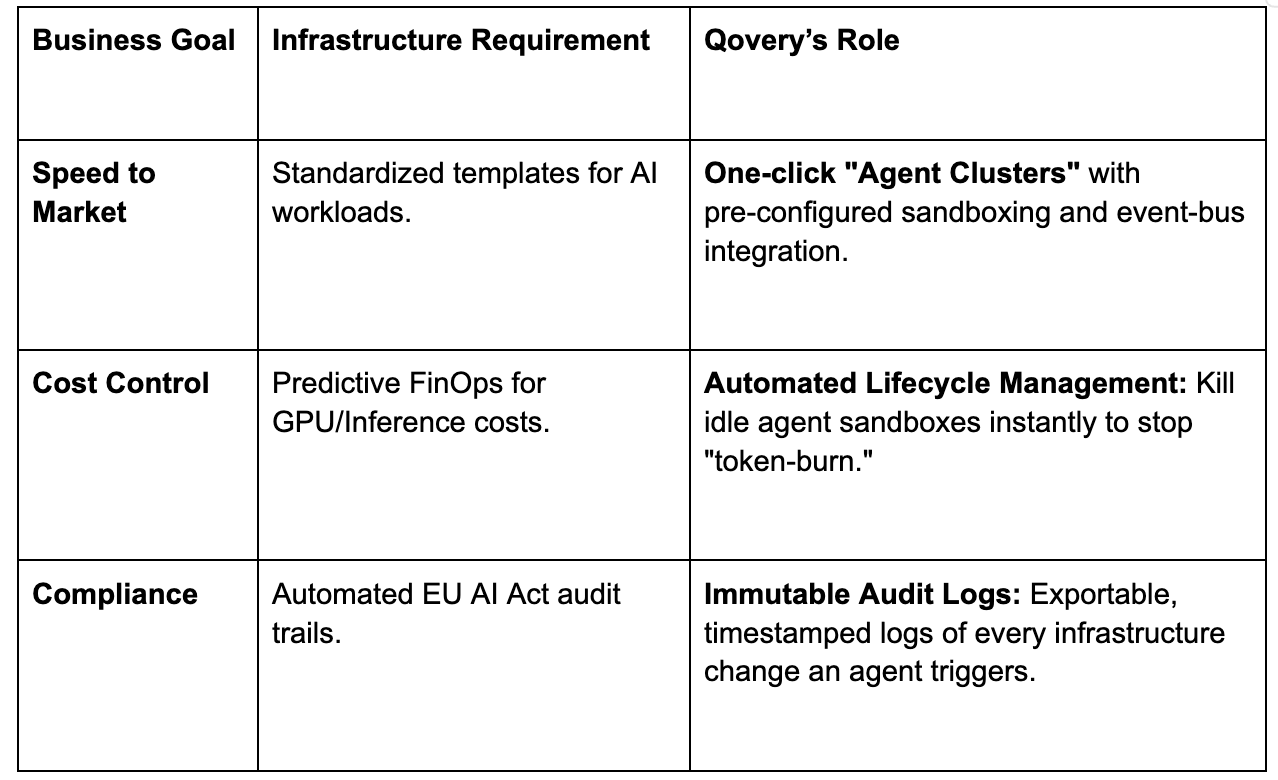
Business objectives: why Kubernetes management is the key
For any CTO at scaling midsize and enterprise companies, "Agentic AI" must be integrated into your existing engineering standards.
Moving forward
The leap from Copilot to Agent is an infrastructure hurdle, if your Kubernetes management layer isn't prepared to handle the stateful, autonomous, and highly-regulated nature of these entities, your AI strategy will stall at the PoC stage.
At Qovery, we’re building this layer directly into Kubernetes workflows, so agent workloads inherit the same security, observability, and deployment standards as any production service
Melanie leads content at Qovery. She covers platform engineering trends, Kubernetes operations, FinOps, and the tools that help engineering teams ship faster.
Next step
Agents ship fast. Guardrails keep them safe.
Qovery ensures every agent action is scoped, audited, and policy-checked. Start deploying in under 10 minutes.