Looking to modernize your stack for AI agents? This comparison is part of our guide to AI DevOps & CI/CD.
Key Points:
Stop Unpredictable Costs & Fragmentation: Move away from Vercel's usage-based billing and frontend limits. Qovery eliminates vendor lock-in by deploying your entire full-stack application to your own cloud, ensuring predictable cost control and unified infrastructure.
Unify the Backend with Full-Stack PaaS: Vercel forces backend fragmentation. Alternatives like Render and Qovery offer a single, unified platform for managing all persistent services, simplifying security and monitoring compared to running services separately.
Prioritize Ownership Over Edge Speed: Scaling enterprises must trade Vercel's proprietary, high-speed DX for control and compliance. Solutions like Qovery and AWS Amplify ensure full data ownership and enterprise-grade infrastructure management.
Vercel is the leader in frontend deployment, offering an unparalleled developer experience, instant deploys, and deep integration with Next.js. However, for growing enterprises and platform engineering teams, Vercel’s core model introduces significant challenges:
Unpredictable Costs: Usage-based pricing can lead to sudden, expensive overage bills at scale.
Vendor Lock-in: The proprietary platform makes migrating off difficult and complicates integrating deep backend services.
Frontend Focus: Vercel is optimized for the frontend, forcing teams to run and manage complex backend services (APIs, databases, workers) separately.
This guide evaluates Vercel alternatives by prioritizing full-stack capability, cost control, and ownership, helping you move beyond frontend limitations to adopt a production-ready, holistic deployment strategy.
Why DevOps Teams Look Beyond Vercel
Vercel is a fantastic development tool, but its proprietary, frontend-first nature creates several roadblocks for robust production workflows:
Cost and Billing: The Serverless Functions and Edge Network usage can be difficult to predict, leading to variable monthly expenses that are hard to budget for at the enterprise level.
Full-Stack Fragmentation: Vercel requires separate hosting for persistent backends, databases, and message queues. This fragmentation increases maintenance, introduces latency, and complicates security and monitoring.
Vendor Lock-in: Deploying on Vercel means you rely on their specific infrastructure architecture, making it challenging to leverage your existing cloud contracts (AWS/GCP/Azure) or migrate if the pricing changes.
The Best Vercel Alternatives for Full-Stack Control
1. Qovery: The Best Alternative for Cloud Control & Full-Stack Automation
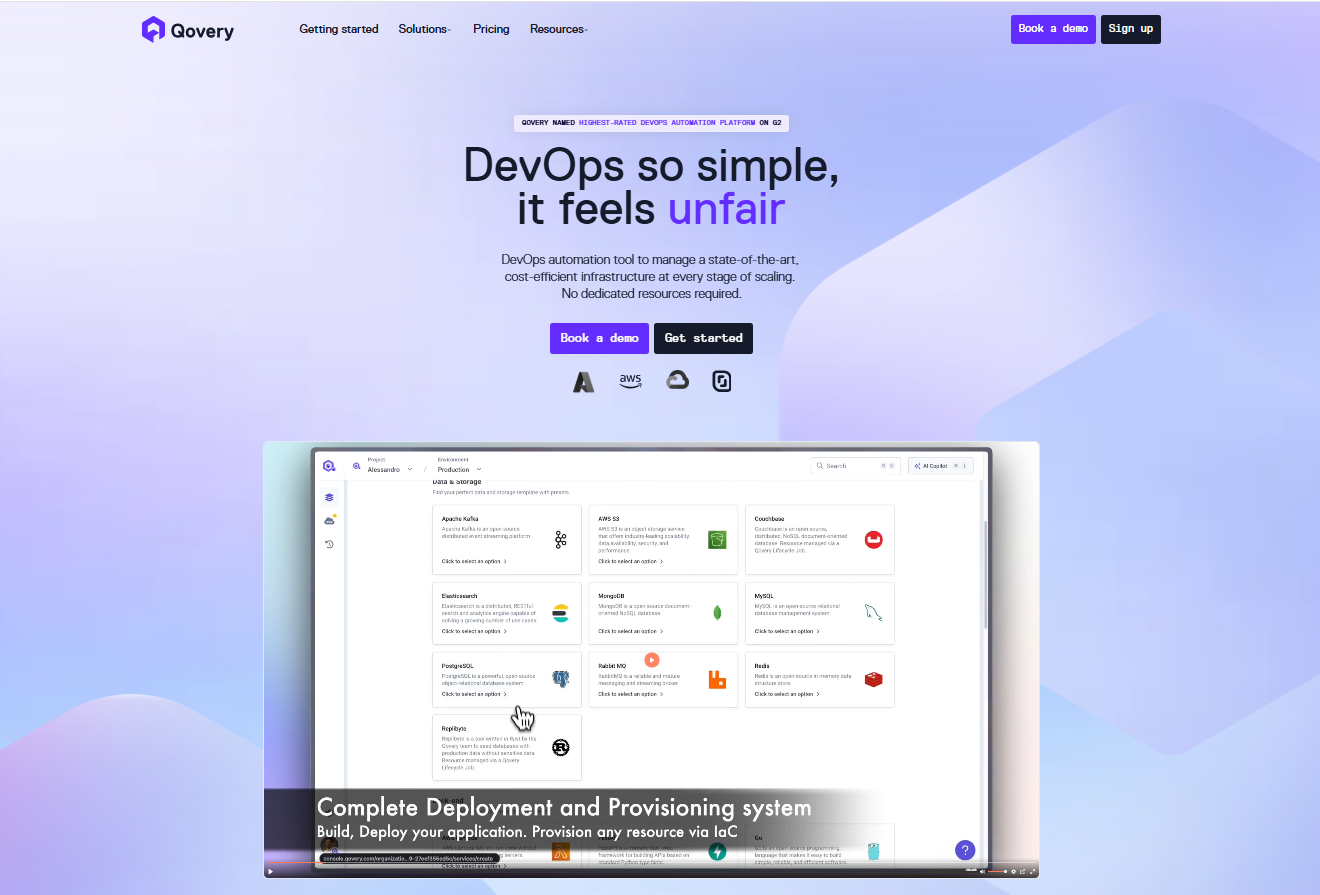
Qovery is a DevOps Automation Platform designed to bring the simplicity of Vercel’s Git-push workflow to your entire, full-stack application running on your own cloud infrastructure (BYOC). This is the ideal solution for teams who want Vercel's DX without sacrificing control, cost management, or backend capabilities.
Qovery Pros (Full-Stack & Control)
Full-Stack Support: Deploys and manages all application components-frontends, APIs, databases (PostgreSQL, MongoDB, etc.), and background workers-from a single platform.
Own Your Infrastructure (BYOC): Eliminates vendor lock-in by running everything on your existing AWS, GCP, or Azure account, ensuring you retain full data ownership and security compliance.
Predictable Cost: You pay cloud provider rates for provisioned resources, making budgeting easier than Vercel's usage-based model.
Kubernetes Automation: Provides a "Vercel-like" Git workflow on top of Kubernetes, abstracting away the complexity while providing enterprise-grade scaling and stability.
Qovery Cons (Full-Stack & Control)
Not Edge-Native: While using your cloud's CDN, Qovery does not offer the same deep, proprietary edge-native runtime optimization that Vercel provides for Next.js applications specifically.
Initial Setup: Requires a brief initial setup to connect to your cloud account, unlike Vercel’s instant sign-up.
Feature
Qovery: Full-Stack Platform
Vercel: Frontend Ecosystem
Primary Focus
Full-Stack: Frontend, Backend, Databases, Workers
Frontend: React, Next.js, Edge Functions
Infrastructure
Runs on Your AWS, GCP, or Azure account (BYOC).
Runs on Vercel's proprietary cloud infrastructure.
Cost Control
Direct access to cloud billing; predictable usage based on provisioned resources.
Usage-based Serverless/Edge billing; susceptible to high overages.
Ephemeral Environments
Full-stack ephemeral environments (with DBs) via PRs.
Frontend preview environments and serverless functions via PRs.
2. Render
Render is a unified cloud platform widely considered the modern replacement for Heroku. It excels in providing a robust, full-stack environment with a great DX, similar to Vercel, but focused on traditional persistent services.
Render Pros
Unified Platform: Supports static sites, web services, private services, managed databases (PostgreSQL, Redis), and background workers all within one account.
Simplified Full-Stack: Excellent for teams migrating from Heroku or those who need persistent, long-running backend processes without deep infrastructure knowledge.
Automatic Scaling: Offers straightforward autoscaling for web services and auto-deploys from Git.
Render Cons
Steep Pricing: Similar to Vercel, costs can rise steeply as your applications scale beyond the generous free tier, making it a "boutique PaaS."
Less Edge-Focused: While it has a global CDN, it lacks the deep, edge-first architecture and proprietary performance optimizations Vercel has for global distribution.
3. Netlify
Netlify is Vercel's direct and strongest competitor, focusing on the JAMstack and frontend serverless deployment. Netlify is a superior choice for static sites and frontend projects that don't rely on complex backends.
Generous Free Tier: Offers competitive free bandwidth (100GB) that allows commercial use, making it highly cost-effective for small businesses and static sites.
Rich Feature Set: Includes built-in Serverless Functions (Edge/Standard), form handling, split testing, and a comprehensive plugin ecosystem.
Strong CD Workflow: Provides automated Git-based builds, preview environments, and instant rollbacks on par with Vercel.
Backend Limitations: Like Vercel, it struggles with complex, persistent backends, databases, and non-Node services. Teams often end up fragmenting their stack.
Cold Starts: Netlify's serverless functions can experience longer cold start delays compared to Vercel's Edge/Next.js-optimized functions.
4. Fly.io
Fly.io is a revolutionary platform for running full-stack applications on lightweight virtual machines deployed globally at the "edge." It is ideal for high-performance, low-latency applications that need to be close to users worldwide.
Fly.io Pros (Global Edge & Performance)
True Global Edge: Deploys applications across 30+ regions on small VMs, offering unparalleled low latency for global audiences.
Reasonable Pricing: Provides transparent, usage-based pricing on VMs that are very cost-effective for global deployment compared to Vercel's high-volume overages.
Persistent Services: Supports persistent volumes and databases (Fly Postgres) with global replication capabilities.Fly.io Cons (Global Edge & Performance)
Lower Abstraction: Requires developers to manually containerize their applications (using Dockerfiles) and manage deployment via the CLI. The DX is lower than Vercel or Render.
No Auto CI/CD: Lacks the seamless, Git-push CI/CD pipeline built into platforms like Vercel, Netlify, or Qovery.
5. AWS Amplify Hosting
AWS Amplify is the ideal choice for enterprises already all-in on the AWS ecosystem. It provides a Vercel-like experience but integrates natively with the security, billing, and scale of AWS.
AWS Amplify Pros (Enterprise & AWS Integration)
Deep AWS Integration: Seamlessly connects frontend deployments with Lambda, S3, RDS, and other core AWS services, simplifying security and data flow.
Enterprise Scale & Compliance: Leverages AWS's enterprise-grade reliability, compliance certifications, and massive global CDN network (CloudFront).
Unified Billing: Everything runs on the AWS bill, simplifying cost tracking and leveraging existing Reserved Instances or volume discounts.
AWS Amplify Cons (Enterprise & AWS Integration)
High Complexity: The sheer number of services and configuration options can be overwhelming, leading to a much steeper learning curve than Vercel.
Slow DX: Build times, deployments, and general development velocity can be slower than Vercel's highly optimized, proprietary environment.
Feature
Qovery
Render
Netlify
Vercel
Full-Stack Support
Excellent (Front, Back, DBs, Workers)
Good (Web Services, Managed DBs)
Limited (Frontend + Serverless Functions)
Limited (Frontend + Serverless Functions)
Cost Control
Best (BYOC/Predictable)
Moderate (Predictable but expensive at scale)
Moderate (Generous free tier, usage risks)
Low (Unpredictable usage-based overages)
Vendor Lock-in
None (Runs on your cloud account)
Moderate (Proprietary PaaS)
Moderate (Proprietary PaaS)
High (Proprietary architecture)
Target User
DevOps/Platform Teams
Full-Stack Developers (Heroku Migrants)
Frontend/JAMstack Developers
Next.js/React Frontend Devs
Deployment Model
GitOps on Kubernetes
Unified PaaS (Containers)
Edge/Serverless Functions
Edge/Serverless Functions
Agents ship fast. Guardrails keep them safe.
Qovery ensures every agent action is scoped, audited, and policy-checked. Start deploying in under 10 minutes.
Vercel is the undisputed champion of the frontend Developer Experience, but its limitations in full-stack support and cost control are major pain points for scaling organizations.
If your core need is Unpredictable Cost Control, Backend Support, and eliminating Vendor Lock-in, you need a platform that runs on your cloud account. Qovery is the direct answer, providing a Vercel-like DX on top of your own enterprise-grade cloud infrastructure.
If you need a modern, simple full-stack PaaS without managing your own cloud, Render is the best choice.
If you are primarily building static sites and JAMstack projects on a tight budget, Netlify provides the most generous free option.
The strategic choice for DevOps is clear: Move from being a consumer of a proprietary frontend service to being the builder of a powerful, automated platform on your own cloud - one that brings full DevOps automation to your entire stack, not just the frontend.
Frequently asked questions
What is the best Vercel alternative?
It depends on your needs. For full-stack control on your own cloud with no vendor lock-in, Qovery is the strongest Vercel alternative. For a simple managed full-stack PaaS, Render is the best fit. For static sites and JAMstack on a budget, Netlify offers the most generous free tier. Fly.io is best for global edge performance.
Why do teams look for Vercel alternatives?
The most common reasons are unpredictable cost overages at scale, limited backend and full-stack support, and vendor lock-in to a proprietary platform. Teams scaling beyond frontend-only workloads often need infrastructure that runs on their own AWS, GCP, or Azure account.
Is there a Vercel alternative that runs on my own cloud?
Yes. Qovery provides a Vercel-like developer experience while deploying to your own cloud account, so you keep full control over cost, data residency, and infrastructure. This eliminates the egress and usage-based overages that make managed platforms expensive at scale.
Are Vercel alternatives cheaper than Vercel?
They can be, especially at scale. Platforms that run on your own cloud (like Qovery) let you pay your cloud provider directly and optimize usage, avoiding the markup and overage fees of managed services. For small projects, Netlify's and Render's free tiers can also be more cost-effective than Vercel.
Melanie leads content at Qovery. She covers platform engineering trends, Kubernetes operations, FinOps, and the tools that help engineering teams ship faster.
Next step
Agents ship fast. Guardrails keep them safe.
Qovery ensures every agent action is scoped, audited, and policy-checked. Start deploying in under 10 minutes.