Looking to modernize your stack for AI agents? This comparison is part of our guide to AI DevOps & CI/CD.
Key Points:
Escape the Pricing Trap: Terraform Cloud’s pricing models (often based on Resources Under Management or RUM) can become prohibitively expensive as you scale. Moving to specialized platforms or open-source alternatives drastically reduces Total Cost of Ownership (TCO).
Abstract the Complexity: Terraform Cloud requires deep knowledge of HCL, modules, and state locking. Modern platforms like Qovery abstract this away, allowing developers to provision infrastructure without touching a .tf file.
Adopt Ephemeral Environments: Managing dynamic preview environments in Terraform Cloud is slow and script-heavy. Modern platforms automate Ephemeral Environments natively, accelerating the feedback loop.
Terraform Cloud (HCP Terraform) is the undisputed standard for managed Infrastructure as Code. It popularized the concept of remote state management and policy enforcement. But in an era of platform engineering and cost-consciousness, its traditional model is showing cracks.
For DevOps teams, Terraform Cloud often represents governance friction: managing state file locking, debugging "drift," navigating complex HCL modules, and dealing with unexpected bills due to resource counting.
This guide evaluates the 10 best Terraform Cloud alternatives, categorized by the strategic problem they solve: Modernizing Delivery, Enterprise Governance, or Code-First Freedom.
Why DevOps Teams Break Up with Terraform Cloud
The move away from Terraform Cloud is rarely about the core engine - Terraform itself is excellent. The move is about Management Overhead and Pricing Predictability.
The "State Lock" Bottleneck: Developers often find themselves waiting for Ops to unlock state files or fix "drift" errors before they can deploy simple changes.
The "Resource Counting" Tax: Pricing models that charge per resource or run can punish teams for efficiency or scaling. Teams spend hours optimizing code just to lower the bill rather than improving the product.
Lack of Developer Autonomy: To spin up a database or a staging environment, developers usually have to open a ticket for a Terraform Cloud run. Tools like Qovery solve this by offering self-service infrastructure.
Environment & Platform Automation (The "Platform" Upgrade)
Terraform Cloud is often most painful when used for Application Infrastructure - spinning up clusters, databases, and staging environments for developers. These tools replace the "Infrastructure Provisioning" toil with a higher-level platform.
1. Qovery (Kubernetes management platform)
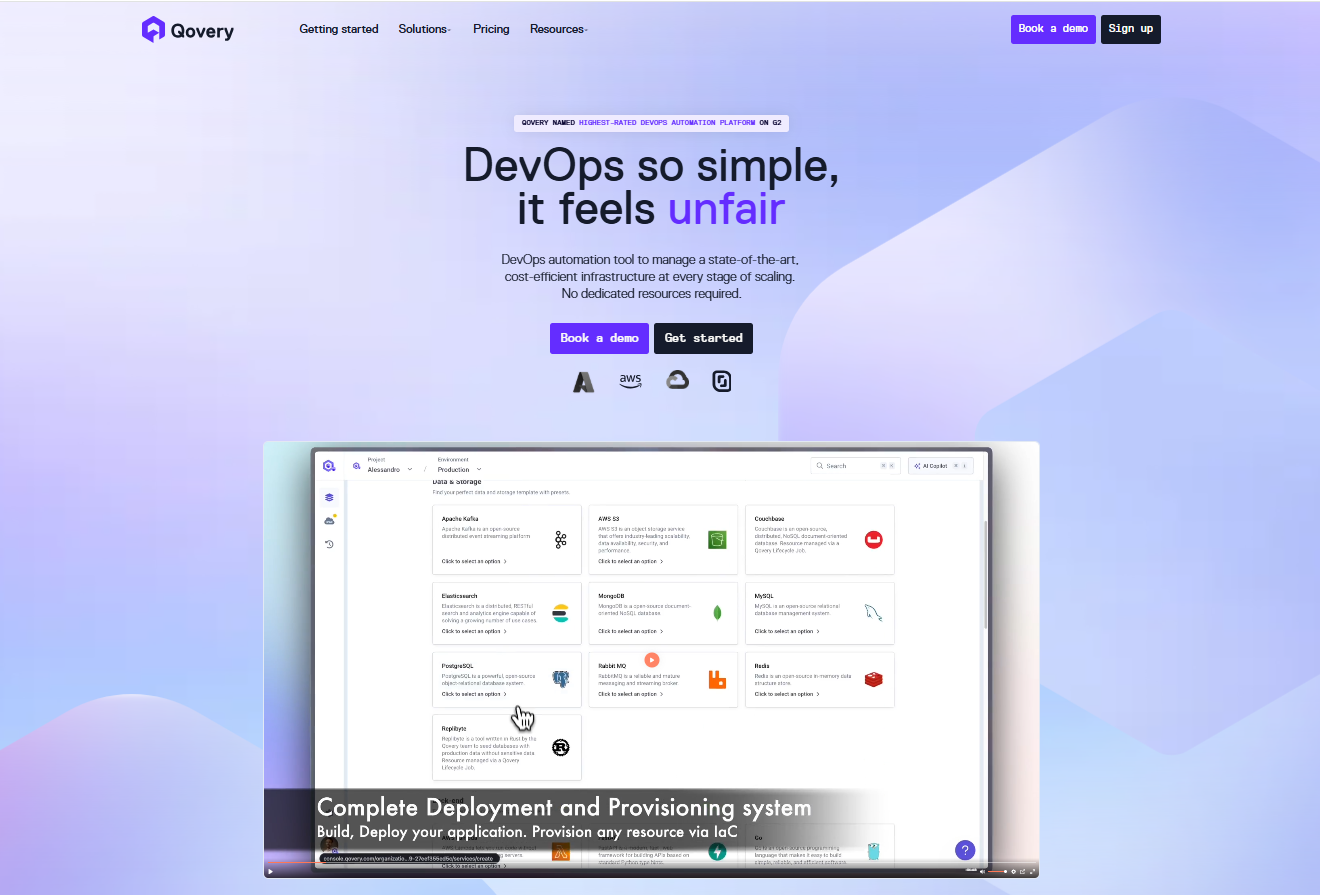
Qovery is the best alternative for teams who use Terraform Cloud to manage application environments. It sits a layer above Terraform, using it under the hood to manage infrastructure while providing a simple, developer-friendly interface.
Pros:
Automated Infrastructure: Qovery manages the underlying Terraform for you. You don't write HCL; you declare that you need a Cluster or a Database, and Qovery handles the provisioning on your AWS/GCP/Azure account.
Ephemeral Environments: Automatically spins up full-stack preview environments (including RDS databases and Redis) for every Pull Request - something that requires complex logic in Terraform Cloud.
Cost Optimization: automatically shuts down unused environments (like staging on weekends) to save cloud costs, a feature not native to Terraform Cloud.
Cons:
Not a Generic IaaS Tool: Qovery is optimized for application delivery (K8s, DBs, Jobs). If you are provisioning obscure networking hardware or legacy VM setups, raw Terraform might still be needed.
Qovery vs. Terraform Cloud: The Fundamental Difference
The core difference lies in abstraction: Terraform Cloud is an execution engine, while Qovery is a Platform.
Terraform Cloud (Imperative): You must define every resource (VPC, Subnet, Security Group, EKS Node Group) in HCL code. You are responsible for the logic, the state file, and the maintenance of that code.
Qovery (Declarative Platform): You focus on value. You tell Qovery "I need an environment." Qovery's engine (powered by Terraform and Helm) handles the 'how' - provisioning the VPCs, clusters, and security groups automatically using best practices.
Specialized TACOS (The "Enterprise" Upgrade)
TACOS (Terraform Automation and Collaboration Software) are direct competitors to Terraform Cloud. They run your .tf files but offer better pricing, UI, or governance features.
2. Spacelift
A sophisticated management platform for Terraform and OpenTofu, focusing on policy-as-code and visualization.
Pros:
Visual Workflow: Offers a "Space" concept to visualize dependencies between different infrastructure stacks.
OPA Native: Uses Open Policy Agent (OPA) for governance, which is often preferred over HashiCorp’s Sentinel.
Cons:
Complexity: Can be overkill for smaller teams just looking for a remote state runner.
3. env0
Focused heavily on Cost Estimation and Time-to-Live (TTL) for environments.
Pros:
Self-Service with TTL: Allows you to let developers spin up environments that automatically destroy themselves after a set time - perfect for cost control.
Granular Cost Insights: Tags resources automatically to show exactly how much a specific deployment costs.
Cons:
Smaller Ecosystem: Slightly fewer integrations than the massive Terraform Cloud marketplace.
4. Scalr
A legacy name that reinvented itself as a drop-in replacement for Terraform Cloud.
Pros:
Hierarchical Management: Excellent for large enterprises that need to manage environments across many departments/teams.
Pricing: Generally offers a more predictable model than TFC’s resource-based pricing.
Cons:
UI/UX: The interface can feel more "enterprise-heavy" compared to modern SaaS tools.
Open Source & Code-First (The "Freedom" Upgrade)
These tools are for teams that want to avoid vendor lock-in or prefer using standard programming languages over HCL.
5. OpenTofu
The open-source fork of Terraform, created in response to HashiCorp’s license change to BSL.
Pros:
True Open Source: Under the Linux Foundation, ensuring it remains free and community-driven forever.
Drop-in Compatibility: Works with your existing Terraform code (for now).
Cons:
Tooling Fragmentation: You need to ensure your other tools (IDEs, CI pipelines) support Tofu specifically.
6. Atlantis
The popular open-source tool for "Pull Request Automation." It runs inside your Git workflow.
Pros:
Git-Centric: You run atlantis plan and atlantis apply directly in GitHub/GitLab comments. No separate UI to log into.
Free: You host it yourself.
Cons:
Security Risks: Because it runs on PR comments, you must secure your webhooks and access rights carefully.
Maintenance: You are responsible for hosting and patching the Atlantis server.
7. Pulumi
Moving away from HCL entirely? Pulumi lets you define infrastructure using TypeScript, Python, Go, or Chttps://www.google.com/search?q=%23.
Pros:
Real Code: Use loops, functions, and classes to define infrastructure. Much more powerful than HCL's limited logic.
Testing: You can write standard unit tests for your infrastructure code.
Cons:
Learning Curve: Requires developers to be comfortable with coding, not just configuration.
State Management: Still requires a backend (Pulumi Cloud or self-hosted) to manage state.
8. Crossplane
The Kubernetes-native approach. It turns your K8s cluster into a control plane to manage external cloud resources (AWS/GCP).
Pros:
No "Drift": It creates a continuous reconciliation loop. If someone manually changes a bucket, Crossplane changes it back instantly.
Unified API: Manage infrastructure using Kubernetes YAML manifests.
Cons:
Complexity: Requires a running Kubernetes cluster just to manage the control plane. Heavy operational burden.
9. GitHub Actions / GitLab CI
The "DIY" approach. Using generic CI/CD runners to execute terraform apply.
Pros:
Consolidation: You already use these for code; why not use them for infra?
Free (mostly): No extra licensing costs for a separate "Terraform" platform.
Cons:
State Management: You must configure your own backend (S3/DynamoDB) manually.
Concurrency Hell: Hard to prevent two CI jobs from trying to modify the same state file simultaneously without custom scripting.
10. Terragrunt
Not a replacement platform, but a wrapper tool that keeps your Terraform code DRY (Don't Repeat Yourself).
Pros:
Reduces Boilerplate: Drastically shrinks the amount of HCL you need to write.
Dependency Management: Handles deploying a stack of modules in the correct order.
Cons:
Maintenance: An extra tool to install and update in your pipeline.
Agents ship fast. Guardrails keep them safe.
Qovery ensures every agent action is scoped, audited, and policy-checked. Start deploying in under 10 minutes.
Comparison: Terraform Cloud vs. The Strategic Alternatives
Feature
Terraform Cloud
Qovery (Platform Focus)
Spacelift (Control Focus)
Atlantis (DIY Focus)
Primary Role
Managed IaC Runner
DevOps Automation Platform
Specialized Policy/IaC Runner
PR Automation Bot
User
Ops / SRE
Developers & Ops
Ops / SRE
Ops / Developers
State Management
Managed (Locked)
Abstracted / Automated
Managed
Self-Hosted S3/GCS
Language
HCL (Proprietary)
YAML / UI (Declarative)
HCL / OpenTofu
HCL
Preview Envs
Manual / Scripted
Native / Automated
Scripted
Manual
Cost Model
Resource / RUM Based
User / Usage Based
Concurrency Based
Free (Self-Hosted)
Terraform alternatives vs. Terraform Cloud alternatives: what are you replacing?
It helps to be precise about what you're replacing. Terraform Cloud alternatives (Spacelift, env0, Scalr, Atlantis) swap out the managed runner while you keep writing HCL. Broader Terraform alternatives replace the IaC tool itself:
OpenTofu - the open-source, drop-in fork of Terraform after the license change. The closest 1:1 Terraform alternative.
Pulumi - infrastructure as real code (TypeScript, Python, Go) instead of HCL.
Crossplane - Kubernetes-native infrastructure provisioning via CRDs.
Platform abstraction (Qovery) - skip writing infrastructure code for application workloads entirely; declare intent and let the Kubernetes management platform generate the underlying resources.
If you're frustrated with HCL itself, a true Terraform alternative (OpenTofu, Pulumi) is the answer. If you're frustrated with the operational burden of running Terraform across teams, a platform that automates DevOps delivery removes the problem rather than relocating it.
Conclusion: Matching the Tool to the Goal
The era of manually managing state files and wrestling with HCL for every minor change is ending. While tools like OpenTofu preserve the traditional model, the strategic move for high-velocity teams is to adopt a Kubernetes management platform.
This is where Qovery is the essential upgrade.
Instead of just changing where you run your Terraform (e.g., moving from TFC to Spacelift), change how you deliver infrastructure.
Eliminate the "HCL" Tax: Replace complex modules with a platform that understands what a "Microservice" or "Database" is.
Unlock Ephemeral Environments: Stop writing Terraform scripts to spin up staging environments. Let the platform handle it automatically on PR creation.
Control Costs: Stop paying for "Resources Under Management" and start optimizing your actual cloud bill with auto-shutdown features.
Keep your deep, low-level infrastructure (like VPC peering or Transit Gateways) in Terraform if you wish, but let Qovery handle the dynamic, high-volume application infrastructure.
Frequently asked questions
What is the best alternative to Terraform Cloud?
It depends on your goal. To keep using HCL but get better policy controls and concurrency, Spacelift and env0 are strong managed runners. To stop managing state files and HCL altogether, a Kubernetes management platform like Qovery automates application infrastructure and ephemeral environments without you writing IaC.
What is the best open-source Terraform alternative?
OpenTofu is the leading open-source Terraform alternative - a community-driven, drop-in fork created after HashiCorp changed Terraform's license to BSL. It is CLI- and state-compatible with existing Terraform code. Pulumi is the best alternative if you'd rather define infrastructure in a general-purpose programming language.
Why are teams moving away from Terraform Cloud?
The common drivers are rising costs under the resource-based (RUM) pricing model, the operational overhead of managing state and HCL modules at scale, slow feedback loops for developers, and the BSL license change that pushed open-source users toward OpenTofu.
Do I have to replace Terraform completely?
No. Many teams keep Terraform or OpenTofu for low-level, stable infrastructure (VPCs, networking) and add a platform layer on top for high-velocity application infrastructure and ephemeral environments. This hybrid approach reduces toil without a risky big-bang migration.
Melanie leads content at Qovery. She covers platform engineering trends, Kubernetes operations, FinOps, and the tools that help engineering teams ship faster.
Next step
Agents ship fast. Guardrails keep them safe.
Qovery ensures every agent action is scoped, audited, and policy-checked. Start deploying in under 10 minutes.