Hi, fellow Qovery readers, Albane here! 👋🏻 To give you a bit of background, I joined Qovery in August 2021, initially as a Product Owner, then moved to a Product Marketing Manager position in March 2022. So yes, I’m all about our product. While I spend much time working around our product, it’s also essential for me to stay aware of trends and other products in the tech world, and that’s why, on February 7 and 8, 2023, I spent the day at the Queen Elizabeth Center two in London to attend the annual State of Open Conference. There are conferences where you split your time walking around stands and exploring the venue while attending sessions. Still, there were so many sessions I wanted to attend that I spent most of my two days in the conference room, mainly because there was a whole track dedicated to platform engineering.
State of the Open Conference (SOOCon) is a technical conference focused on the open-source cloud computing community and infrastructure. The conference brings together experts, developers, and users from the open source community to exchange ideas and experiences, discuss the latest advancements and innovations, and address the challenges facing the industry. The conference covers topics such as OpenStack, Kubernetes, cloud-native applications, and other related subjects. The goal of the conference is to promote collaboration and foster the growth of the open-source cloud computing ecosystem.
Top 5 Sessions of the Event
The State of Open Conference (SOOCon) offered an extensive lineup of over 100 talks and workshops, with six main tracks, including the Platform Engineering track, Entrepreneurship, Security, Government, Law and Policy, Open Data, and Open Hardware. In addition to these tracks, the conference also featured plenary sessions and un-conferences. Despite my initial interest in the Platform Engineering track, I took the opportunity to attend sessions from other tracks. I was pleasantly surprised by the quality of the content, and this top could have easily been a top 15 or 20, but here is my final selection of my top 5 sessions at the SOOCon 23:
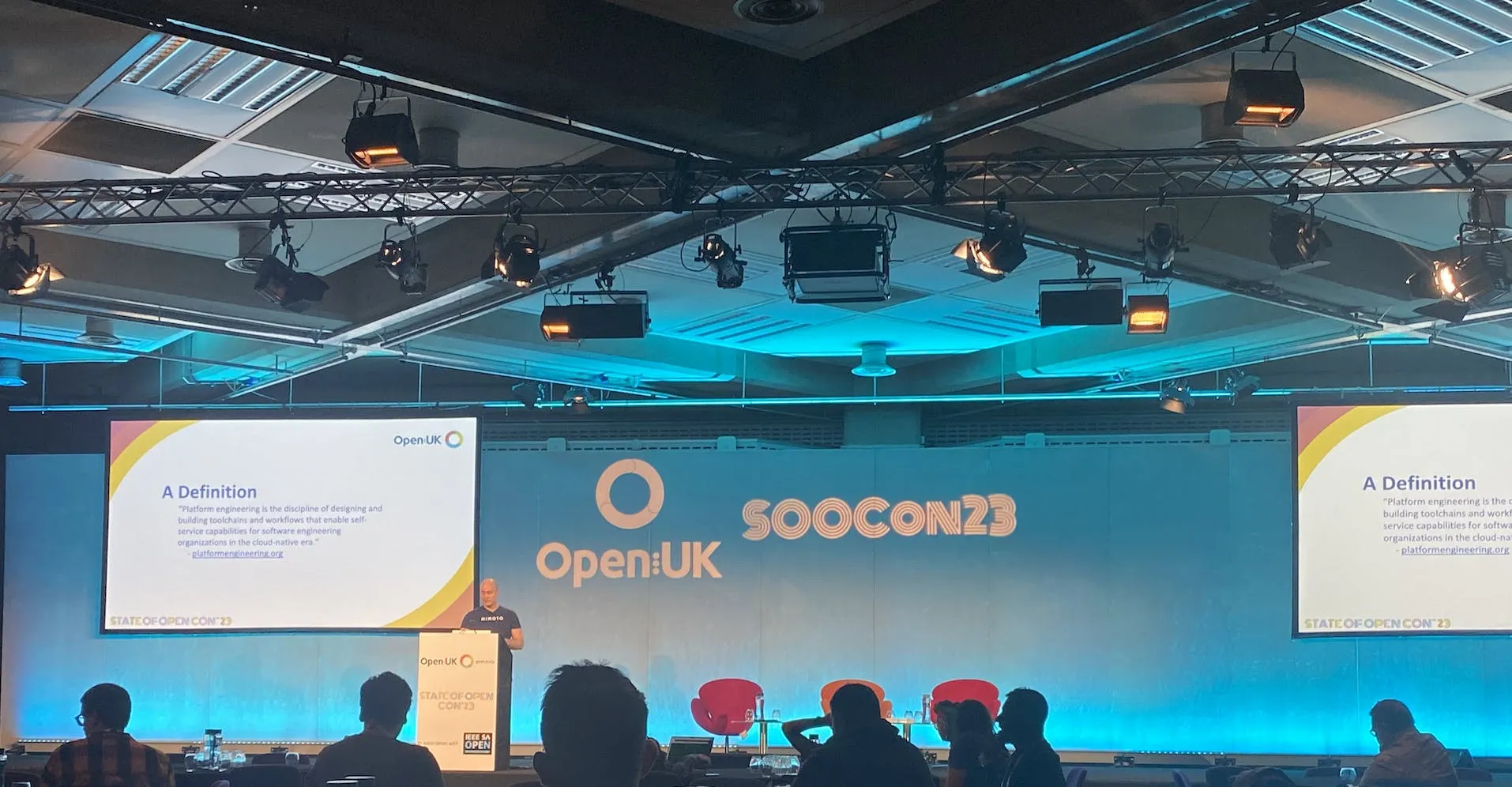
During the conference, I was intrigued by David Charboneau's talk on the "Why and How of Platform Engineering with Open Source," especially being part of a startup myself. David began by explaining a bottom-up approach to platform engineering, which emphasizes the importance of standardized developer environments that utilize open source tools such as pytest. He then skillfully connected the dots from starting at developer environments to implementing CI/CD, scaling, and monitoring a product that includes a web application, internal data science, and machine learning infrastructure, as well as a range of operating systems and devices hosting an agent. I found David's talk to be highly educational and full of actionable insights for any startup looking to learn more about Platform Engineering and Open Source.
David Charboneau at the SOOCon 23
Internal Developer Platform Of the People, By the People, For the People
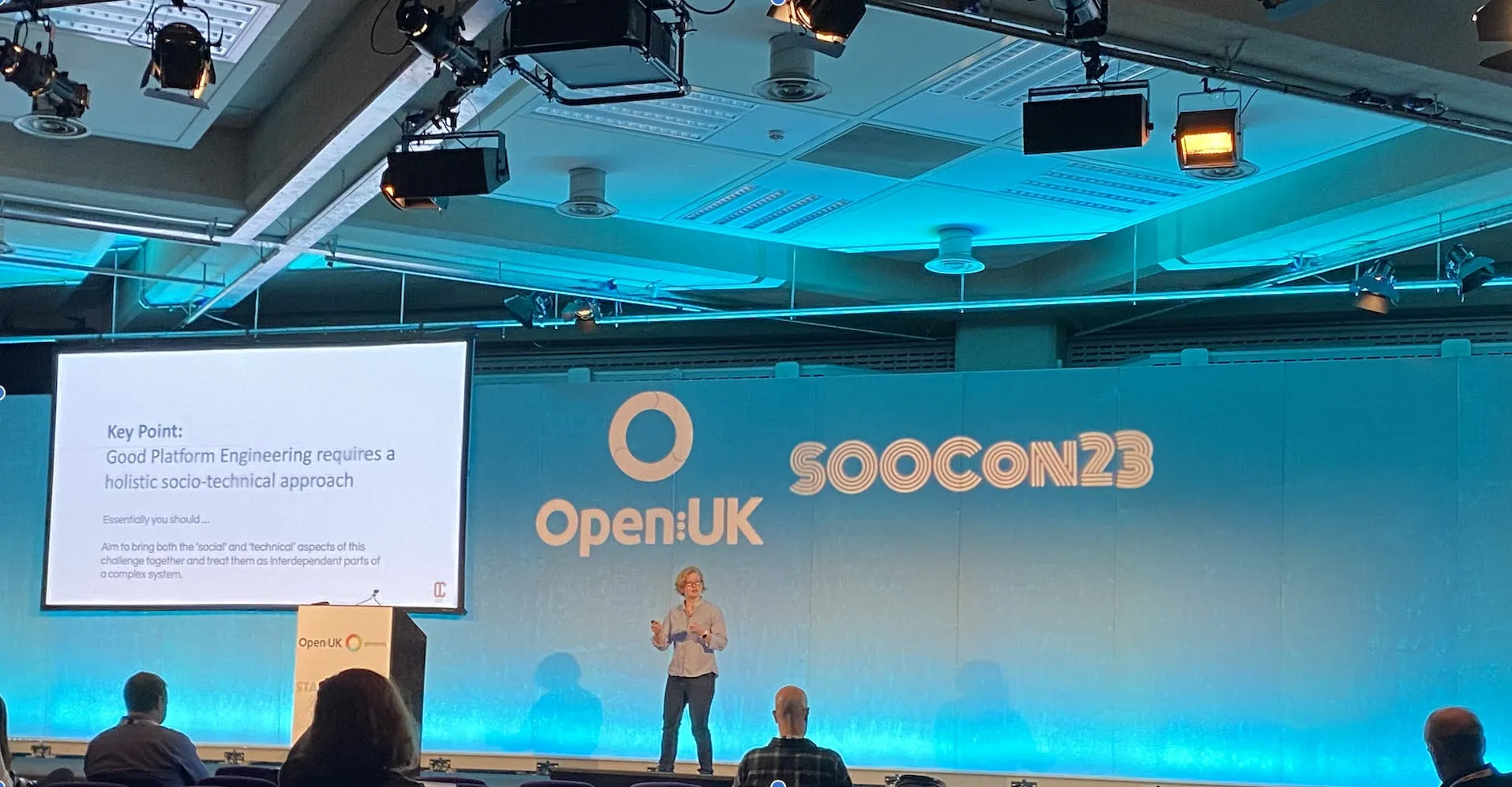
This talk from Nicki Watt, CTO, CEO & Company Director at Open Credo, was centered around the question of what it takes to create a robust internal developer platform (IDP) that can effectively serve the needs of multiple engineering teams with varying skills, working on similar or different projects. While Kubernetes has emerged as the backbone for many platforms, Nicki challenged the audience to consider whether it is enough.
Nicki explored the key technical considerations essential to building a successful IDP, as well as the organizational and soft skills critical to the platform engineering discipline. Drawing on her experience working with clients with different setups, she shared insights into what it takes to build platforms that are fit to serve the varied communities that ultimately use them.
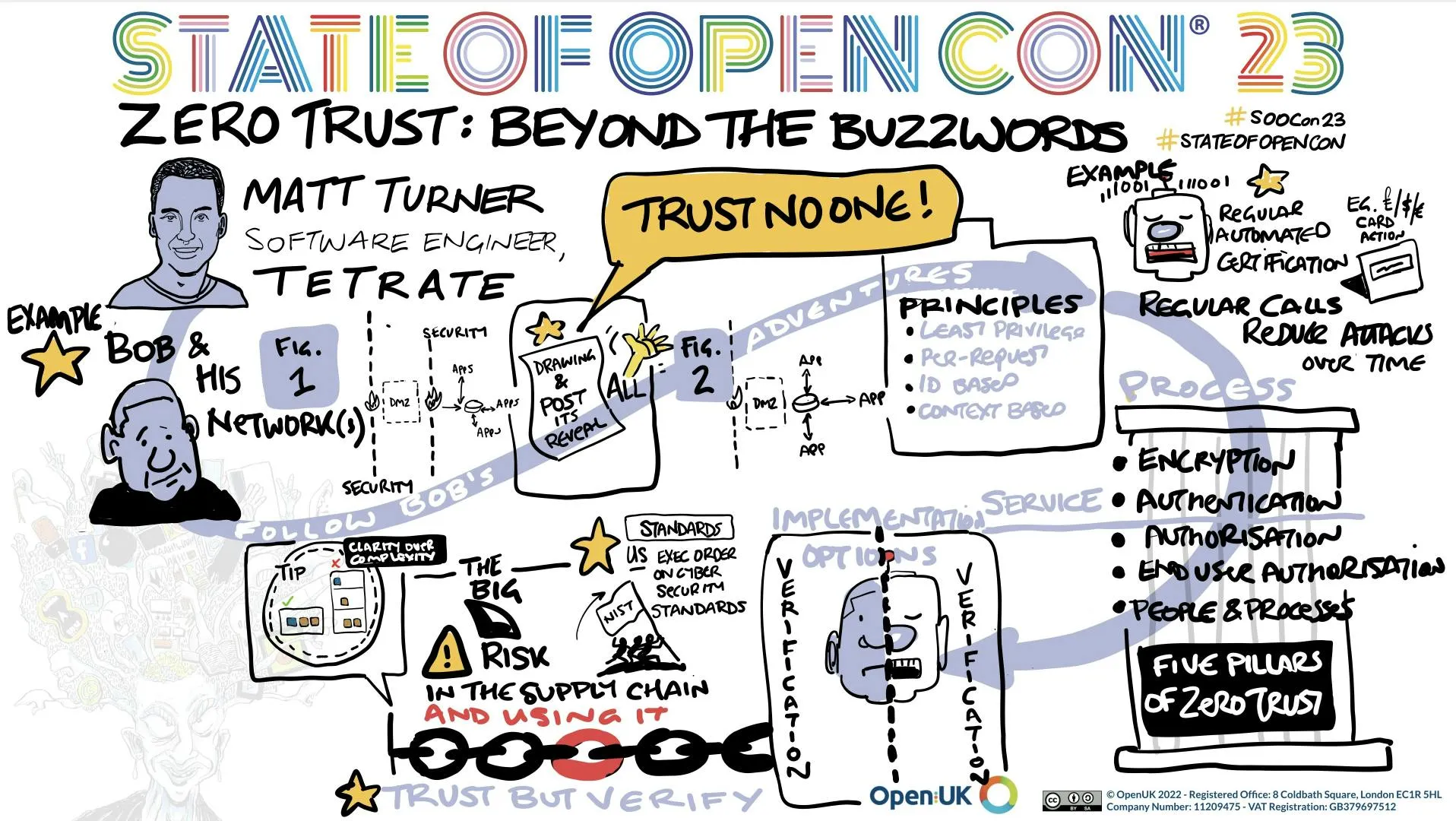
The session focused on the meaning and benefits of the increasingly popular "Zero Trust" approach, what it truly means, what it aims to achieve, and how we can implement it to enhance our security.
Matt started by succinctly defining zero-trust networking with five specific criteria, and then went on to discuss how this approach can be implemented in modern and traditional environments alike. He also touched on the latest NIST standards that can help guide the development of high-trust systems.
He then delved into the technical side of things, discussing topics such as the use of containerization and eBPF for strong isolation, as well as trusted execution environments that are tied to TPMs. He placed a particular emphasis on practical supply chain issues, including using SBOMs to identify what's in software images, building custom minimal images, and keeping ca-certs up to date. Overall, I found the talk to be highly informative and engaging, and it provided me with a better understanding of how we can approach security in a more robust way.
Drawing of Matt Turner's talk at SOOCon 23 by Drawnalism
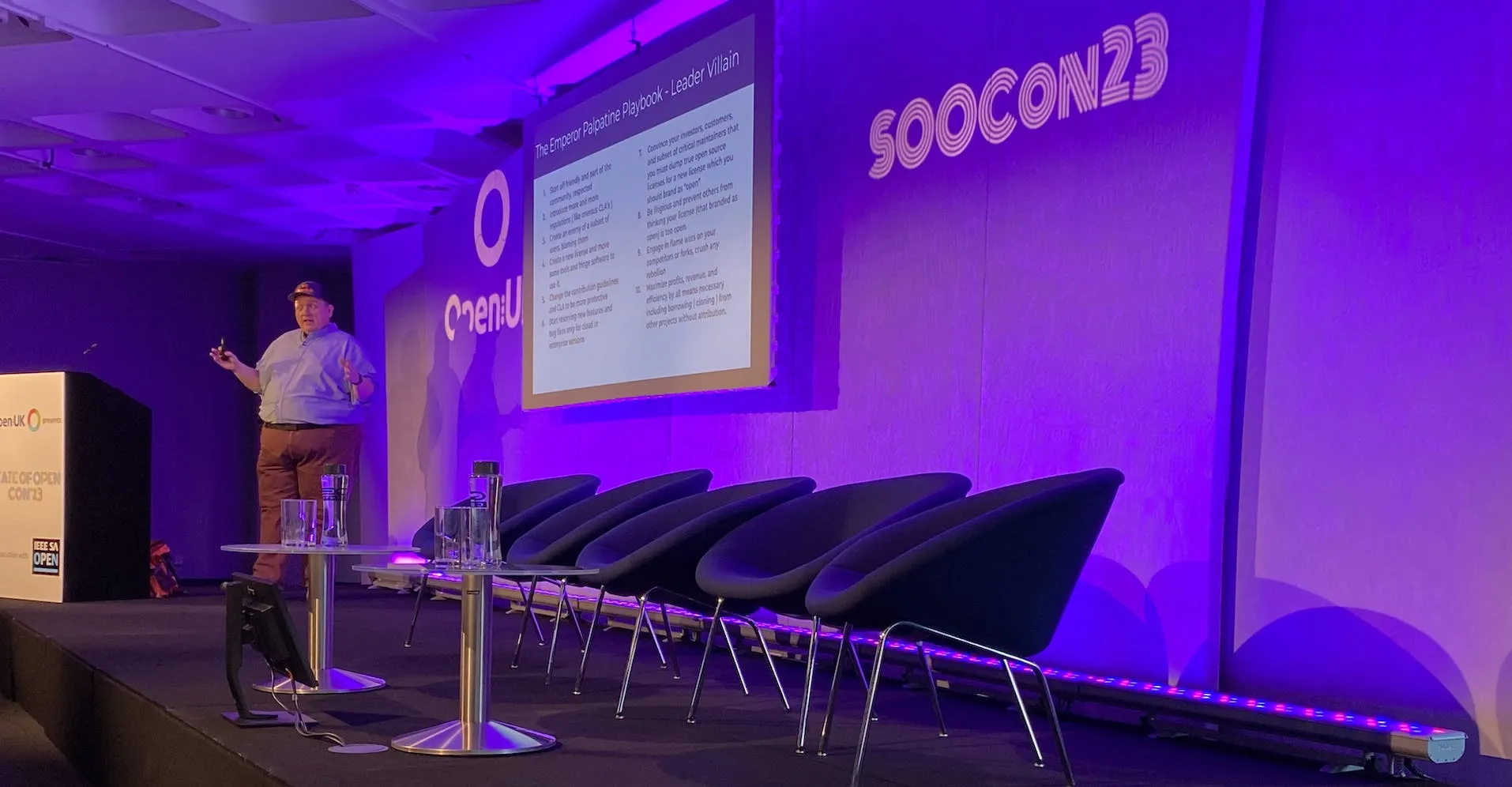
In this session, Matt Yonkovit, Head of Open Source Strategy at Scarf, provided a unique perspective on building an open source community by focusing on what NOT to do (unless you are a Supervillain). Matt shared his insights on how a project, company, or community can be slowly dismantled and cause large communities to abandon a technology or project. He shared proven ways to not only stunt community growth but also destroy it, intentionally or inadvertently.
Matt took the audience through a journey of the secret community-destroying weapons of supervillains. He discussed how they could be applied to real-life scenarios to slowly bring the user base down to zero.
His insights and examples provided a unique and fresh perspective on community building end he even offered a certificate for becoming a "certified evil community-destroying supervillain," which was a fun.
Matt Yonkovit at the SOOCon 23
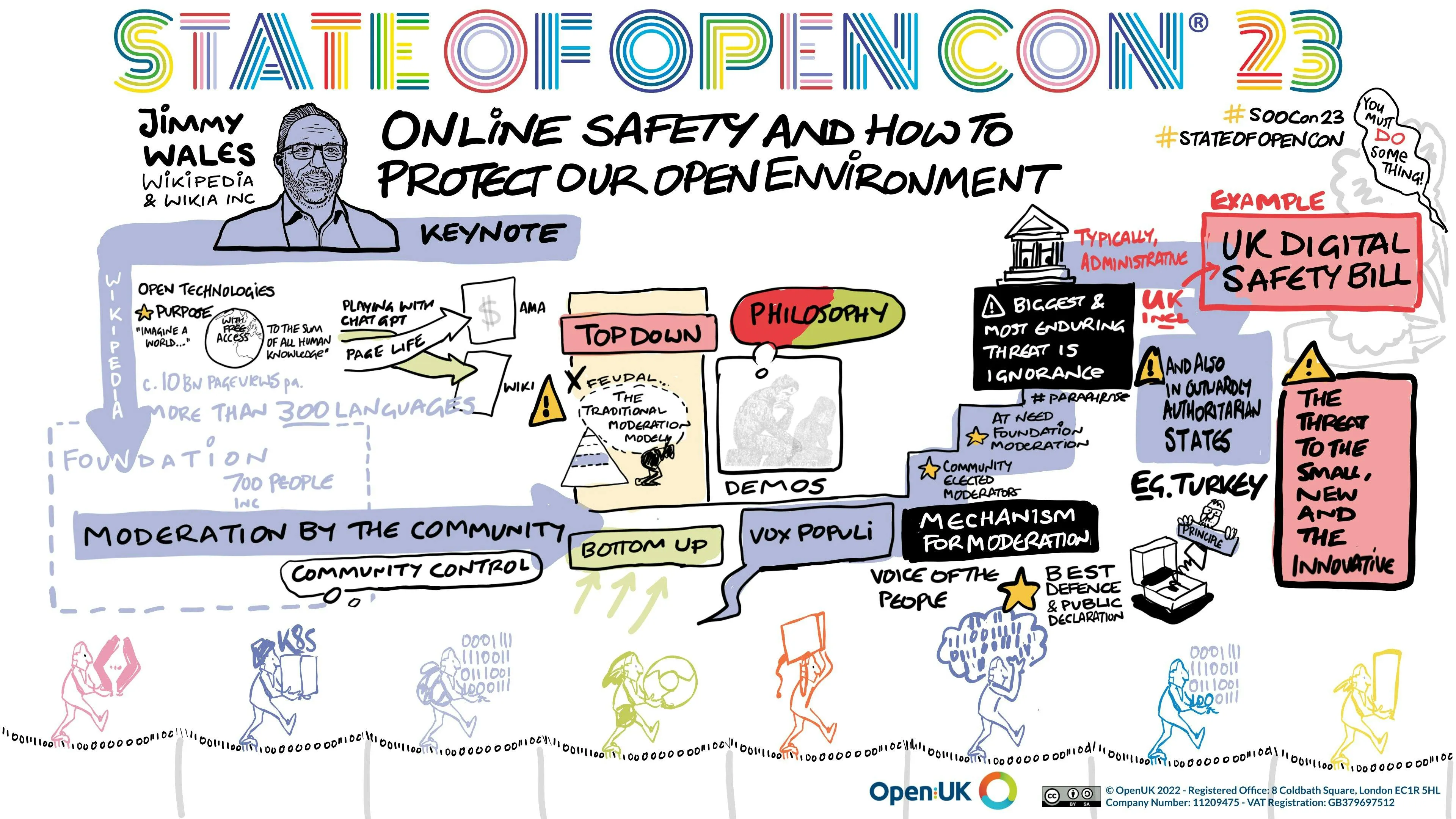
Online Safety and How to Protect Our Open Environment
In this session, Jimmy Wales, the founder of Wikipedia, spoke about the importance of protecting open technologies for the future of free and open societies. He emphasized how free knowledge platforms like Wikipedia, which are built by volunteers from around the world, depend on open software and data as well as copyright laws that allow ideas and information to spread.
Jimmy expressed his excitement for OpenUK, as it provided an opportunity to discuss how the UK government can protect and support the open movement. He stressed the importance of online safety and the need for strong protection of online communities against misinformation, harassment, and other online dangers.
The talk was highly inspiring, and it highlighted the essential role that open technologies play in building a more equitable and informed society.
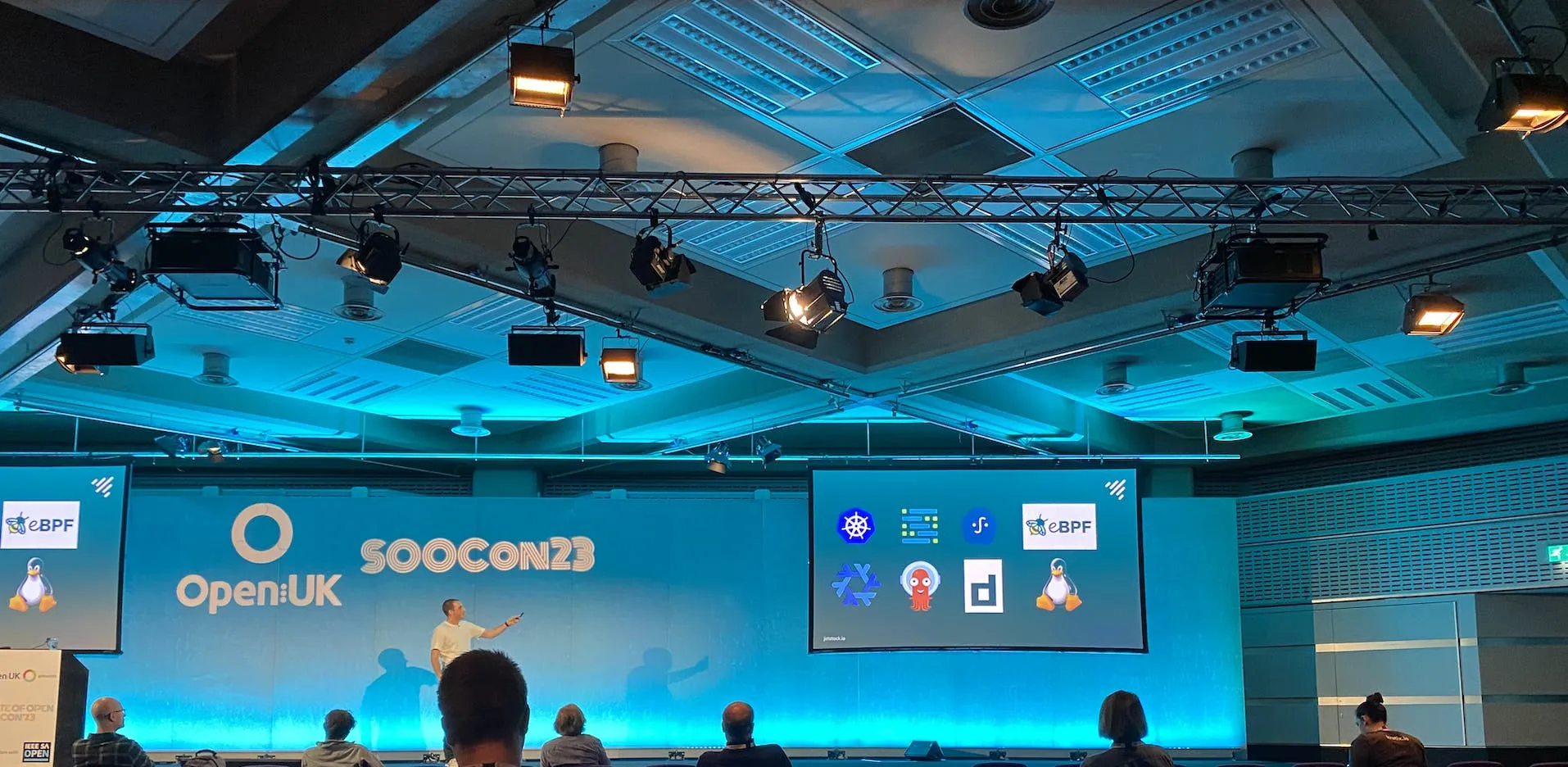
In this powerful 15-minute talk, Thomas Meadows, a Solutions Engineer at Jetstack, shared his journey in the tech industry. He began by sharing how his summer holidays to Cuba caused him to miss out on a conference in Tampa, FL, as his ESTA got refused and it was too late for a Visa, which is why he ended up giving a small talk at SOOCon. Despite being his first-ever real talk, Thomas delivered a compelling and engaging presentation. Thomas then delved into how he initially found the tech industry daunting and struggled to comprehend the various concepts and jargon at the start. However, he persevered and found a supportive community that helped him grow and excel in his career. While he may have only sometimes fully understood the technical aspects of his job, Thomas found that the community made him love his work. Thomas's story was inspiring, and he highlighted that anyone can succeed in tech. You don't need to be a superhero with unlimited resources to succeed; you need a willingness to learn and a supportive community to help you along the way. I was genuinely inspired by Thomas’s talk and can’t wait to hear him speak again at the Kubecon conference.
Thomas Meadows at SOOCon 23
Agents ship fast. Guardrails keep them safe.
Qovery ensures every agent action is scoped, audited, and policy-checked. Start deploying in under 10 minutes.
Absolutely! Thank you for taking the time to read my recap of the State of Open Con 2023. I hope you enjoyed the highlights I shared from this event, and it was insightful for you to know more about the open-source cloud computing community and infrastructure. The conference provided an excellent opportunity for learning and exchanging ideas between developers, experts, and users from the open-source community. If you want to see the full talks, you can find all of it on their Youtube Channel and my side; I will patiently wait for the SOOCon 2024!