Blog
Community
Events
3
minutes

Qovery at the Open Source Experience Event in Paris

Join Romaric (CEO at Qovery) on November 9 and 10 in Paris for the Open Source Experience, where he will be the track leader for the DevOps and Cloud track.
September 26, 2025
Albane Tonnellier
Product Marketing Manager
Summary
Twitter icon
linkedin icon

What is the Open Source Experience?

Supported by Systematic Paris Region, the Open Source Experience is the meeting place for the entire open-source software industry, bringing together more than 4,500 professionals over two days! A place for technological exchanges, meetings, and business opportunities dedicated to open source and to all the players in the open source sector.

Open Source Experience focuses on open source technologies, solutions, and challenges in France and Europe. It highlights the driving role of open-source innovations in the digital transformation of companies in technologies such as AI, IoT, Cloud, and Blockchain.

Talks

During this event, you will be able to enjoy plenty of talks with a panel of speakers coming from inspiring companies and while here is the list of all the talks, let me give you a glimpse of what you can find:

  • Secure multi-cloud deployment by Tony Jarriault - Cloud architect - SOGETI
  • Honey, I Shrunk the cloud cost by Yannig PERRE - Administrateur système - AIOS
  • Open Source, the appropriate response to societal and environmental issues by Charline Rageade - Accompagnatrice du changement | Ecologeek | Un pied dans l'agilité et l'autre dans le libre - Algoo

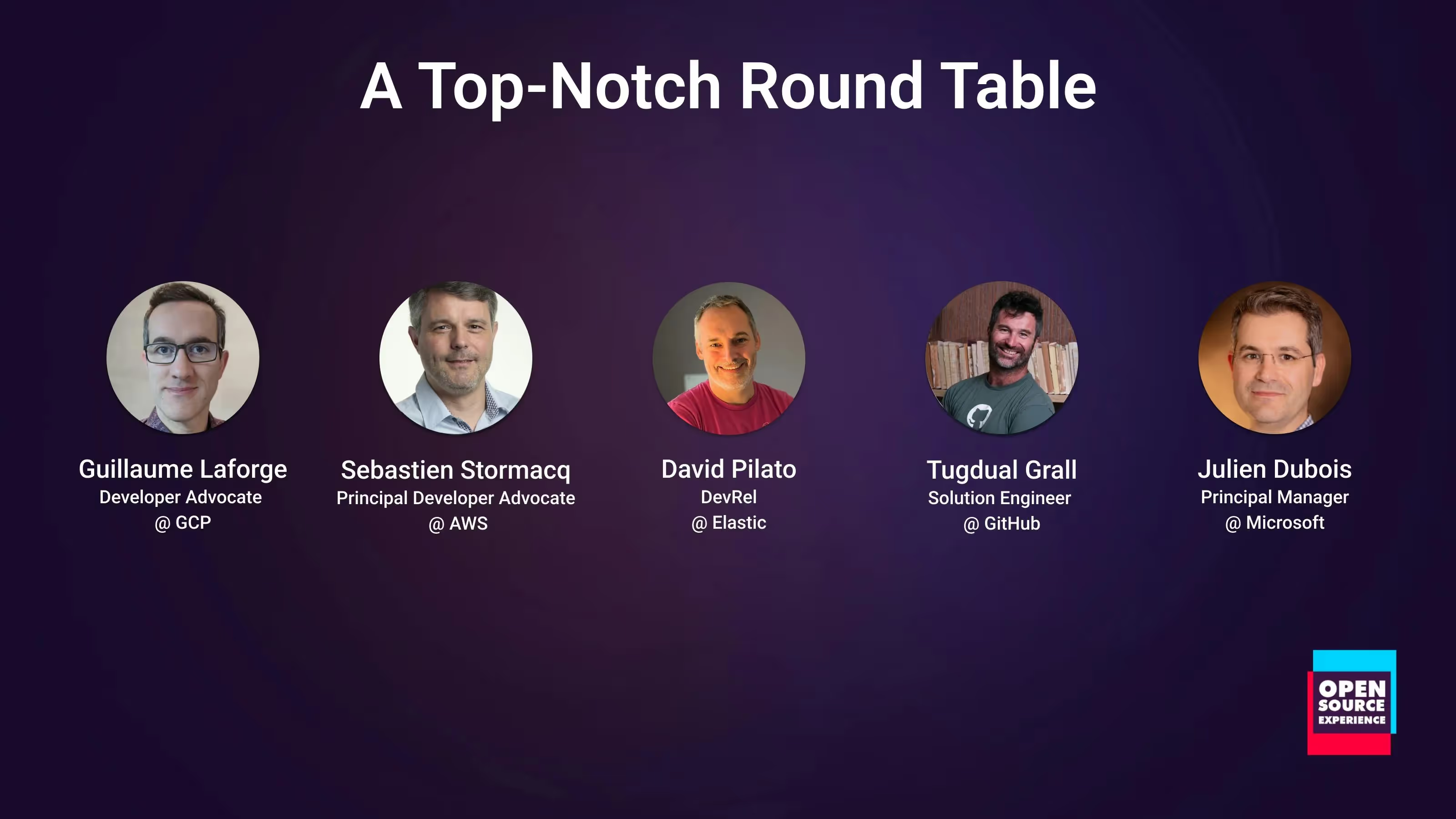
A Top-Notch Round Table

Whether it’s about securing multi-cloud deployment, hyperscaling platform and technology independence, database management in a fast-growing SaaS start-up, and much more, it will be the right place to come and get advice from one of the 80 open source experts and exhibitors that will be present at the event!

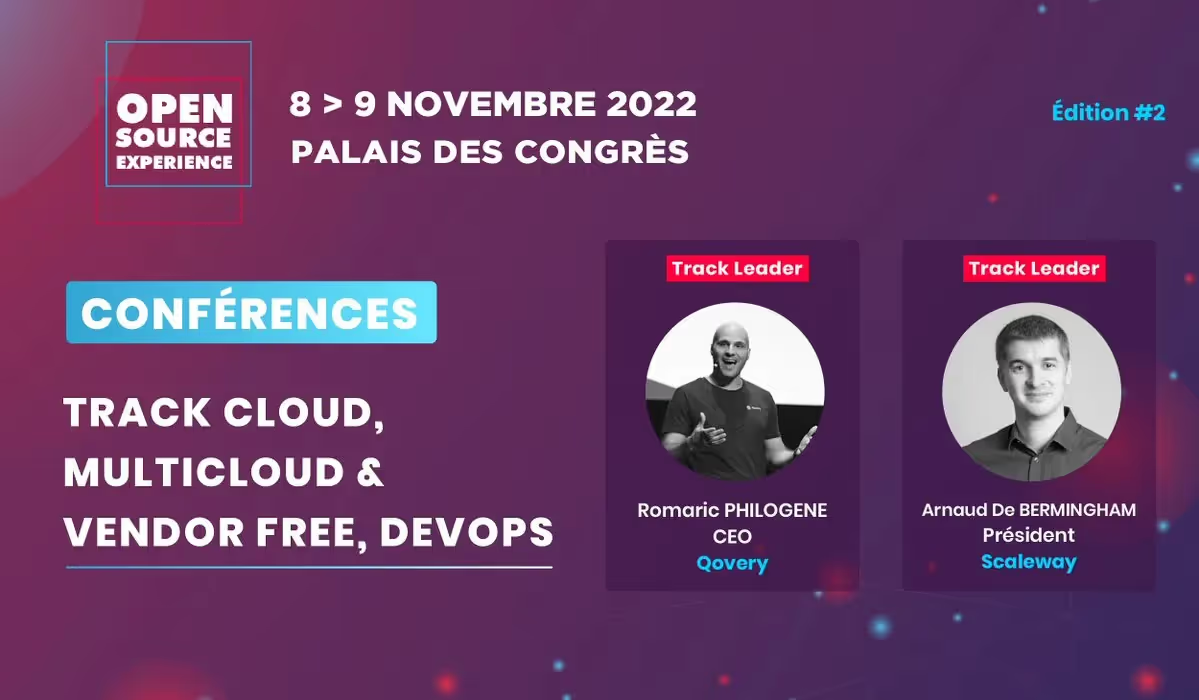
But that’s not it; discover the conferences of the track "Cloud, Multicloud & vendor-free, DevOps" with Romaric Philogène (Qovery) and Arnaud de Bermingham (Scaleway), which will be the track leaders for the event.

The conference also includes a top-notch round table with:

  • Guillaume Laforge, Developer Advocate for Google Cloud Platform and Co-founder of the Apache Groovy programming language
  • Sebastien Stormacq, Principal Developer Advocate at Amazon Web Services
  • David Pilato, Devrel at Elastic for 10 years now, organizer of several events such as Devoxx
  • Tugdual Grall, Solution Engineer at GitHub
  • Julien Dubois, Principal Manager, Java & JavaScript Developer Advocacy at Microsoft and Creator of JHipster
A Top Notch Round Table

Want to come?

Of course, we would love to see you there; make sure you are available on the 9 or 10 of November in Paris and grab your free invite. Don’t hesitate to drop us a line if you’re coming and are planning to meet us there. 💜

Share on :
Twitter icon
linkedin icon
Tired of fighting your Kubernetes platform?
Qovery provides a unified Kubernetes control plane for cluster provisioning, security, and deployments - giving you an enterprise-grade platform without the DIY overhead.
See it in action

Suggested articles

Kubernetes
7
 minutes
Day 2 operations: an executive guide to Kubernetes operations and scale

Kubernetes success is determined by Day 2 execution, not Day 1 deployment. While migration is a bounded project, maintenance is an infinite loop that often consumes 40% of senior engineering capacity. To protect margins and velocity, enterprises must transition from manual toil to agentic automation that handles scaling, security, and cost.

Mélanie Dallé
Senior Marketing Manager
Kubernetes
8
 minutes
The 2026 guide to Kubernetes management: master day-2 ops with agentic control

Master Kubernetes management in 2026. Discover how Agentic Automation resolves Day-2 Ops, eliminates configuration drift, and cuts cloud spend on vanilla EKS/GKE/AKS.

Romaric Philogène
CEO & Co-founder
DevOps
Kubernetes
6
 minutes
Day-0, day-1, and day-2 Kubernetes: defining the phases of fleet management

Day-0 is planning, Day-1 is deployment, and Day-2 is the infinite lifecycle of maintenance. While Day-0/1 are foundational, Day-2 is where enterprise operational debt accumulates. At fleet scale (1,000+ clusters), managing these differences manually is impossible, requiring agentic automation to maintain stability and eliminate toil.

Morgan Perry
Co-founder
Kubernetes
7
 minutes
Kubernetes multi-cluster: the Day-2 enterprise strategy

A multi-cluster Kubernetes architecture distributes application workloads across geographically separated clusters rather than a single environment. This strategy strictly isolates failure domains, ensures regional data compliance, and guarantees global high availability, but demands centralized Day-2 control to prevent exponential cloud costs and operational sprawl.

Morgan Perry
Co-founder
Kubernetes
6
 minutes
Kubernetes observability at scale: cutting the noise in multi-cloud environments

Stop overpaying for Kubernetes observability. Learn how in-cluster monitoring and AI-driven troubleshooting with Qovery Observe can eliminate APM ingestion fees, reduce SRE bottlenecks, and make your cloud costs predictable.

Mélanie Dallé
Senior Marketing Manager
Kubernetes
 minutes
Understanding CrashLoopBackOff: Fixing AI workloads on Kubernetes

Stop fighting CrashLoopBackOff on your AI deployments. Learn why traditional Kubernetes primitives fail large models and GPU workloads, and how to orchestrate AI infrastructure without shadow IT.

Mélanie Dallé
Senior Marketing Manager
Kubernetes
Platform Engineering
 minutes
Kubernetes multi-cluster architecture: solving day-2 fleet sprawl

Kubernetes multi-cluster management is the Day-2 operational practice of orchestrating applications, security, and configurations across geographically distributed clusters. Because native Kubernetes was designed for single-cluster orchestration, enterprise platform teams must implement a centralized control plane to prevent configuration drift and manage a global fleet without scaling manual toil.

Mélanie Dallé
Senior Marketing Manager
Engineering
Product
11
 minutes
How to achieve zero downtime on kubernetes: a Day-2 architecture guide

Achieving zero-downtime deployments on Kubernetes requires more than running multiple pods. It demands a standardized architecture utilizing Pod Disruption Budgets (PDBs), precise liveness and readiness probes, pod anti-affinity, and graceful termination handling. At an enterprise scale, these configurations must be enforced via a centralized control plane to prevent catastrophic configuration drift.

Pierre Mavro
CTO & Co-founder

It’s time to change
the way you manage K8s

Turn Kubernetes into your strategic advantage with Qovery, automating the heavy lifting while you stay in control.