Blog
Events
2
minutes

Meetup - The Present and The Future of Infrastructure as Code

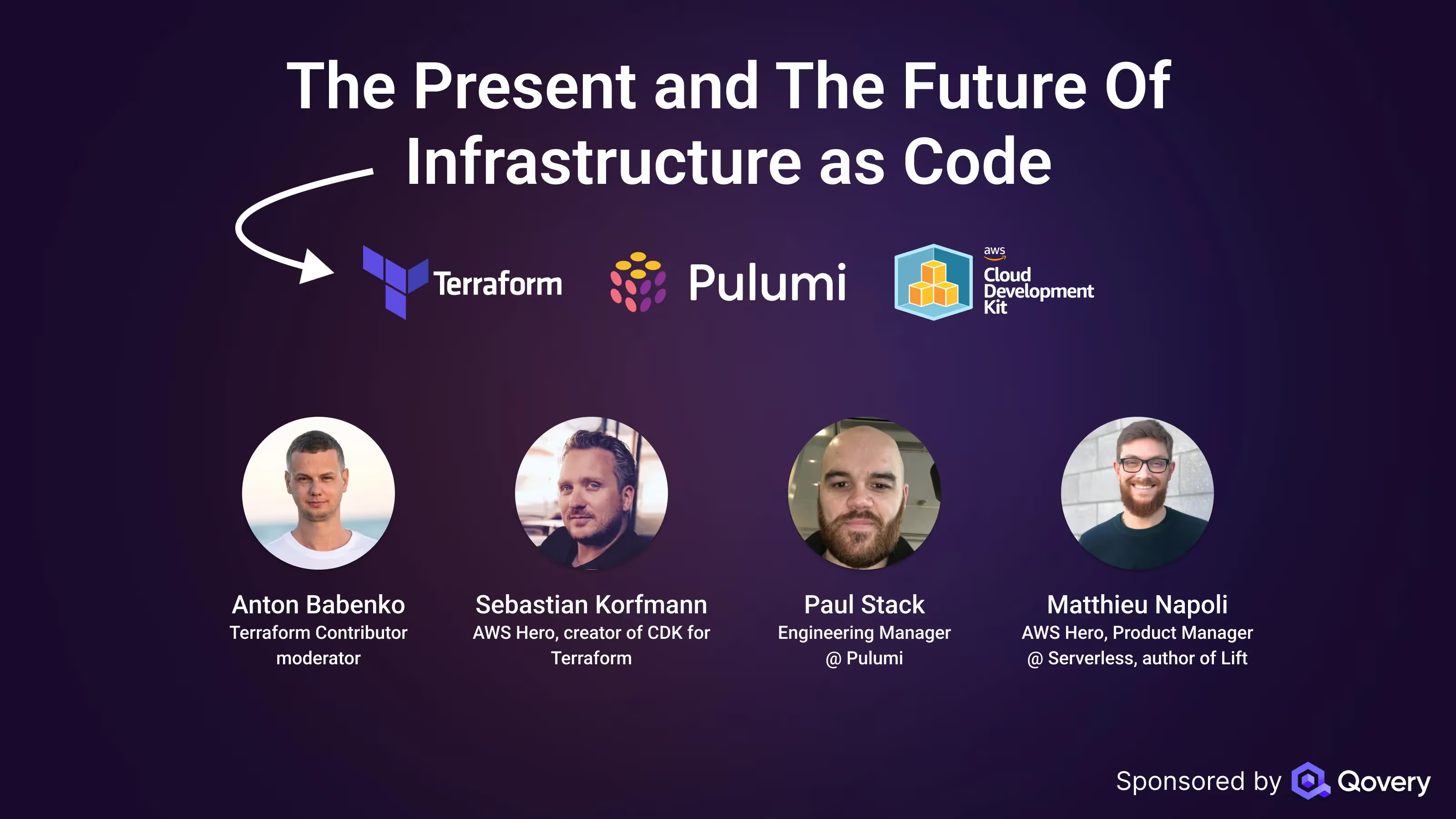
On Tuesday, 11th October at 6 PM Paris time, Qovery will be the proud sponsor of an expert panel about the future of IaC and Terraform with Anton Babenko (Terraform Influencer and open-source maintainer of AWS Terraform modules), Sebastian Korfmann (the original creator of Terraform for CDK), Matthieu Napoli (former PM of Serverless Framework, author of Lift), Paul Stack (engineering manager at Pulumi Corporation), the meetup will take place in Paris. đŸ‡«đŸ‡·
November 19, 2025
Albane Tonnellier
Product Marketing Manager
Summary
Twitter icon
linkedin icon

Tell Me More!

The goal is to discuss Infrastructure as Code with several experts and lightning talks by the community (no boring sales pitches).

This HUG meetup will be in English and will talk about the Present and The Future of Infrastructure as Code:

  • Pulumi, Terraform, CDK, other ?
  • What do you think about Components and Higher-level constructs?
  • Why is the DX experience an afterthought?
  • Is type safety overrated?
  • How many IaC tools does it take to change a light bulb?
  • Ask your question beforehand here

Join us if you are curious about DevOps, Infrastructure as Code, Terraform, Pulumi, CDKs, and everything in between!

Agenda

⏰ Meetup on Tuesday 11th of October from 6 PM.

🍔 đŸ„€ 18:00 - Snacks and non-alcoholic drinks (sponsored by Couchbase). Time to mingle.

âšĄïž 19:00 - Lightning talk - 10 minutes max, by the community, no sales pitches, straight to the point. Call for speakers is open!

đŸŽ€ 19:30 - Round table (in English) - the Present and The Future of Infrastructure as Code - with industry experts:

⭐ Paul Stack works as an engineering manager at Pulumi Corporation and is an expert in DevOps, IaC, and many other areas.

⭐ Matthieu Napoli is an AWS Hero, former PM of Serverless Framework, and author of Lift, integrating AWS CDK with Serverless Framework.

⭐ Sebastian Korfmann is an AWS Hero and the original creator of Terraform for CDK.

⭐ Anton Babenko (moderator) is an AWS Hero, Terraform influencer, and open-source maintainer of AWS Terraform modules.

Want to Join Us?

You need to be in Paris on the 11th of October and register by following this link!

Share on :
Twitter icon
linkedin icon
Tired of fighting your Kubernetes platform?
Qovery provides a unified Kubernetes control plane for cluster provisioning, security, and deployments - giving you an enterprise-grade platform without the DIY overhead.
See it in action

Suggested articles

Kubernetes
 minutes
Stopping Kubernetes cloud waste: agentic automation for enterprise fleets

Agentic Kubernetes resource reclamation is the practice of using an autonomous control plane to continuously identify, suspend, and delete idle infrastructure across a multi-cloud Kubernetes fleet. It replaces manual cleanup and reactive autoscaling with intent-based policies that act on business state, eliminating the configuration drift and cloud waste typical of unmanaged fleets.

Mélanie Dallé
Senior Marketing Manager
Platform Engineering
Kubernetes
DevOps
10
 minutes
What is Kubernetes? The reality of Day-2 enterprise fleet orchestration

Kubernetes focuses on container orchestration, but the reality on the ground is far less forgiving. Provisioning a single cluster is a trivial Day-1 exercise. The true operational nightmare begins on Day 2. Teams that treat multi-cloud fleets like isolated pets inevitably face crushing YAML configuration drift, runaway AWS bills, and severe scaling bottlenecks.

Morgan Perry
Co-founder
AI
Compliance
Healthtech
 minutes
Agentic AI infrastructure: moving beyond Copilots to autonomous operations

The shift from AI copilots to autonomous agents is redefining infrastructure requirements. Discover how to build secure, stateful, and compliant Agentic AI systems using Kubernetes, sandboxing, and observability while meeting EU AI Act standards

Mélanie Dallé
Senior Marketing Manager
Kubernetes
8
 minutes
The 2026 guide to Kubernetes management: master day-2 ops with agentic control

Effective Kubernetes management in 2026 demands a shift from manual cluster building to intent-based fleet orchestration. By implementing agentic automation on standard EKS, GKE, or AKS clusters, enterprises eliminate operational weight, prevent configuration drift, and proactively control cloud spend without vendor lock-in, enabling effective scaling across massive fleets.

Mélanie Dallé
Senior Marketing Manager
Kubernetes
 minutes
Building a single pane of glass for enterprise Kubernetes fleets

A Kubernetes single pane of glass is a centralized management layer that unifies visibility, access control, cost allocation, and policy enforcement across § cluster in an enterprise fleet for all cloud providers. It replaces the fragmented practice of switching between AWS, GCP, and Azure consoles to govern infrastructure, giving platform teams a single source of truth for multi-cloud Kubernetes operations.

Mélanie Dallé
Senior Marketing Manager
Kubernetes
 minutes
How to deploy a Docker container on Kubernetes (and why manual YAML fails at scale)

Deploying a Docker container on Kubernetes requires building an image, authenticating with a registry, writing YAML deployment manifests, configuring services, and executing kubectl commands. While necessary to understand, executing this manual workflow across thousands of clusters causes severe configuration drift. Enterprise platform teams use agentic platforms to automate the entire deployment lifecycle.

Mélanie Dallé
Senior Marketing Manager
Qovery
Cloud
AWS
Kubernetes
8
 minutes
10 best practices for optimizing Kubernetes on AWS

Optimizing Kubernetes on AWS is less about raw compute and more about surviving Day-2 operations. A standard failure mode occurs when teams scale the control plane while ignoring Amazon VPC IP exhaustion. When the cluster autoscaler triggers, nodes provision but pods fail to schedule due to IP depletion. Effective scaling requires network foresight before compute allocation.

Morgan Perry
Co-founder
Kubernetes
Terraform
 minutes
Managing Kubernetes deployment YAML across multi-cloud enterprise fleets

At enterprise scale, managing provider-specific Kubernetes YAML across multiple clouds creates crippling configuration drift and operational toil. By adopting an agentic Kubernetes management platform, infrastructure teams abstract cloud-specific configurations (like ingress controllers and storage classes) into a single, declarative intent that automatically reconciles across 1,000+ clusters.

Mélanie Dallé
Senior Marketing Manager

It’s time to change‹the way you manage K8s

Turn Kubernetes into your strategic advantage with Qovery, automating the heavy lifting while you stay in control.