Is it GitOps or DevOps? Stop choosing between them. Learn how DevOps culture and GitOps workflows work together to automate Kubernetes, eliminate drift, and accelerate software delivery.
The "Why" vs. The "How": DevOps is the overarching philosophy of collaboration and shared responsibility, while GitOps is the specific technical mechanism for implementing those principles in cloud-native environments.
Imperative vs. Declarative: Traditional DevOps often relies on imperative scripts, whereas GitOps relies on declarative configuration and automated reconciliation (pulling state from Git).
Abstraction is Key: While GitOps offers superior auditability and consistency, implementing it manually is complex. Platforms like Qovery abstract the reconciliation layer, allowing teams to adopt GitOps workflows without maintaining custom agents.
"GitOps vs. DevOps" is a false dichotomy. If you view them as competing alternatives, you are missing the bigger picture.
DevOps is the philosophy, the cultural shift toward collaboration, automation, and shared ownership. GitOps is the mechanism, the concrete set of practices used to implement that philosophy specifically for Kubernetes and cloud-native infrastructure.
They operate at different levels of abstraction. DevOps tells you why you need to automate; GitOps tells you how to do it securely using version control as your single source of truth. In this article, we break down the distinction, the relationship, and how to combine them to build a resilient engineering organization.
DevOps: The Philosophy and the "Why"
DevOps emerged in the late 2000s as a response to organizational dysfunction within engineering teams. Development teams wrote code and threw it over the wall to operations teams responsible for running it. This separation created misaligned incentives, slow feedback loops, and mutual blame when systems failed.
The DevOps movement proposed a cultural shift: break down silos between development and operations, share responsibility for system reliability, and automate manual processes that slow delivery. Rather than a specific technology or tool, DevOps represents a philosophy about how software teams should work.
The Four Pillars of DevOps
DevOps culture rests on four foundational principles that guide organizational behavior and technical decisions.
1. Culture
Culture emphasizes collaboration and shared ownership. Development and operations teams work together throughout the software lifecycle rather than operating as separate departments with handoff points. The target being for everyone to take ownership for production reliability.
2. Automation
Automation removes manual steps from repetitive processes. Build, test, deployment and infrastructure provisioning pipelines execute without human intervention. Automation reduces errors, increases speed, and frees engineers for product development work.
3. Lean
Lean principles focus on eliminating waste and optimizing flow. Incremental delivery reduces risk and accelerates feedback, while continuous improvement drives incremental refinement of processes and systems.
4. Measurement
Measurement provides visibility into system behavior and team performance. Deployment frequency, lead time, change failure rate, and mean time to recovery quantify delivery effectiveness. Monitoring and observability reveal system health as teams use data to drive decisions rather than intuition.
Organizations implement DevOps through various practices: continuous integration, continuous delivery, infrastructure as code, monitoring, and incident response. These practices embody the philosophy without prescribing specific tools or workflows.
GitOps: The Mechanism for Cloud-Native Automation
GitOps emerged as a specific methodology for operating production workloads and Kubernetes clusters. Rather than a broad philosophy, GitOps prescribes concrete practices for managing infrastructure and application deployments.
The core insight is simple: Git already provides version control, collaboration workflows, audit trails, and rollback capabilities for application code. These features should then be used for infrastructure and deployment configuration.
The Four Principles of GitOps
GitOps defines four principles that distinguish it from other deployment approaches.
1. Declarative Configuration
Declarative configuration describes the desired system state rather than the steps to achieve it. Kubernetes manifests, Helm charts, or terraform configurations specify what should exist, and the system determines how to reach that state from the current configuration. This approach eliminates imperative scripts that may behave differently depending on starting conditions.
2. Git as the Single Source of Truth
Git serves as the single source of truth for all configurations. Every change to infrastructure or application deployment flows through Git repositories. The cluster state reflects what exists in Git, and Git history provides a complete audit trail of every change, who made it, and when.
3. Automated Reconciliation
Automated reconciliation continuously compares the actual cluster state against the desired state in Git. When differences exist, the system automatically applies changes to bring reality into alignment with the declared configuration. This self-healing behavior corrects drift without manual intervention.
4. Agent-Based Pull Deployment
Agent-based pull deployment inverts the traditional push model. Rather than CI pipelines pushing changes to clusters, agents running inside clusters pull configuration from Git repositories. This approach improves security by eliminating the need for external systems to have cluster credentials.
GitOps implementations typically involve deploying and managing a reconciliation agent like ArgoCD or Flux in the cluster. Developers commit configuration changes to Git, and the agent detects changes and applies them to the cluster automatically.
This workflow provides several benefits. Traceability comes automatically through Git history, and rollbacks execute by reverting commits rather than remembering previous configurations.
The approach particularly suits Kubernetes environments where declarative configuration is native to the platform. The reconciliation model aligns with how Kubernetes controllers already operate, extending the same pattern to the deployment process itself.
Agents ship fast. Guardrails keep them safe.
Qovery ensures every agent action is scoped, audited, and policy-checked. Start deploying in under 10 minutes.
Understanding how GitOps and DevOps relate requires examining their scope, mechanisms, and how they reinforce each other in practice.
Scope and Abstraction Level
DevOps operates at the organizational and cultural level, as it addresses how teams collaborate, what values guide decisions, and which practices improve delivery effectiveness. DevOps applies to any software organization regardless of technology stack or deployment target.
GitOps operates at the infrastructure and deployment level. It specifies how configuration should be managed, where truth lives, and what mechanisms enforce consistency. GitOps applies specifically to declarative infrastructure, particularly Kubernetes environments.
The relationship is hierarchical rather than competitive. DevOps provides the foundation, while GitOps provides a specific implementation approach.
Change Mechanisms: Imperative vs. Declarative
Traditional DevOps implementations often use imperative deployment scripts. CI pipelines execute commands that modify production systems directly: apply this manifest, run this migration, restart this service.
GitOps uses declarative configuration with pull-based reconciliation. No external system pushes changes directly. Instead, agents inside the cluster pull configuration and apply it autonomously. The only way to change the system is to change the git repository.
This shift from imperative to declarative represents a maturation of DevOps automation principles. Both approaches automate deployment, but GitOps provides stronger guarantees about consistency, auditability, and security.
Complementary Strengths
DevOps principles focus on automating deployments, while GitOps specifies exactly how: declarative configuration in Git, reconciled automatically by cluster agents.
DevOps enhances collaboration across teams, while GitOps enables this through pull request workflows where infrastructure changes receive the same review process as application code. Operations, security, and development teams collaborate in shared repositories with established review processes.
DevOps helps teams measure everything, and GitOps supports this by providing automatic audit trails through Git history, showing every change, its author, and its timestamp without additional logging infrastructure. Compliance and security reviews become straightforward when every modification exists in version control.
Qovery's Value in GitOps Adoption
Many teams attempt GitOps adoption only to abandon it when operational burden exceeds perceived benefit. The principles remain good, but the implementation becomes a hard reach for organizations without dedicated platform engineering resources.
Eliminate Operational Toil
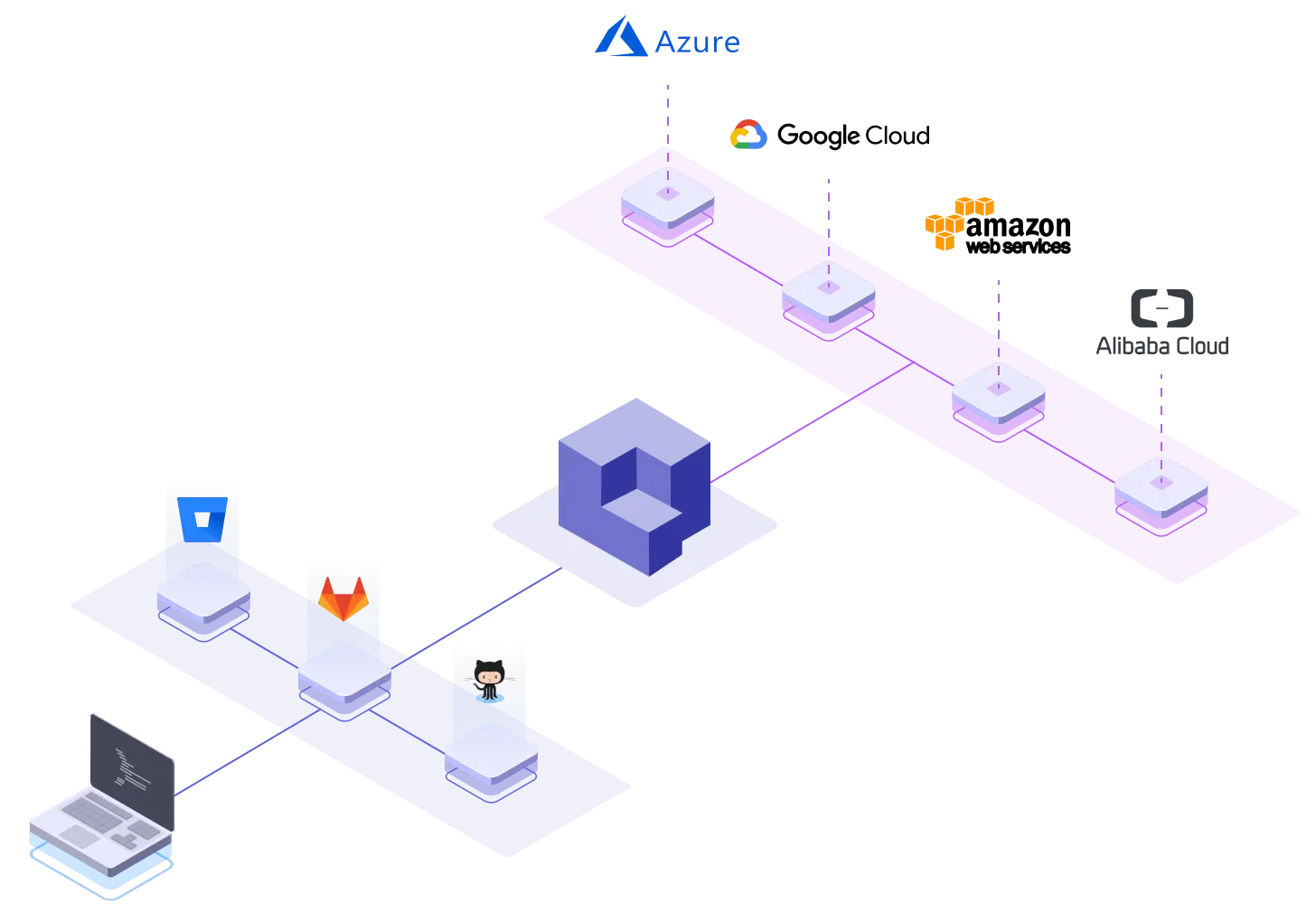
Qovery abstracts the complexity of Kubernetes, allowing developers to adopt GitOps best practices without manually configuring ArgoCD, Flux, or writing complex YAML. The platform handles environment management, deployment orchestration, and state reconciliation automatically.
Teams gain the auditability and rollback capabilities of GitOps without the operational burden of maintaining reconciliation infrastructure. This abstraction layer allows organizations to implement GitOps workflows immediately rather than spending months building internal tooling.
Full Control and Portability
Qovery lessens vendor dependence by deploying to your cloud account and building out Kubernetes clusters. Infrastructure runs on your account, not a shared multi-tenant platform, data stays within your perimeter.
This approach preserves the full control required by GitOps while simplifying the operational experience. Teams can inspect the underlying Kubernetes resources Qovery creates, export configurations, or migrate away if requirements change. The platform simplifies operations without creating lock-in.
Automated Git Workflow
Qovery provides a seamless Git-centric workflow where pushing code automatically triggers environment updates. This aligns perfectly with the GitOps principle of repositories being the single source of truth.
Pull requests can create ephemeral environments for review. Reviewers evaluate running systems, not just code changes. Merging deploys to target environments without manual intervention, effectively promoting an already tested live environment,
Environments disappear automatically when pull requests close, avoiding resource accumulation.
For teams evaluating GitOps tools, Qovery offers an alternative to assembling and maintaining a custom stack. The platform provides GitOps workflows without the operational burden of managing reconciliation agents directly.
Conclusion
GitOps is not a replacement for DevOps. It is the most mature and disciplined implementation of DevOps principles for cloud-native infrastructure. DevOps provides the cultural foundation and philosophical direction, while GitOps provides the specific mechanisms that make those principles concrete and enforceable.
Teams operating Kubernetes environments benefit most from combining both approaches. DevOps culture guides collaboration and continuous improvement. GitOps methodology ensures that deployment automation meets the highest standards of auditability, security, and reliability.
For organizations ready to adopt GitOps within their DevOps practice, the path forward involves several concrete steps:
Assessyour current deployment workflow. Identify where imperative scripts and manual processes introduce inconsistency. These friction points represent the highest-value targets for GitOps adoption.
Establish Git as your source of truth. Move infrastructure and deployment configuration into version-controlled repositories. Even before implementing reconciliation agents, this step improves traceability and enables collaborative review workflows.
Start with a single application or environment. GitOps adoption succeeds through incremental implementation rather than organization-wide transformation. Prove the model works in a contained scope before expanding.
Evaluate existing solutions for GitOps tooling. Teams with platform engineering capacity can assemble custom stacks using ArgoCD or Flux. Teams prioritizing speed and simplicity benefit from platforms like Qovery that provide GitOps workflows without operational overhead.
Stop managing reconciliation agents and YAML configurations manually. Implement GitOps workflows with Qovery and focus on delivering software, not operating deployment infrastructure. Try Qovery for free today.
Frequently asked questions
What is the difference between GitOps and DevOps?
DevOps is a culture and set of principles for collaboration between development and operations to deliver software faster and more reliably. GitOps is a specific operational mechanism that implements those principles for cloud-native systems by using Git as the single source of truth and automated agents to reconcile actual state with desired state. DevOps is the "why"; GitOps is one concrete "how".
Can GitOps and DevOps work together?
Yes - they are complementary, not competing. DevOps provides the cultural foundation (collaboration, automation, measurement) while GitOps provides the enforcement mechanism (declarative config, Git as source of truth, automated reconciliation). Teams running Kubernetes get the most value by combining both: DevOps culture guides how they work, and GitOps ensures deployments are auditable and drift-free.
Is GitOps replacing DevOps?
No. GitOps does not replace DevOps; it is the most disciplined implementation of DevOps principles for cloud-native and Kubernetes management. You still need DevOps culture and broader DevOps automation practices - GitOps simply makes deployment automation more reliable and reversible.
What tools are used for GitOps?
The most common GitOps tools are Argo CD and Flux, which continuously reconcile cluster state with Git repositories. Teams that prefer to avoid operating these agents themselves can use a platform like Qovery that provides GitOps workflows out of the box without the maintenance overhead.
Melanie leads content at Qovery. She covers platform engineering trends, Kubernetes operations, FinOps, and the tools that help engineering teams ship faster.
Next step
Agents ship fast. Guardrails keep them safe.
Qovery ensures every agent action is scoped, audited, and policy-checked. Start deploying in under 10 minutes.