
Vercel to AWS in an hour.
Fully automated.
One command. An agent reads your repository and your vercel.json, then deploys into the AWS account you already own - after you approve the plan.
Eligible teams may receive AWS migration credits through our ISV Accelerate partnership.

Trusted by +200 companies to simplify their infrastructure burden










Proven by teams
that moved to AWS
See how teams moved their applications into AWS accounts they own and improved the way they deploy.
“Within a few days, we had something running that replicates our previous setup but with multiple environments, greater control, best practices in place, extensibility, and future-proof capabilities.”

“We liked the ease of a managed platform, and we knew AWS meant skills and effort we did not have spare - that is why we kept putting the migration off. We do not regret doing it with Qovery. Deployments that took me over two hours now take 30 minutes.”

Vercel is the best frontend DX there is. Your backend still hits a wall.
Nobody leaves Vercel over the git-push workflow or the preview URLs - those are genuinely excellent. They leave when the workload stops looking like a frontend.
A serverless function has a duration and a memory ceiling
A Vercel Function is capped at 300 seconds on Hobby, 800 seconds on Pro and Enterprise, or 1800 seconds on an extended beta - with memory topping out at 2 GB or 4 GB. Queue workers, gRPC and websocket servers holding a long connection, heavy ETL and GPU inference do not fit that shape, and Vercel’s own answer is to redesign the work around Workflows and Queues rather than run it as a persistent process.
On Qovery, running in the AWS account you already own:
Any process runs as long as it needs to on EKS, with no invocation ceiling and a GPU node pool when the workload needs one.
Your database lives in someone else’s account
Vercel provisions Postgres, key-value and vector storage through Marketplace partners - Neon, Supabase, Upstash, AWS Aurora Postgres - and injects the credentials as environment variables. That is a fast way to get a database, and a hard sentence to write for a compliance review that asks which account, region and encryption keys hold the data, because the honest answer names a company that is not you.
On Qovery, running in the AWS account you already own:
Amazon RDS for PostgreSQL runs inside your own account, under your KMS keys and your backup policy.
Production-grade governance starts at Enterprise
SAML SSO, enhanced observability and logging, isolated build infrastructure and any SLA all require the Enterprise plan - and even then, private connectivity to your own network means Secure Compute, which is dedicated static IPs plus VPC peering capped at 100 projects and 50 peering connections per network, not a VPC you configure yourself.
On Qovery, running in the AWS account you already own:
AWS IAM governs access, CloudTrail records what happened, and it is a property of the account rather than a plan tier.
Three steps, then the agent does it.
Your side takes about five minutes. Everything after that is automated.
- 01
A CloudFormation stack provisions the network and an EKS cluster in your own account - about twenty minutes, and nothing leaves your boundary. Qovery gets a role you can read, scope down or revoke. Talk to a migration engineer before you connect anything.
- 02
One command teaches your coding agent how to read the repository - a vercel.json, a Dockerfile, a zero-config build, a set of environment variables - and describe the deployment in Qovery’s own terms. Nothing is deployed at this point. You are only giving the agent the vocabulary.
- 03
The agent detects every service, writes a Dockerfile where one is missing, maps your Vercel environment variables to Qovery variables and secrets, and shows you the plan. You approve it before a single resource is created - and your Neon (via Vercel Marketplace) stays where it is, connected over the network, so you validate against real data before migrating a byte.
- 04Optional
Take this first or last - some teams want it as step zero, before they connect anything. A Qovery staff solution engineer reviews the cluster setup and environment layout with your team, then goes through the practices that keep the estate cheap and quiet: node sizing and Spot policy, autoscaling thresholds, preview-environment lifetimes, secret scoping and how to promote the same artifact between stages.
- network
- your VPC, three fixed egress IPs
- cluster
- EKS, in your region
- access
- a role scoped to Qovery
Works with any coding agent that reads skills. Nothing is deployed at this point.
web         Node.js 20      Dockerfile generated
worker      Node.js 20      detected from vercel.json
scheduler   cron            2 jobs
database    PostgreSQL 15   Neon (via Vercel Marketplace), connected remotely
Nothing has been created yet. You approve the plan first.
- cluster
- node sizing, Spot policy, autoscaling
- workflow
- stages, approval gates, preview TTLs
- access
- secret scoping, roles per environment
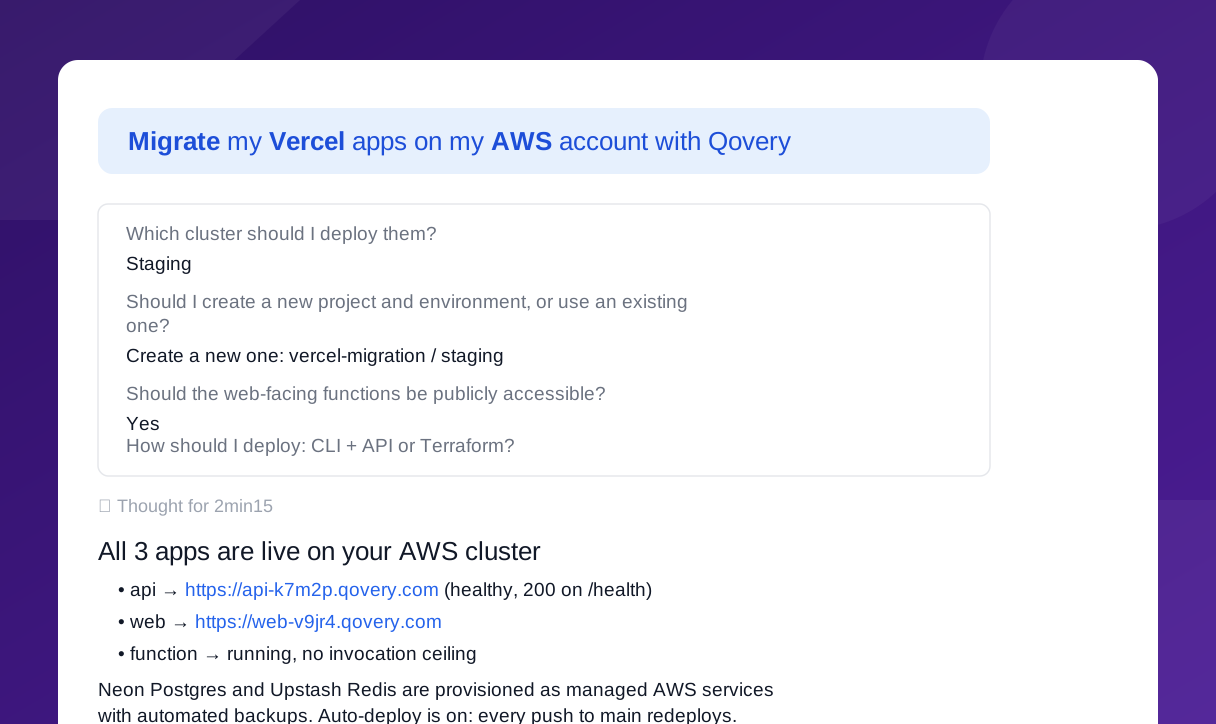
From there it is automatic. Your apps come up running and live on AWS, reachable on a public URL - while the Vercel stack keeps serving traffic untouched.
You pay AWS directly. And bandwidth stops being a line item.
Vercel bills Functions by active CPU and memory time with no commitment tier, and bandwidth over the Pro plan’s 1 TB allowance starts at $0.15/GB. AWS charges for what you use and then lets you discount it - Savings Plans, Reserved Instances, Graviton and Spot are all things you can buy as the customer, and egress on your own account is priced by AWS directly rather than marked up as a platform fee.
Depends on your function counts and durations, database and KV plans, egress volume and region. A migration engineer will model your estate against the equivalent AWS shape before you commit to anything.

AWS may fund part of your move
Answer a few questions and see roughly how much credit you could get toward the migration.
Three levers AWS gives you that a per-invocation bill does not.
A Vercel Function is billed per invocation and active CPU time, with no way to commit to a level of usage in exchange for a lower rate. Once the same workload runs in an AWS account you own, three levers open up that have no equivalent on a usage meter.
Savings Plans and Reserved Instances
Commit to a level of compute for one or three years and the same capacity costs materially less than on-demand. Vercel has no commitment tier to sell you - Functions are billed per invocation and active CPU time, forever, at the same rate whether you run one a month or a billion. Qovery sizes the node groups; the commitment is made in your account, on your terms, and it applies to everything running there rather than to one function.
Graviton, for the same code
AWS's ARM instances generally give better price-performance than the x86 equivalent on ordinary web and worker loads. The agent builds your image for arm64 and Qovery schedules the node group onto Graviton, so this is a build-target change rather than a rewrite. Vercel does not expose the processor a Function runs on, so it is not a choice you currently have.
Spot capacity for the work that can be interrupted
Background jobs, queue processing and preview environments tolerate interruption; a checkout endpoint does not. Qovery keeps web services on on-demand nodes and places the interruptible pools on Spot - a split a per-invocation Function bill cannot express, because every invocation is priced the same regardless of how much it matters.
Ceilings are AWS’s own published figures for EC2 Instance Savings Plans, Graviton and Spot, checked August 2026. Each is a best case: what a given workload realises depends on its shape, and a migration engineer models it against your bill before you commit to anything.
Our control plane. Your account, your bill.
Qovery sits above the infrastructure and never owns it. Every cluster, database and bucket is provisioned inside the AWS account you already hold - AWS invoices you directly.
- We do not take a cut of your AWS spend. A flat subscription, whether your bill is $2k or $200k.
- We push it the other way: idle nodes, oversized requests and preview environments left running get flagged so you stop paying for them.
- Vercel runs your functions on its own edge network, and your database in a Marketplace partner’s account. Qovery runs all of it in yours.
Not sure which AWS services fit your workload? A solution engineer will map it with you.
 CONTROL PLANE
Stop paying Qovery and the stack keeps running - the manifests and qovery/qovery Terraform are already in your account.
Your first app on AWS,
live within the hour.
Any commercial AWS region - not a fixed list of twenty - with multi-region and multi-cluster from one control plane. Nothing you do here touches your existing Vercel deployments until you decide to move the domain.

Qovery is an AWS ISV Accelerate partner, available on AWS Marketplace. Spend transacts through your existing AWS agreement and counts toward an Enterprise Discount Program commitment.
View on AWS Marketplace →Vercel to AWS
Something not covered here? and a migration engineer will pick it up from there.