
Hey Team,
Before we get into what shipped, a heads-up on our next live webinar: Heroku to AWS in one command, with an agent doing the work, on Thursday, September 24 from 5:00 to 6:00 PM. Guillaume Da Silva and Romaric Philogène will walk through migrating a Heroku application onto AWS with a single command, with a Qovery agent doing the work end to end. Several companies have already made this move in production, and this session shows it live instead of as a slide deck. Join the live webinar.
This release also adds a way to cut ECR-related NAT Gateway costs on AWS clusters, and grows the Qovery Blueprints catalog with new database blueprints and a way to request the ones we don't have yet.
⚡ ECR Pull-Through Cache: cut NAT Gateway costs on AWS clusters
Nodes on AWS-managed clusters routinely pull system images from public.ecr.aws for Qovery-managed infrastructure components, and every one of those pulls travels through the NAT Gateway, adding up in processing charges on busy clusters.
A new cluster advanced setting, aws.ecr.enable_pull_through_cache, lets Qovery cache those public images in a private ECR registry in your own AWS account and region instead. Turn it on, and Qovery handles the setup and permissions for you, trading a small amount of private ECR and VPC endpoint cost for lower NAT Gateway charges on clusters with heavy node churn.
This is available today for Qovery-managed EKS clusters that use Karpenter with a Qovery-managed VPC and NAT Gateways. It is not supported on clusters without NAT Gateways or on a user-provided network. See cluster advanced settings for the full configuration reference.
🧱 Qovery Blueprints: new database blueprints, and a way to ask for the ones you need
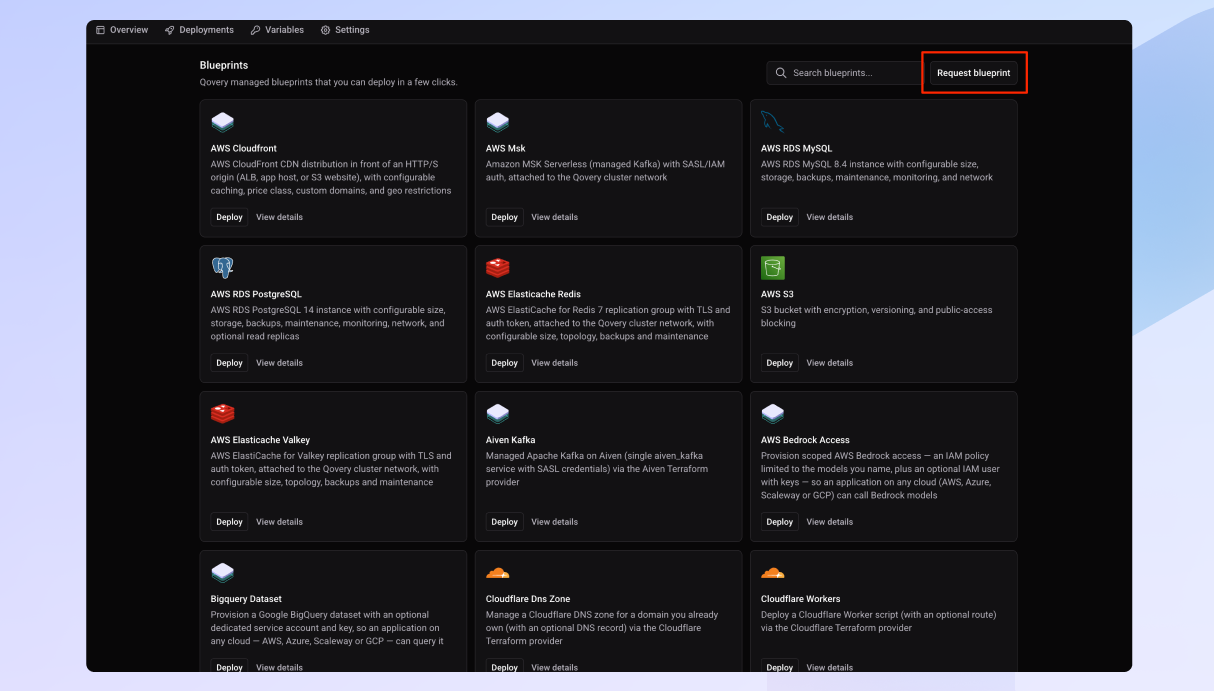
The Blueprints catalog keeps growing. This cycle adds ready-to-use blueprints for BigQuery, Snowflake, and Amazon Bedrock, alongside the existing database blueprints. For all of them, if you leave the database credentials empty when creating the resource, Qovery now generates them for you instead of forcing you to fill in a value up front.
We also closed a gap in the catalog itself. If the blueprint you need is not there yet, whether that is a database, a secret manager integration, or something else, you can now request it directly from the catalog UI instead of opening a support ticket or waiting for a roadmap update. You can browse the current catalog today from the Console by adding a new service within an environment.
Together, these make the catalog a faster path to production for teams standardizing on managed data services, and give us a direct signal on what to build next.
🛠️ Minor updates
- Blueprint deployments now report a failure instead of a false success when a dispatch fails, and a timed-out preview now tells you why instead of leaving you guessing. RC tag support was also added for testing pre-release blueprint versions.
- The Qovery CLI can now create your first organization directly with
qovery api organization, instead of requiring the console for that one step. - Terraform provider validation errors now name the specific variable that failed, instead of a generic error, making a bad input easier to track down.
- Fixed a Terraform provider issue where state could lock during an environment deployment, which could block subsequent applies until manually cleared.
As always, let us know what you think and what you would like to see next.
Talk soon, The Qovery Team 🚀