Blog
Qovery
Business
Product
4
minutes

Qovery ranks as a G2 High Performer 3x in a row

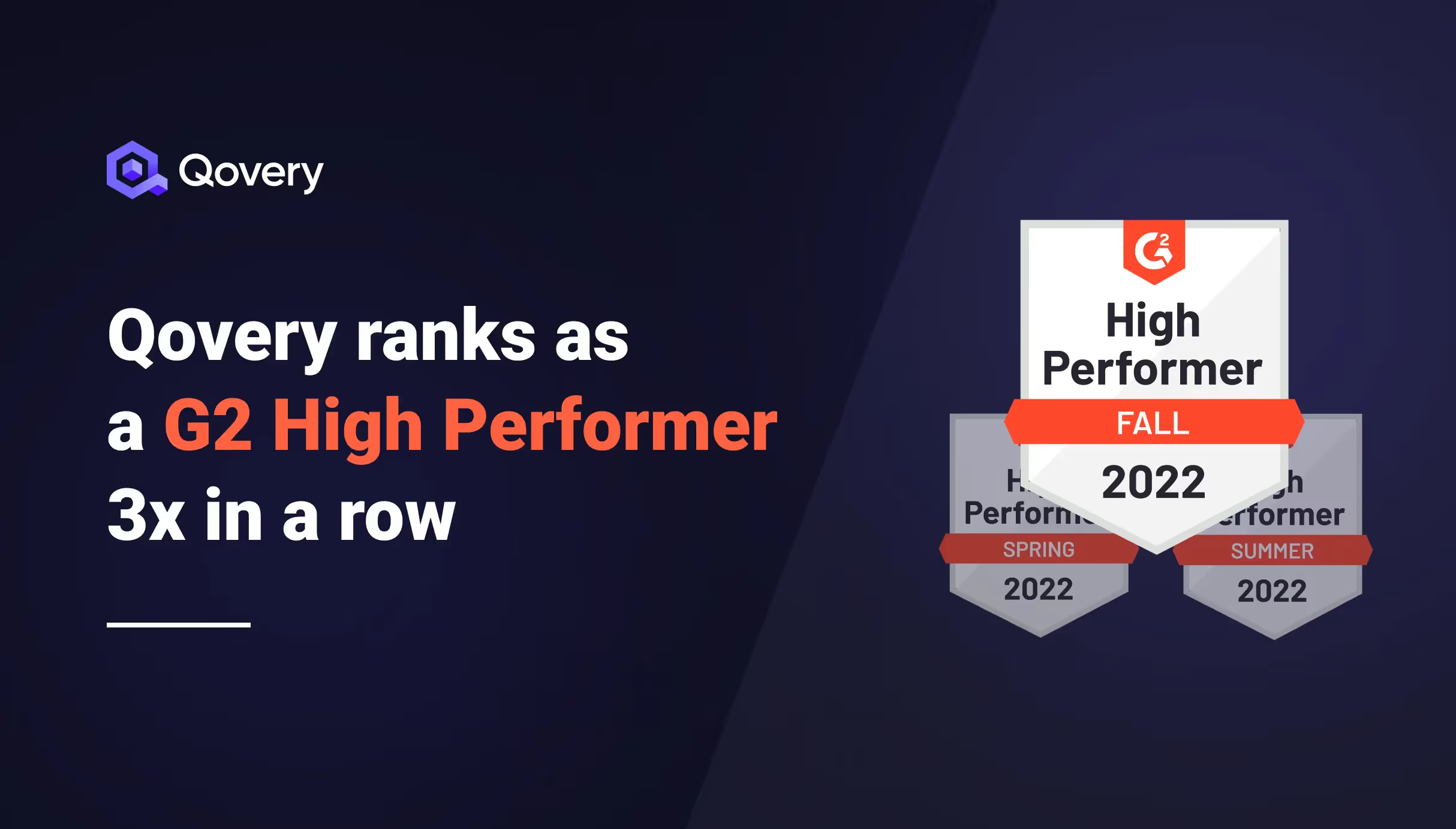
Qovery's DevOps automation software has been named a High Performer in the Fall 2022 G2 Reports for the third consecutive time. Today, we’re excited to share that Qovery maintains its High Performer status in its category. We are also grateful for our users’ continued support, which has resulted in us receiving 4.8/5 stars and winning three G2 awards in a row.
September 26, 2025
Morgan Perry
Co-founder
Summary
Twitter icon
linkedin icon

Qovery is built around a simple concept: We deliver an Environment-as-a-Service solution that enables engineering teams to deploy and manage production-like environments seamlessly on your cloud, with a high standard of security and compliance. We do this by delighting customers every step of the way, solving their infrastructure and environment provisioning challenges, and helping them build faster through self-service infrastructure while enabling a high standard of security and governance.

In less than three years, Qovery has become the leader of the EaaS (Environment-as-a-Service) category, which we graciously attribute to the trust and collaboration established with each of our customers.

"Qovery is a must-have for anyone who wants to easily assemble a CD/CI pipeline on AWS services. Managing environments and apps on such a great platform that centralizes everything, makes this a terrific tool for anyone using AWS", said Emanuel Silva, Software Engineering Team Leader at Rely.io

While we’re happy to tell you why Qovery is a High Performer in its category, we’ll leave it to our customers:

null
“Qovery makes cloud infrastructure usable for everyone.” —Peter K.
“Deploying our services on a scalable Kubernetes cluster, made quick and easy.” —Donal I.
“Life made easier.” —Raymond L.

Our users have spoken. But why hundreds of organizations are using Qovery?

#1 Increase Developer productivity

Many tech startups experience rapid growth. This means they must scale, develop new features quickly, and find the best talent to grow significantly. While rapid growth is usually a good sign that the business is going well, things can get messy quickly and slow down the developer’s productivity.

null
"As we just started our business, we got many ideas. Many ideas can technically translate into many different branches on Github. Since the beginning, we have only worked with one staging environment. The key feature that helped me to choose Qovery was the « on the fly » cloning environments. Each developer has their own environment to push and test their updates in one click", said Victor Fritz, Co-Founder and CTO at Deskare.

#2 Unlock Testing Potential

To prevent bugs in production, reduce development costs and improve performance, testing is mandatory in the development cycle.

Now, even if you test your code, have you ever wanted to test the changes in one of your teammate's pull requests? Validating this new feature that is about to be released? Or this urgent fix that you must apply before leaving the office? There are plenty of cases where testing needs to go beyond a simple GitHub action pass.

"We need a full replica of the database for each PR in order to get as close as possible to replicating the production environment when testing PRs. Qovery makes this a lot easier than other solutions, at a lower price than Heroku", said Travis Long, Co-Founder of DevDocs.

And to unlock all this testing potential, the Qovery Preview Environment is the answer!

#3 Faster Time to Market

A secure product is an absolute must in every business, and it’s no different for the tech industry. On top of the security measure that you can take on your side, there might be some compliance ones to add on top; those can be confusing and take a while to put in place.

"Qovery helped us in a critical shift for our growing engineering team and allowed us to cut our compliance journey by weeks, if not months", said Kevin Maschtaler, Platform & Reliability Lead at Tint

We have several ways to keep your product secure, by being HIPAA compliant, for example, but using our multi-clusters and multi-environments is a way to speed many compliance processes.

null

G2 scores products and vendors based on reviews gathered from its user community, and data aggregated from online sources and social networks, culminating in quarterly Grid and Index Reports.

Learn more about our amazing customers and what they are building.

Share on :
Twitter icon
linkedin icon
Tired of fighting your Kubernetes platform?
Qovery provides a unified Kubernetes control plane for cluster provisioning, security, and deployments - giving you an enterprise-grade platform without the DIY overhead.
See it in action

Suggested articles

AI
Compliance
 minutes
Agentic AI infrastructure: moving beyond Copilots to autonomous operations

The shift from AI copilots to autonomous agents is redefining infrastructure requirements. Discover how to build secure, stateful, and compliant Agentic AI systems using Kubernetes, sandboxing, and observability while meeting EU AI Act standards

Mélanie Dallé
Senior Marketing Manager
Kubernetes
8
 minutes
The 2026 guide to Kubernetes management: master day-2 ops with agentic control

Effective Kubernetes management in 2026 demands a shift from manual cluster building to intent-based fleet orchestration. By implementing agentic automation on standard EKS, GKE, or AKS clusters, enterprises eliminate operational weight, prevent configuration drift, and proactively control cloud spend without vendor lock-in, enabling effective scaling across massive fleets.

Mélanie Dallé
Senior Marketing Manager
Kubernetes
 minutes
Building a single pane of glass for enterprise Kubernetes fleets

A Kubernetes single pane of glass is a centralized management layer that unifies visibility, access control, cost allocation, and policy enforcement across § cluster in an enterprise fleet for all cloud providers. It replaces the fragmented practice of switching between AWS, GCP, and Azure consoles to govern infrastructure, giving platform teams a single source of truth for multi-cloud Kubernetes operations.

Mélanie Dallé
Senior Marketing Manager
Kubernetes
 minutes
How to deploy a Docker container on Kubernetes (and why manual YAML fails at scale)

Deploying a Docker container on Kubernetes requires building an image, authenticating with a registry, writing YAML deployment manifests, configuring services, and executing kubectl commands. While necessary to understand, executing this manual workflow across thousands of clusters causes severe configuration drift. Enterprise platform teams use agentic platforms to automate the entire deployment lifecycle.

Mélanie Dallé
Senior Marketing Manager
Kubernetes
Terraform
 minutes
Managing Kubernetes deployment YAML across multi-cloud enterprise fleets

At enterprise scale, managing provider-specific Kubernetes YAML across multiple clouds creates crippling configuration drift and operational toil. By adopting an agentic Kubernetes management platform, infrastructure teams abstract cloud-specific configurations (like ingress controllers and storage classes) into a single, declarative intent that automatically reconciles across 1,000+ clusters.

Mélanie Dallé
Senior Marketing Manager
Kubernetes
Cloud
AI
FinOps
 minutes
GPU orchestration guide: How to auto-scale Kubernetes clusters and slash AI infrastructure costs

To stop GPU costs from destroying SaaS margins, teams must transition from static to consumption-based infrastructure by utilizing Karpenter for dynamic provisioning, maximizing hardware density with NVIDIA MIG, and leveraging Qovery to tie scaling directly to business metrics.

Mélanie Dallé
Senior Marketing Manager
Product
AI
Deployment
 minutes
Stop Guessing, Start Shipping. AI-Powered Deployment Troubleshooting

AI is helping developers write more code, faster than ever. But writing code is only half the story. What happens after? Building, deploying, debugging, scaling. That's where teams still lose hours.We're building Qovery for this era. Not just to deploy your code, but to make everything that comes after writing it just as fast.

Alessandro Carrano
Head of Product
AI
Developer Experience
Kubernetes
 minutes
MCP Server is the future of your team's incident’s response

Learn how to use the Model Context Protocol (MCP) to transform static runbooks into intelligent, real-time investigation tools for Kubernetes and cert-manager.

Romain Gérard
Staff Software Engineer

It’s time to change
the way you manage K8s

Turn Kubernetes into your strategic advantage with Qovery, automating the heavy lifting while you stay in control.