Blog
Engineering
DevOps
3
minutes

June 2020, What's new? Gitlab support, persistent storage, faster deployments...

Hello and welcome to another issue of This Month in Qovery! Qovery helps developers to deploy their applications in the Cloud in just a few seconds. This is a monthly summary of its progress and community. Do you build something with Qovery? Do you want to be mentioned? Tweet us at @Qovery_. Want to get involved? Join the community. WE ARE HIRING👨‍💻 Needless to say - we are hiring passionate engineers.

November 19, 2025
Romaric Philogène
CEO & Co-founder
Summary
Twitter icon
linkedin icon

Product updates

Gitlab Support

Do you use Gitlab repositories? You can now deploy your application by using Qovery. Read more...

Persistent Storage

You can enjoy attaching storage to your application and keeping your data persisted. Read more...

Web Interface

The team is working hard to make the web interface live as soon as possible. We are looking for a pixel-perfect frontend developer to join us and help us to make it live faster :) We expect to release a beta version for July 2020.
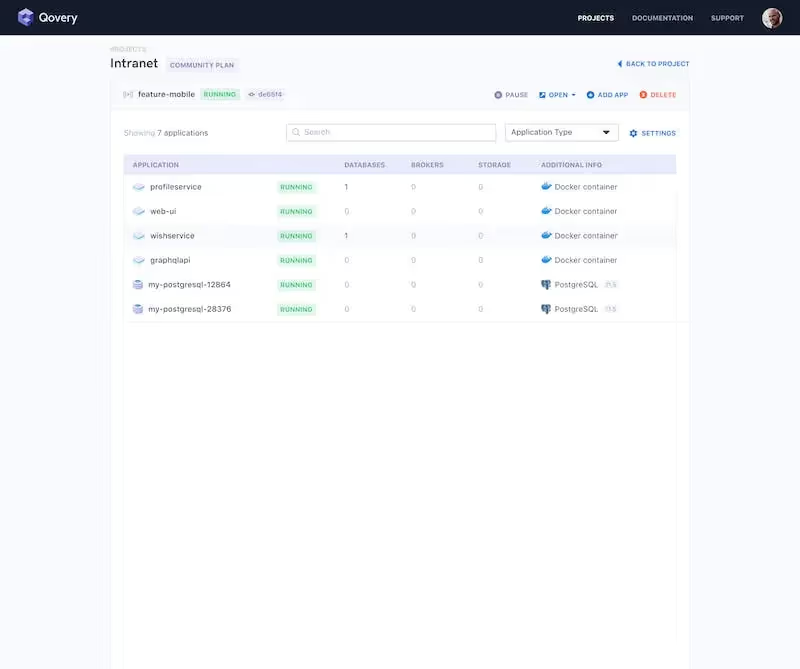
Qovery web interface mockup

Faster deployments 🚀

Before: deploying an application with a database could lead to waiting 20 minutes.
Now: deploying an application with a database take less than 3 minutes.

We aim to make it even faster in the coming weeks. Our goal is to deploy a complete application in less than a minute.

Feedback / Roadmap

Your feedback is welcome, they help improve our product, and we'll do our best to do them. Also, do not hesitate to vote for wanted features or submit your ideas.

Community

Hasura Con' 2020

Hasura is a turnkey engine that connects your micro-services and database to generate a real-time GraphQL API. That is super cool. Hasura and Qovery is a perfect match to deploy production-ready GraphQL service in just a few seconds. That's why the Hasura team invited us to show the world what we do.

Record coming soon - in the meantime, you can read this article to know how to deploy a full-stack application with Hasura, PostgreSQL, and Angular.
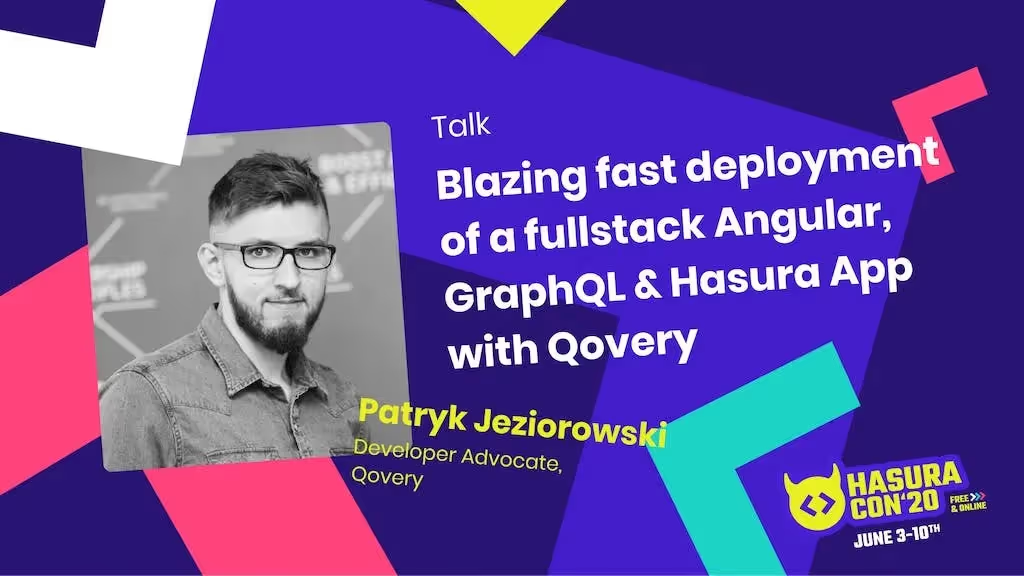
Qovery on stage at the Hasura Con 2020

Passionate developer?

Do you like to share your knowledge and your passion for the code? We are looking for two technical writers for an ambitious new project. Interested? Contact us on Discord.

Resource highlights

- Tutorial: How to deploy a full-stack application (Hasura, PostgreSQL, Angular)
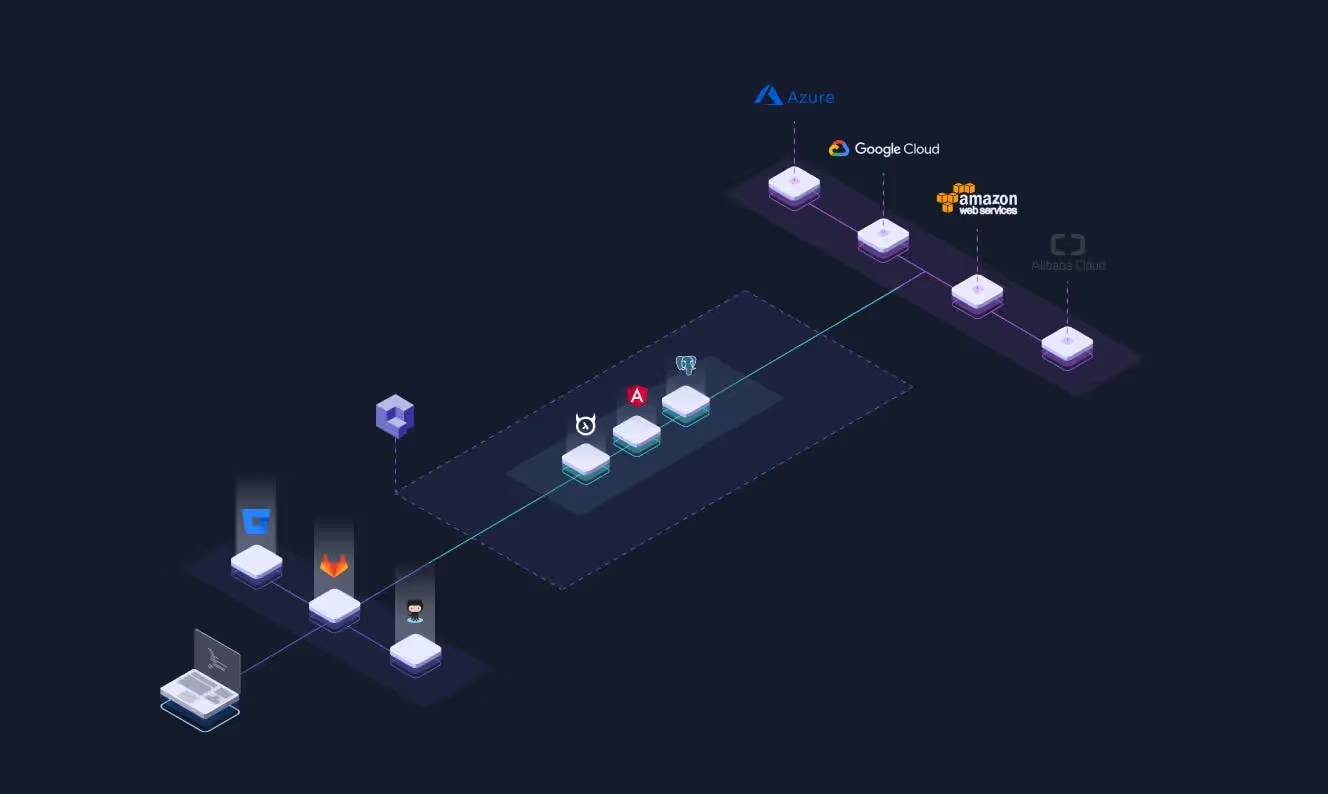
Deploy your full-stack (Hasura, PostgreSQL and Angular) app with Qovery

- Article: A month after switching from Slack to Discord in a tech startup
- Article: Network isolation in Kubernetes
- Article: Differences between Heroku and Qovery
- Tutorial: Creating a blazing fast REST API in Rust (Part 1/2)
- Tutorial: How to deploy a Docker container
- Tutorial: How to deploy Django with PostgreSQL (Python framework)

What's next?

- Web interface: The first release of the Qovery web interface is expected for next month (July).
- Qovery Business: We plan to launch an alpha version of Qovery Business - To deploy Qovery on your Cloud account.
- Feature: Redis Support
- Feature: Memcached Support
- Feature: Support Monorepository

Vote for the subsequent development

As always, we would love to get your feedback on these updates.

That's all folks - The Qovery Team

Share on :
Twitter icon
linkedin icon
Tired of fighting your Kubernetes platform?
Qovery provides a unified Kubernetes control plane for cluster provisioning, security, and deployments - giving you an enterprise-grade platform without the DIY overhead.
See it in action

Suggested articles

Kubernetes
7
 minutes
Day 2 operations: an executive guide to Kubernetes operations and scale

Kubernetes success is determined by Day 2 execution, not Day 1 deployment. While migration is a bounded project, maintenance is an infinite loop that often consumes 40% of senior engineering capacity. To protect margins and velocity, enterprises must transition from manual toil to agentic automation that handles scaling, security, and cost.

Mélanie Dallé
Senior Marketing Manager
Kubernetes
8
 minutes
The 2026 guide to Kubernetes management: master day-2 ops with agentic control

Master Kubernetes management in 2026. Discover how Agentic Automation resolves Day-2 Ops, eliminates configuration drift, and cuts cloud spend on vanilla EKS/GKE/AKS.

Romaric Philogène
CEO & Co-founder
DevOps
Kubernetes
6
 minutes
Day-0, day-1, and day-2 Kubernetes: defining the phases of fleet management

Day-0 is planning, Day-1 is deployment, and Day-2 is the infinite lifecycle of maintenance. While Day-0/1 are foundational, Day-2 is where enterprise operational debt accumulates. At fleet scale (1,000+ clusters), managing these differences manually is impossible, requiring agentic automation to maintain stability and eliminate toil.

Morgan Perry
Co-founder
Kubernetes
7
 minutes
Kubernetes multi-cluster: the Day-2 enterprise strategy

A multi-cluster Kubernetes architecture distributes application workloads across geographically separated clusters rather than a single environment. This strategy strictly isolates failure domains, ensures regional data compliance, and guarantees global high availability, but demands centralized Day-2 control to prevent exponential cloud costs and operational sprawl.

Morgan Perry
Co-founder
Kubernetes
6
 minutes
Kubernetes observability at scale: cutting the noise in multi-cloud environments

Stop overpaying for Kubernetes observability. Learn how in-cluster monitoring and AI-driven troubleshooting with Qovery Observe can eliminate APM ingestion fees, reduce SRE bottlenecks, and make your cloud costs predictable.

Mélanie Dallé
Senior Marketing Manager
Kubernetes
 minutes
Understanding CrashLoopBackOff: Fixing AI workloads on Kubernetes

Stop fighting CrashLoopBackOff on your AI deployments. Learn why traditional Kubernetes primitives fail large models and GPU workloads, and how to orchestrate AI infrastructure without shadow IT.

Mélanie Dallé
Senior Marketing Manager
Kubernetes
Platform Engineering
 minutes
Kubernetes multi-cluster architecture: solving day-2 fleet sprawl

Kubernetes multi-cluster management is the Day-2 operational practice of orchestrating applications, security, and configurations across geographically distributed clusters. Because native Kubernetes was designed for single-cluster orchestration, enterprise platform teams must implement a centralized control plane to prevent configuration drift and manage a global fleet without scaling manual toil.

Mélanie Dallé
Senior Marketing Manager
Engineering
Product
11
 minutes
How to achieve zero downtime on kubernetes: a Day-2 architecture guide

Achieving zero-downtime deployments on Kubernetes requires more than running multiple pods. It demands a standardized architecture utilizing Pod Disruption Budgets (PDBs), precise liveness and readiness probes, pod anti-affinity, and graceful termination handling. At an enterprise scale, these configurations must be enforced via a centralized control plane to prevent catastrophic configuration drift.

Pierre Mavro
CTO & Co-founder

It’s time to change
the way you manage K8s

Turn Kubernetes into your strategic advantage with Qovery, automating the heavy lifting while you stay in control.