Build vs Buy: When to Build or Buy an Internal Developer Platform
An Internal Developer Platform (IDP) is an ecosystem that empowers developers to manage the entire application lifecycle from development to deployment autonomously. As a vital component for organizations, the implementation of an IDP often presents a ‘Build vs. Buy’ dilemma: should you construct your own IDP, tailored to your unique needs, or would it be more efficient to purchase a pre-built solution? This decision is not a trivial one, and making the right choice can significantly impact your team’s productivity and your organization’s bottom line. In this article, we will conduct a transparent analysis of both options, exploring the benefits and challenges associated with each. We aim to provide you with comprehensive insights that can guide you in making the best choice for your team.
Let’s begin by understanding what an Internal Developer Platform (IDP) is and why it’s an essential tool in today’s competitive business horizon.
What is an Internal Developer Platform?
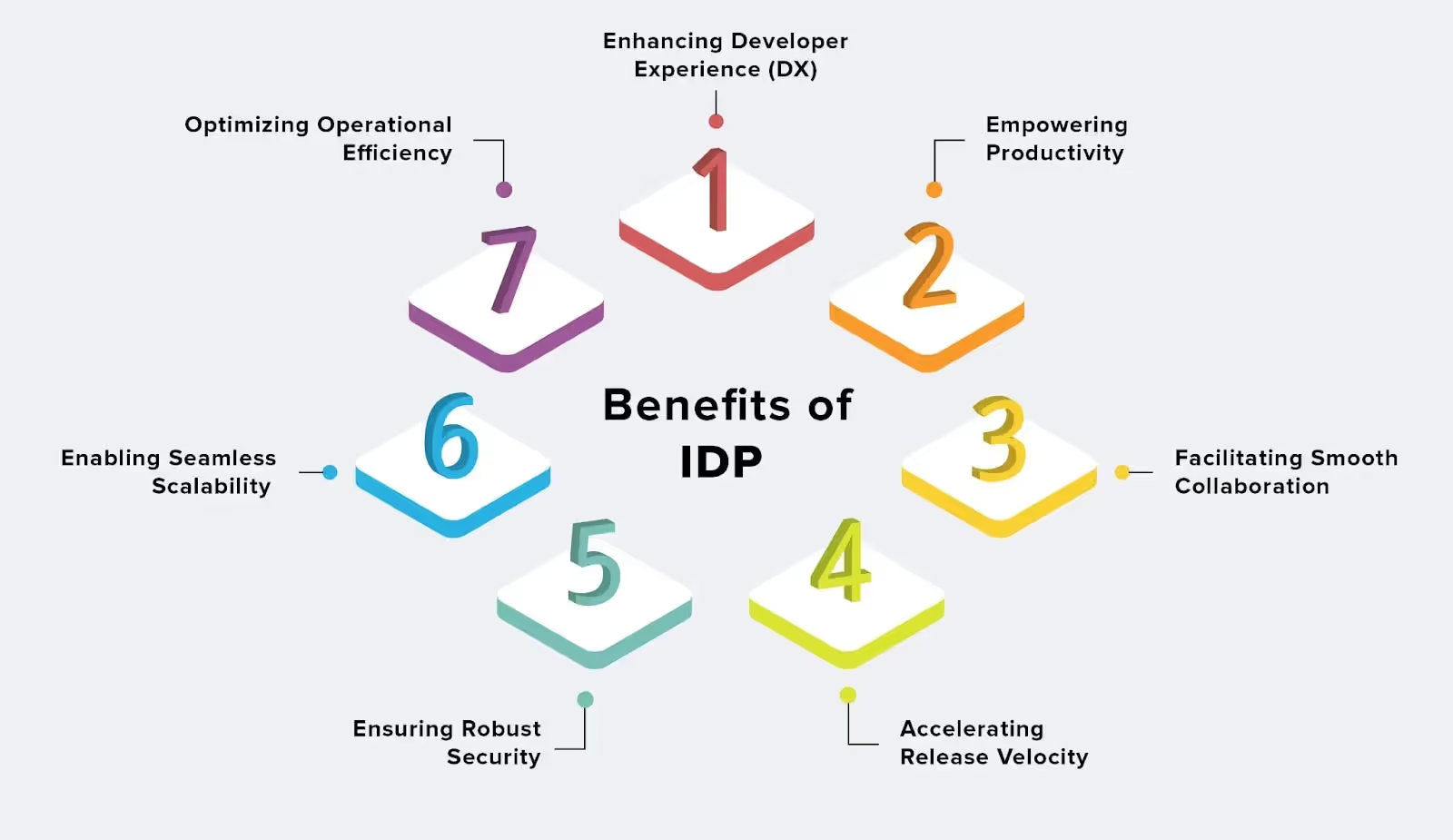
An Internal Developer Platform (IDP) acts as a middleware, offering a self-service experience that enables developers to run and manage their applications independently throughout the lifecycle. This innovative approach emerged as a solution to the delays and inefficiencies caused by the dependency on external teams for application deployment and management. By integrating various tools and services, IDPs facilitate a more streamlined, efficient, and autonomous workflow for developers, significantly enhancing productivity and fostering a culture of innovation within organizations. Some of the benefits of IDP are:
Gain autonomy: Developers can manage projects independently, reducing bottlenecks.
Enhance productivity: Streamlines deployment processes for faster delivery.
Accelerate innovation: Encourages creativity and experimentation in a flexible environment.
Standardization: Ensures uniform processes and tools across projects.
Enhanced security and compliance: Through features like RBAC and audit logs.
Operational efficiency: Automates routine tasks to focus on strategic areas.
Scalability: Offers adaptable solutions that grow with the organization.
Benefits of an IDP
Now that we know what an Internal Developer Platform (IDP) is, let’s compare both options of buying an IDP versus building one.
Option 1: Building an Internal Developer Platform (IDP)
Advantages:
Customization: Open-source IDPs offer flexibility to tailor the platform to your organization's specific needs and development processes. You can integrate custom tools, workflows, and functionalities that perfectly align with your unique environment.
Control: Building your IDP grants you complete ownership and control over the platform. This empowers you to make critical decisions regarding features, security posture, and data management, ensuring they adhere to your specific security and compliance requirements.
Innovation: The process of building your IDP brings a culture of innovation and experimentation within your development team. Developers gain valuable experience by actively participating in the creation and evolution of the platform, promoting a deeper understanding of its inner workings and potential for improvement.
Disadvantages:
High upfront cost and development time: Building an IDP requires a significant investment in resources and expertise. It demands substantial time and personnel allocation for development, testing, and ongoing maintenance. The complexity of the platform and the desired level of customization directly impact the required resources and time commitment.
Maintenance overhead: Maintaining an in-house IDP necessitates ongoing effort from your development team. This includes keeping the platform secure with regular updates and patches, addressing bugs, and ensuring optimal performance. Balancing these maintenance tasks with core development initiatives can strain your team's bandwidth.
Talent scarcity: Finding developers with the necessary skillset and experience to effectively build and maintain a complex platform like an IDP can be challenging. This can significantly impact the feasibility and timeline of your in-house development efforts.
Option 2: Buying an Internal Developer Platform (IDP)
Advantages:
Faster Time to Value: Internal Developer Platforms (IDPs) offered as self-service solution allow for rapid setup and deployment. Your developers can be up and running quickly, enabling faster realization of the platform's benefits and improved developer productivity.
Reduced Development Costs: Compared to building from scratch, adopting a pre-built IDP can potentially lower your initial investment and ongoing operational expenses. Established vendors offer feature-rich platforms that can help you avoid significant resource allocation for in-house development and maintenance.
Scalability: Cloud-based IDPs offer effortless scalability. You can easily scale your platform up or down based on your evolving development needs, ensuring optimal performance and resource utilization without worrying about infrastructure management.
Access to Expertise: Leverage the expertise and ongoing support provided by established IDP vendors. You benefit from their knowledge base, best practices, and continuous platform improvements, allowing your team to focus on core development activities.
Disadvantages:
Limited Customization: While IDPs offer extensive customization options, they might not perfectly align with every specific need your organization might have. However, some IDPs maintain an open-source nature, allowing for potential contributions and modifications to address specific requirements.
Vendor Lock-in: Choosing a PaaS solution introduces a degree of vendor lock-in. You become reliant on the vendor's roadmap, pricing structure, and future platform direction. Carefully evaluate these factors and ensure the chosen vendor aligns with your long-term development goals.
Security Considerations: Carefully evaluate the security practices and data protection measures offered by the vendor. Ensure your data remains secure when utilizing a third-party platform. Scrutinize the vendor's track record, compliance certifications, and security controls to ensure they meet your organization's security posture requirements.
Check out Qovery’s handy 10 Key Features Checklist to help you choose the right Internal Developer Platform for your team.
Choosing the Right Option: Build vs. Buy
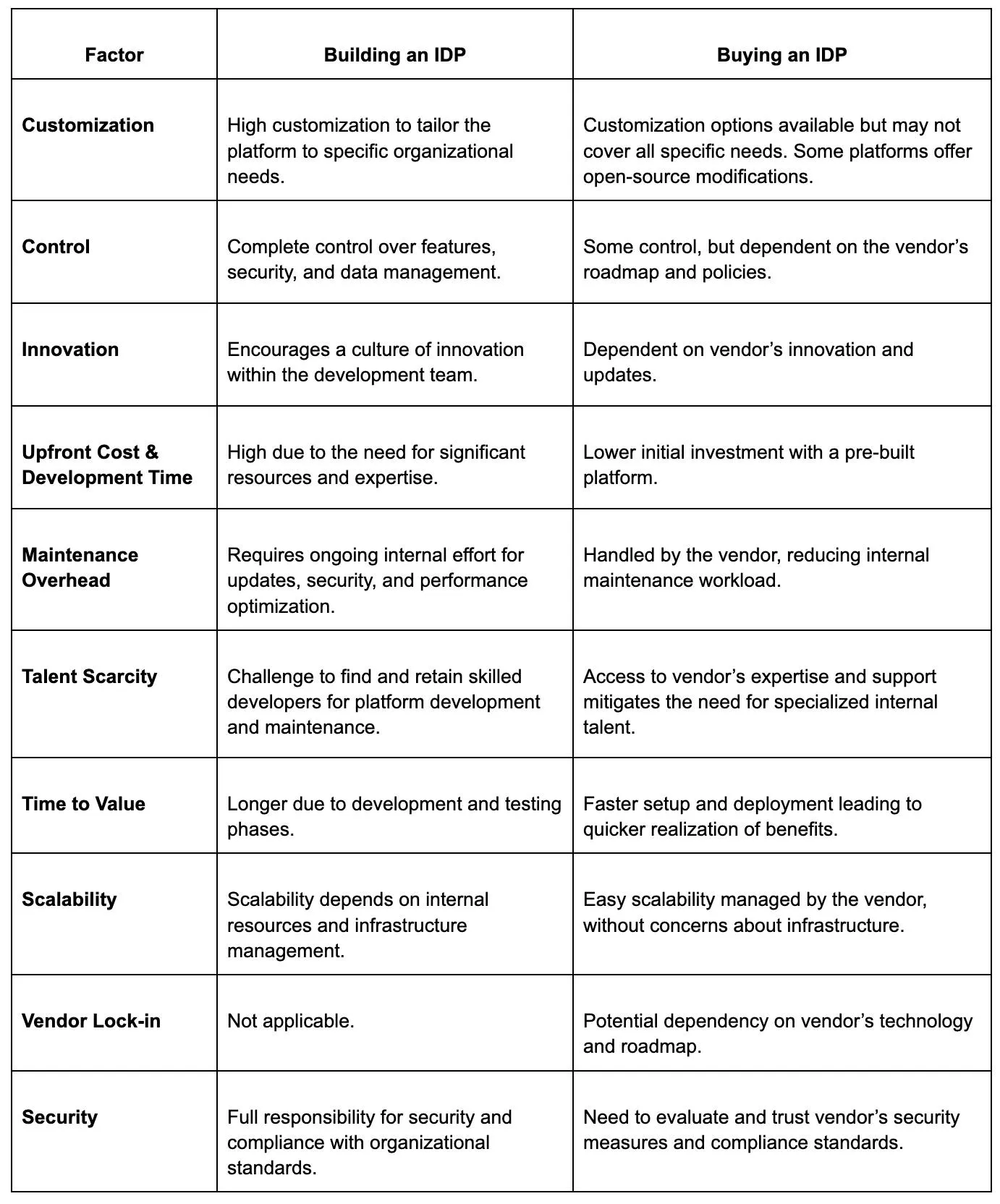
Below is a comparison table that outlines the key factors to consider when deciding between building and buying an Internal Developer Platform (IDP). This table is designed to help organizations assess which approach aligns better with their specific needs, resources, and strategic goals.
Build Vs. Buy an IDP: A Comparison Table
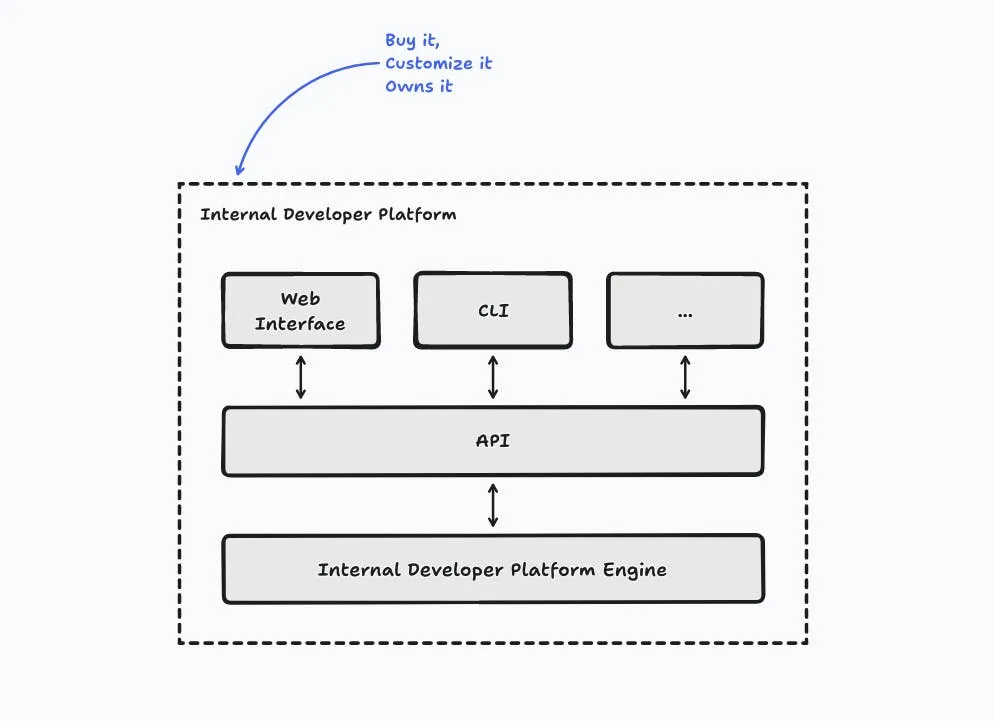
A Hybrid Approach (Buy and Build Upon It)
The "Buy and Build" strategy for Internal Developer Platforms (IDPs) is a hybrid approach that combines the advantages of purchasing a pre-existing, foundational platform with the opportunity to further customize and extend it to meet an organization's specific needs. This method starts with acquiring a solid and reliable IDP that addresses the basic requirements of development teams, providing a quick solution for immediate development challenges. Organizations then build upon this base, adding unique features and workflows that cater to their particular processes and goals, thus creating a tailored development environment.
Key aspects of the "Buy and Build" Strategy
Quick Implementation: Begins with a robust platform to swiftly address the immediate needs of developers.
Efficiency Gains: Enables developers to deploy and manage applications more efficiently, leveraging the foundational strengths of the purchased IDP.
Tailored Enhancements: Facilitates the addition of custom features and workflows, allowing for a platform that reflects the unique requirements of the organization.
Innovation on a Solid Foundation: Encourages innovation within the framework of a proven, reliable platform, focusing efforts on differentiation and value addition.
Benefit from IDP Creators' Knowledge: Utilizes the expertise of those who built the platform to avoid common pitfalls and implement best practices.
Adopt Industry Best Practices: Ensures the platform is built on a foundation of industry standards while allowing for the flexibility to adapt to organizational needs.
Focus on What Matters: Enables platform engineers to concentrate on developing features that offer the most value, rather than on creating basic infrastructure from scratch.
Achieve Balance: Strikes a balance between rapid deployment capabilities and the need for a customized, organization-specific developer experience.
A Hybrid Approach (Buy and Build Upon It)
Agents ship fast. Guardrails keep them safe.
Qovery ensures every agent action is scoped, audited, and policy-checked. Start deploying in under 10 minutes.
Building an IDP might be the ideal choice for organizations with the following characteristics:
Unique and Complex Business Needs:
Organizations in highly specialized industries or with niche development requirements often have workflows and processes that pre-built IDPs might not fully support.
For example, a company developing custom financial trading platforms might need specific integrations with real-time market data feeds and risk management tools, functionalities that might not be readily available in a general-purpose IDP.
Strong In-House Development Expertise:
Building and maintaining an IDP requires a dedicated team with diverse skillsets, including:
Software development: Familiarity with various programming languages and frameworks used to build and maintain the platform.
Cloud infrastructure: Expertise in managing cloud environments where the IDP will be deployed.
Security: Deep understanding of security best practices to implement robust measures for protecting sensitive data and access within the platform.
High Priority on Control and Customization:
Organizations that require complete control over their development environment and data might find building an IDP more suitable.
This approach allows them to tailor the platform to their specific security and compliance requirements, and make independent decisions about its evolution and future features.
This is often crucial for organizations in highly regulated industries like healthcare or finance.
Buying an Internal Developer Platform (IDP) offered as a self-service solution might be the ideal choice for organizations with the following characteristics:
Rapid Time to Value:
Organizations seeking to quickly enable their development teams with a functional platform can benefit from the faster time to value offered by pre-built IDPs.
PaaS solutions typically require minimal setup and configuration, allowing developers to get up and running quickly, and minimizing disruption to existing workflows.
Limited In-House Development Resources:
Organizations with limited in-house development resources or lacking the expertise required to build and maintain a complex platform like an IDP can benefit from leveraging the expertise of established IDP vendors.
This frees up internal teams to focus on core development activities while ensuring access to a robust and feature-rich platform.
Scalability Needs:
Organizations with fluctuating development needs can benefit from the inherent scalability of cloud-based IDPs.
PaaS solutions offer effortless scaling, allowing you to easily adjust your platform's resources up or down based on your evolving development demands, ensuring optimal performance and cost efficiency.
Focus on Core Business Activities:
Organizations that prioritize focusing their resources on core business activities beyond development can benefit from the reduced management burden associated with PaaS solutions.
By leveraging an IDP vendor's expertise and ongoing support, you can minimize the need for dedicated internal resources for platform maintenance and updates, allowing your team to focus on core competencies.
When deciding on an Internal Developer Platform (IDP), it's important to think about what works best for your team. You can either make your own Internal Developer Platform (IDP), which lets you customize it exactly how you want but takes a lot of time and effort, or you can buy one that's already made, which is quicker to start using but might not fit all your needs perfectly.
Qovery is a great choice for those who like the "Buy and Build" option. This means you start with a strong Internal Developer Platform (IDP) that Qovery provides, which gets your team moving fast, and then you add your own custom features on top. This way, you get the quick start of a bought IDP and the customization of a built one. Qovery stands out because it lets you quickly get the benefits of an IDP while also allowing you to make it your own. Whether you're looking to jump right in with a ready-to-use platform or want to tweak things to perfectly suit your team, Qovery supports you every step of the way.
Morgan co-founded Qovery and leads engineering. He writes about Kubernetes architecture, DevOps best practices, and building resilient infrastructure at scale.
Next step
Agents ship fast. Guardrails keep them safe.
Qovery ensures every agent action is scoped, audited, and policy-checked. Start deploying in under 10 minutes.