
Hey Team,
This release is all about helping teams move faster in production while keeping control and context. From detecting incidents earlier, to simplifying cluster operations, to lowering the barrier to try Qovery for real workloads, this sprint brings several important updates.
Let’s dive in.
🚨 Alerting with Qovery Observe
Production issues are often discovered too late, usually through customer complaints or support tickets. By the time engineers investigate, users have already been impacted and key context is gone. This slows down troubleshooting and adds unnecessary stress.
That is why we are releasing alerting today, natively integrated into Qovery Observe. Alerts are directly connected to your services, deployments, and runtime context, so teams can detect issues early and move straight from notification to resolution without switching tools.
This is not just about sending alerts. Qovery guides you through investigation by correlating alerts with recent deployments, logs, and infrastructure changes, helping you reach the root cause faster.
👉 Read the full announcement here
⚙️ Migrate remaining clusters to Karpenter
Customers who are not using a static IP in their infrastructure can now migrate their remaining clusters to Karpenter and benefit from the optimizations it brings.
Karpenter continuously analyzes pod requirements and provisions the right EC2 instances in real time. This means faster scale up, fewer unused resources, and lower infrastructure costs compared to static node groups. It also simplifies cluster operations by automatically handling instance selection, bin packing, and lifecycle management.
With Qovery managing Karpenter for you, the migration removes manual tuning and unlocks better performance and cost efficiency by default.
🎁 Free trial now open to everyone
We launched our 14 day free trial to cut through the usual platform complexity. The goal is simple: get a real application running on your own cloud, without writing a single line of CI/CD configuration.
With the Qovery free trial, you can:
- Deploy without maintaining complex YAML files
- Provision your own Kubernetes cluster in just a few clicks
- Connect an existing Git repository and watch it deploy live
- Ship a production ready app in minutes
- Get started with no sales call required
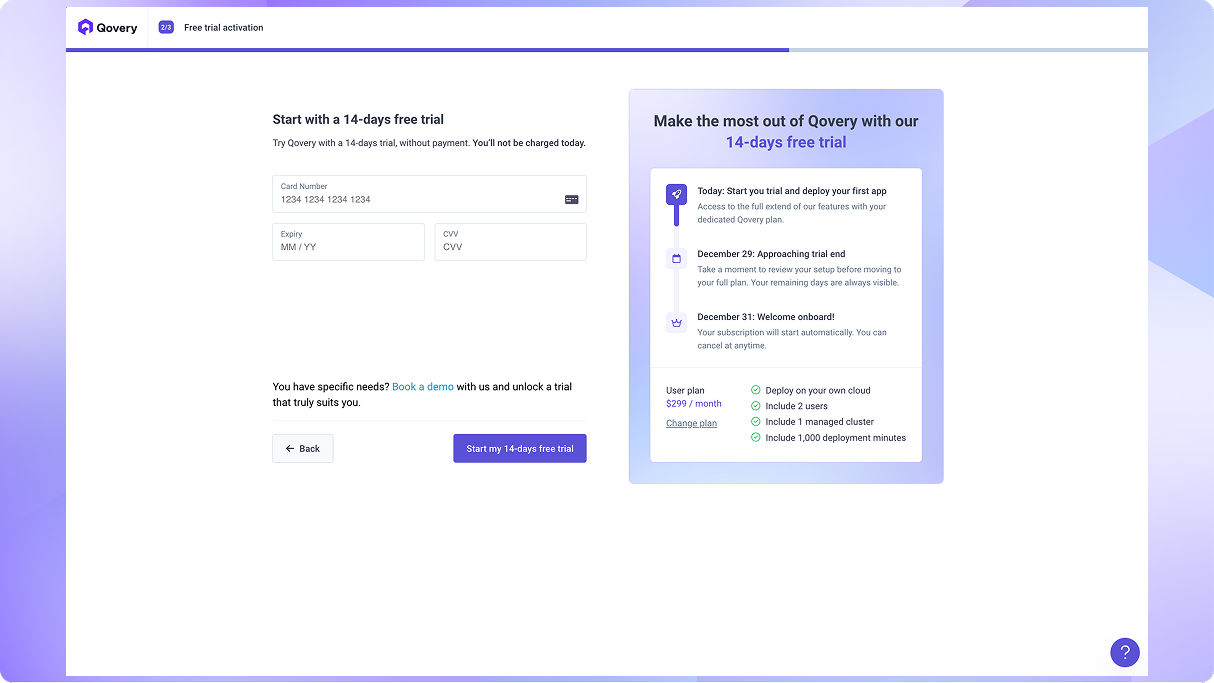
This is your chance to experience a zero friction, production ready environment built for real teams and real workloads.
👉 Sign up here
📘 Kubernetes Best Practices for Production in 2026
Kubernetes is used by more than half of enterprises, yet many engineering teams still struggle with efficiency, security gaps, and runaway cloud costs. In some organizations, 30 to 70 percent of cloud spend is wasted.
We published a new guide that cuts through the noise and provides practical best practices for running Kubernetes in production, today and tomorrow.
In the guide, you will learn how to:
• Reduce cloud costs with concrete resource management techniques
• Prevent downtime using Pod Disruption Budgets and proper health checks
• Strengthen security with RBAC, Network Policies, and external secrets
• Scale confidently with HPA, VPA, and cluster level autoscaling
• Prepare for the future with AIOps and predictive scaling strategies
👉 Get the guide here
🛠️ Minor updates
- Improved Terraform variable definitions with required field indicators, descriptions, and multi line support
- Added the ability to disable Docker build cache from service advanced settings. Documentation available here
That is it for this release. As always, your feedback helps shape what we build next.
Talk soon,
The Qovery Team 🚀