Blog
Product
2
minutes

Clone your production environment instantly

I am super excited to announce that we have released our "clone environment" feature. It is a massive update!! With one click, you can duplicate an existing environment. The cloning environment has been a significant feature expected by our customers and users for a long time. Thanks to our beta testers and our team for making it live for everyone.
Romaric Philogène
CEO & Co-founder
Summary
Twitter icon
linkedin icon

Cloning environment use cases

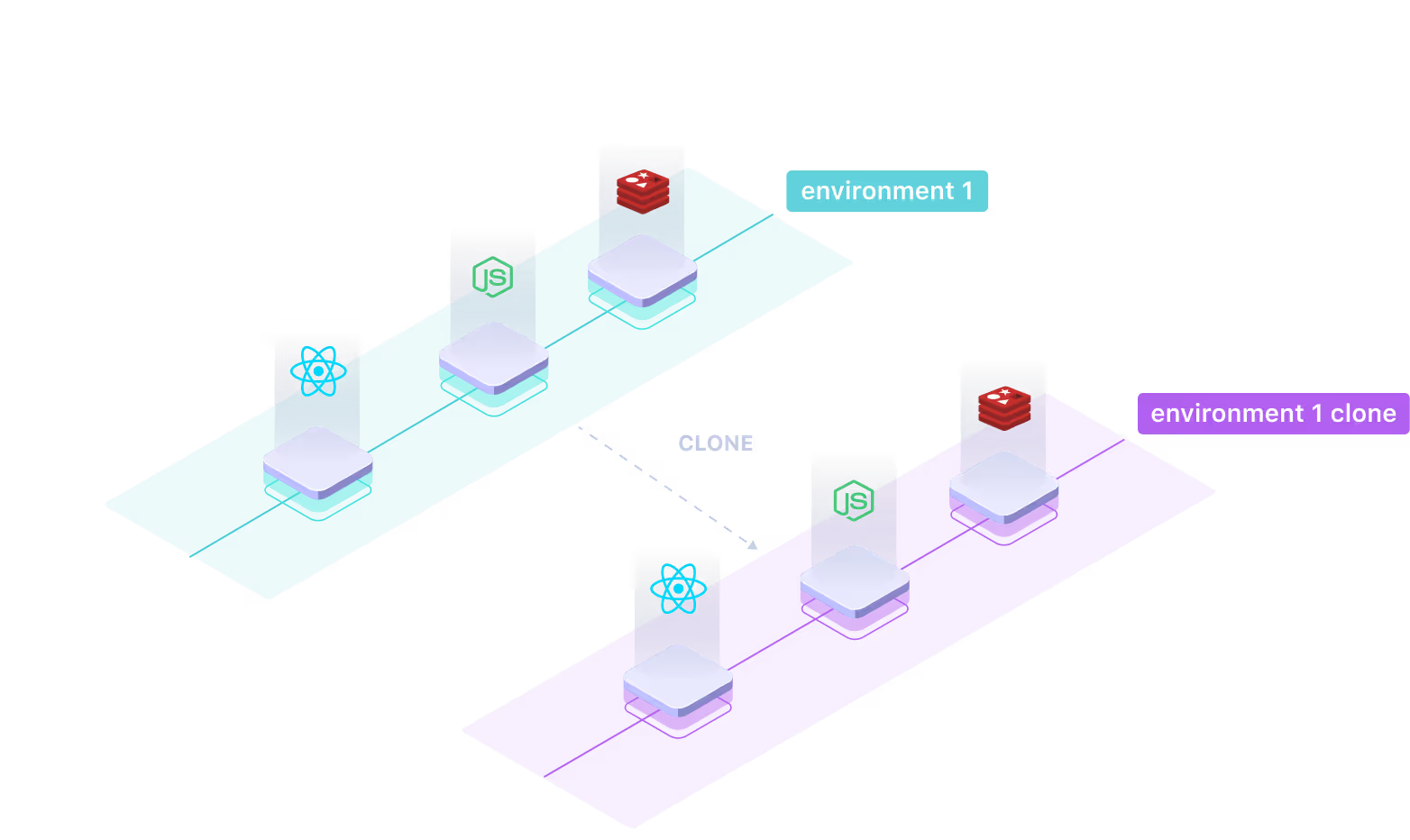
First, I have to refresh your mind on what an environment is. An environment is a combination of multiple applications and databases working altogether. It is pretty typical for a company to have a production and a staging environment. The notion of "environment" is a primary concept in Qovery. Every single application belongs to an environment.

When it comes to mimicking the behavior of an existing environment, cloning makes sense. Then you get an exact copy of your applications, databases, environment variables, and secrets.

"Environment 1 clone" is the clone of "Environment 1"

Here are some excellent use cases where cloning an environment makes sense.

Test production migration

Did you ever experience a lousy migration? Reproducing a migration in the same condition is the best way to prevent critical failure when doing it for real. With Qovery, you can clone your production environment, migrate to your cloned environment, validate your changes, then delete your cloned environment. You are safe and ready to migrate to your production environment.

Mirror production for debugging

We have all been there, trying to reproduce a nasty bug in production reported by a customer, and complex to solve it because of the risk of changing your customer data. Getting the same condition to reproduce a bug and fixing it is mandatory. With Qovery, you can clone your production environment, debug on your cloned environment without risking modifying your customer data, fix it, and then smoothly release the fix in production.

Sales demo environments

There is no better way to close a sale than by letting your customers experience your product – exactly as it should be experienced.

Creating up-to-date demos for your customers can be difficult to maintain and difficult to execute. Release Environments allow you to create isolated demo environments for your customers on-demand, free from the impact and interference of other demos.

What is coming next?

In the coming release, you can choose whether you want to seed your database or not while cloning. Stay in touch.

Read our "clone environment" documentation

We hire remote talents ⚡️.

Share on :
Twitter icon
linkedin icon
Ready to rethink the way you do DevOps?
Qovery is a DevOps automation platform that enables organizations to deliver faster and focus on creating great products.
Book a demo

Suggested articles

Kubernetes
 minutes
How to Deploy a Docker Container on Kubernetes: Step-by-Step Guide

Simplify Kubernetes Deployment. Learn the difficult 6-step manual process for deploying Docker containers to Kubernetes, the friction of YAML and kubectl, and how platform tools like Qovery automate the entire workflow.

Mélanie Dallé
Senior Marketing Manager
Observability
DevOps
 minutes
Observability in DevOps: What is it, Observe vs. Monitoring, Benefits

Observability in DevOps: Diagnose system failures faster. Learn how true observability differs from traditional monitoring. End context-switching, reduce MTTR, and resolve unforeseen issues quickly.

Mélanie Dallé
Senior Marketing Manager
Heroku
15
 minutes
Heroku Alternatives: The 10 Best Competitor Platforms

Fed up of rising Heroku costs and frequent outages? This guide compares the top 10 Heroku alternatives and competitors based on features, pricing, pros, and cons—helping developers and tech leaders choose the right PaaS.

Mélanie Dallé
Senior Marketing Manager
Product
Infrastructure Management
Deployment
 minutes
Stop tool sprawl - Welcome to Terraform/OpenTofu support

Provisioning cloud resources shouldn’t require a second stack of tools. With Qovery’s new Terraform and OpenTofu support, you can now define and deploy your infrastructure right alongside your applications. Declaratively, securely, and in one place. No external runners. No glue code. No tool sprawl.

Alessandro Carrano
Head of Product
AI
DevOps
 minutes
Integrating Agentic AI into Your DevOps Workflow

Eliminate non-coding toil with Qovery’s AI DevOps Agent. Discover how shifting from static automation to specialized DevOps AI agents optimizes FinOps, security, and infrastructure management.

Mélanie Dallé
Senior Marketing Manager
DevOps
 minutes
Top 10 Flux CD Alternatives: Finding a Better Way to Deploy Your Code

Looking for a Flux CD alternative? Discover why Qovery stands out as the #1 choice. Compare features, pros, and cons of the top 10 platforms to simplify your deployment strategy and empower your team.

Mélanie Dallé
Senior Marketing Manager
DevOps
5
 minutes
The 6 Best GitOps Tools for Developers

Discover the top 6 GitOps tools to streamline your development workflow. Compare Qovery, ArgoCD, GitHub Actions, and more to find the perfect solution for automating your infrastructure and deployments.

Morgan Perry
Co-founder
AWS
Cloud
Business
7
 minutes
AWS Production Deployment Checklist: The 4 Pillars for Stability and Scale

AWS Production Deployment Checklist: Ensure stable, scalable deployments. Follow this four-pillar guide covering CI standards, IaC for CD, integrated DevSecOps, and proactive application monitoring.

Morgan Perry
Co-founder

It’s time to rethink
the way you do DevOps

Say goodbye to DevOps overhead. Qovery makes infrastructure effortless, giving you full control without the trouble.