Building a DevOps Culture: Tips for Small Engineering Teams
DevOps is essential for engineering teams looking to enhance collaboration, speed up development cycles, and maintain high-quality software delivery. Building on our previous discussion of common DevOps mistakes startups make, let's move on to ten practical strategies small engineering teams can adopt to foster a robust DevOps culture.
Understanding and integrating this culture is essential-it goes beyond just tools and practices, creating a mindset that unites development and operations to enhance efficiency and innovation.
What is a DevOps Culture?
At its core, a DevOps culture involves closer collaboration and shared responsibility between development (Dev) and operations (Ops) teams. Rather than working in silos, these teams come together to create and maintain products.
Why a strong DevOps culture is particularly beneficial for small engineering teams:
1. Faster time to market:
Collaboration shortens the software development cycle.
Small teams can deliver features and updates more rapidly, gaining a competitive edge.
2. Improved product quality:
Continuous integration, automated testing, and close feedback help identify and fix defects early.
High-quality products lead to satisfied users and reduced support overhead.
3. Cost reduction:
Efficient processes and streamlined workflows minimize waste.
Small teams can achieve more with limited resources.
4. Increased employee satisfaction:
Autonomy, collaboration, and a focus on learning contribute to job satisfaction.
Happy team members are more productive and innovative.
5. Enhanced customer interaction:
Quick responses to user requests and high-quality products lead to customer loyalty.
Small teams can build strong relationships with users.
Key Practices to Follow
Here are some key aspects of DevOps culture:
Shared responsibility:
    \- Developers and operations staff share the responsibility for the success or failure of a product.
    \- Developers adopt a “you build it, you run it” mentality, which means they not only create the software but also oversee its entire lifecycle.
\- This shared ownership leads to a better understanding of challenges faced by operations and simplification of deployment and maintenance processes.
Open communication:
    \- DevOps emphasizes transparency and communication.
    \- Teams collaborate closely, breaking down traditional barriers.
\- Developers gain insights into user requirements, while operations teams contribute maintenance needs and customer insights.
Continuous learning:
    \- DevOps encourages a culture of continuous learning and improvement.
    \- Teams stay updated on industry trends, best practices, and emerging technologies.
\- Learning is not limited to technical skills; it also includes understanding business goals and user needs.
Feedback & Improvement:
    \- Fast feedback loops are essential.
    \- Regularly assess processes, tools, and workflows to identify areas for improvement.
\- Iterate and adapt based on feedback from both internal teams and end users.
Celebrating success:
    \- Acknowledge achievements and milestones.
    \- Celebrate successful deployments, resolved incidents, and collaborative efforts.
\- Positive reinforcement results in a motivated and engaged team.
Agents ship fast. Guardrails keep them safe.
Qovery ensures every agent action is scoped, audited, and policy-checked. Start deploying in under 10 minutes.
Please note that the specific order of adopting these DevOps practices may differ, but their effectiveness lies in how well they work together to enhance your engineering team’s operations
1. Start simple
Don't overwhelm a small team with a complete DevOps overhaul. Begin with core practices like version control using Git. This keeps track of code changes and allows for easy collaboration.
Next, implement automated testing with frameworks like JUnit (Java) or Jest (JavaScript) to catch bugs early.
Finally, set up continuous integration (CI) using tools like Jenkins or GitLab CI. This automates building and testing your code with each commit, ensuring quality and reducing manual work. Gradually expand your DevOps toolkit with practices like containerization and infrastructure as code (IaC) as your team becomes more comfortable.
2. Embrace automation
Eliminate repetitive tasks to free up your team's time for innovation. Consider platforms like Qovery for a simpler and more user-friendly approach. Qovery automates many DevOps tasks "out of the box," including:
One-click deployments: Deploy your application with a single click from Git repositories like GitHub or GitLab.
Automatic scaling: Qovery automatically scales your infrastructure based on traffic, ensuring optimal performance without manual intervention.
Built-in CI/CD pipelines: Set up automated CI/CD pipelines with built-in testing and deployment functionalities, streamlining your software delivery process.
3. Team structure and size
There's no one-size-fits-all structure, but here are some tips for small teams:
Focus on Diverse Skills: Aim for a team with skills encompassing development, operations, and security (DevSecOps). However, if resources are limited, prioritize core skills and adapt based on your specific needs.
Start Small, Scale Gradually: Begin with a cross-functional team that can learn DevOps practices alongside their existing responsibilities. This promotes collaboration and knowledge sharing. As DevOps matures and your startup grows, you can consider scaling the team by hiring dedicated DevOps engineers.
Cross-training is Key: Bridge any skill gaps within a smaller team by implementing cross-training programs. Encourage team members to learn basic DevOps principles and participate in online courses or workshops. This empowers individuals and fosters a culture of continuous learning.
4. Implement CI/CD
Set up automated CI/CD pipelines to streamline your software delivery process. Tools like GitLab Github Actions, or CircleCI can be used to automate testing (unit, integration, end-to-end) with each code commit. This catches bugs early in the development cycle, minimizing the risk of regressions and ensuring high-quality releases. Faster feedback allows developers to fix issues promptly, leading to shorter lead times for changes. By automating deployments, CI/CD pipelines reduce manual work and minimize downtime between releases. This allows you to deliver new features and bug fixes to your users faster, giving you a competitive edge.
5. Leverage Infrastructure as Code (IaC)
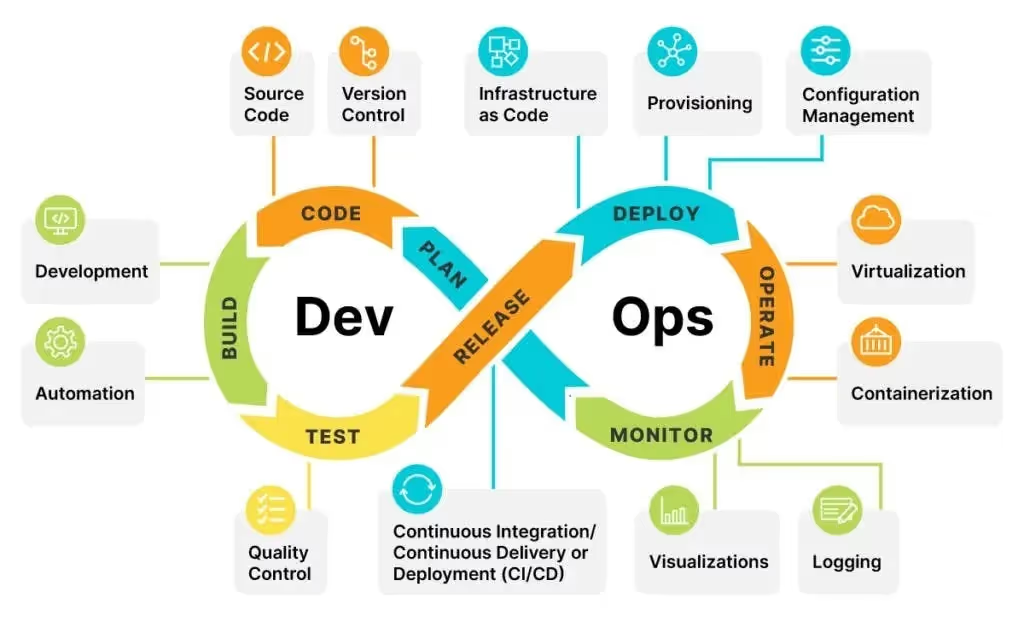
Utilize IaC tools like Terraform or AWS CloudFormation to define your infrastructure as code. This allows you to manage and provision infrastructure in a consistent and repeatable manner across different environments (development, staging, production). IaC eliminates the need for manual configuration, reducing the risk of human error and ensuring all environments are set up identically. This simplifies infrastructure management and makes it easier to scale your infrastructure as your startup grows. Version control for your IaC code allows you to track changes and roll back to previous configurations if necessary. IaC promotes a collaborative approach to infrastructure management, enabling developers and operations teams to work together more effectively.
Top DevOps Best Practices | Source: https://productcoalition.com/12-top-devops-best-practices-for-a-successful-transition-in-2023-b73b54014d0d
6. Adopt Containerization
Utilize Docker containers to package your application and its dependencies into a standardized unit. This ensures your application runs consistently across different environments, regardless of the underlying operating system. Containers simplify deployments by eliminating the need to worry about environment-specific dependencies. You can deploy your containerized application anywhere with a Docker runtime, making it easier to move between development, testing, and production environments. Docker containers also improve resource utilization by isolating applications from each other and sharing the underlying operating system kernel. This allows you to run multiple applications on a single server, maximizing the efficiency of your infrastructure.
7. Monitor & Measure
Implement robust monitoring and measurement practices to gain insights into application performance and identify bottlenecks. Utilize tools like Datadog, which offers real-time observability of infrastructure and applications, or Grafana for visualizing metrics. The ELK Stack (Elasticsearch, Logstash, Kibana) is ideal for log aggregation and analysis. Setting up comprehensive dashboards and alerts ensures that your team can quickly respond to performance issues and maintain optimal system health.
8. Prioritize security
Integrate security practices from the outset by adopting DevSecOps principles. Automate security testing with tools like OWASP ZAP, which can scan web applications for vulnerabilities, and Nessus, which identifies network security issues. Continuous monitoring for threats is essential, and regular security audits and compliance checks help maintain a robust security posture. Implementing automated security scans in your CI/CD pipeline ensures that security is continuously assessed throughout the development lifecycle.
9. Leverage Cloud Services
Utilize cloud infrastructure such as AWS, Azure, or Google Cloud to achieve scalability and flexibility. These platforms offer managed services, enabling you to scale resources up or down based on demand. For example, AWS provides EC2 for scalable computing power, S3 for flexible storage solutions, and RDS for managed database services. Leveraging these cloud services allows your startup to grow without the need for significant upfront investments in hardware and infrastructure.
10. Continuous learning & Improvement
Encourage ongoing education and adaptation within your team. Participate in industry conferences, webinars, and workshops to stay updated on the latest DevOps practices and tools. Regular training sessions and certifications in DevOps methodologies can keep your team skilled and informed. Additionally, promoting a culture of continuous improvement through internal knowledge-sharing sessions and retrospectives can help your team adapt to new challenges and refine their practices over time. This proactive approach ensures that your team remains agile and capable of driving innovation.
Conclusion
Adopting a DevOps culture equips small engineering teams with the tools and mindset necessary to excel. By embracing principles like shared responsibility and continuous improvement, teams can speed up development and enhance product quality.
Qovery offers an excellent option for startups looking to simplify and streamline DevOps. It automates critical processes, allowing teams to focus on innovation rather than operational challenges. With tools like Qovery and a strong DevOps culture, your team can achieve more, fostering an environment of continuous growth and learning. Remember, the journey to effective DevOps is continuous-stay curious, adaptable, and committed to excellence.
Morgan co-founded Qovery and leads engineering. He writes about Kubernetes architecture, DevOps best practices, and building resilient infrastructure at scale.
Next step
Agents ship fast. Guardrails keep them safe.
Qovery ensures every agent action is scoped, audited, and policy-checked. Start deploying in under 10 minutes.