
Hey Team,
Before diving into product updates, we want to highlight a piece of content that matters a lot to us and to many of you.
We just published a deep dive into Qovery’s security architecture and how we approach security by design. The article explains how we bridge the gap between developers and infrastructure without compromising on security or flexibility. From federated identities and per environment encryption keys to real time audit logs and SOC 2 Type II certification, it gives a clear view of how we protect your data while avoiding vendor lock in.
If security and compliance are part of your daily concerns, this one is worth a read.
Now let’s move on to what shipped.
🤖 Scheduled tasks with Qovery AI Copilot
You can now ask the Qovery Copilot to run tasks over time. For example, you can request a security report every Monday afternoon, generated in a specific format and delivered asynchronously.
Behind the scenes, Qovery creates a scheduled task and assigns it a dedicated read only token. This allows the task to run safely in the background for long periods without requiring user interaction, while keeping full control over permissions.
This is another step toward turning the Copilot into a reliable operational assistant, not just a chat interface.
🧩 Customize initialization for Terraform and OpenTofu
Some Terraform or OpenTofu workflows require more than the default execution environment. A common example is using local_exec with external tools like the AWS CLI.
You can now customize the Docker image used to run your Terraform or OpenTofu manifests. This lets you install additional libraries, download tools, or run custom commands before execution.
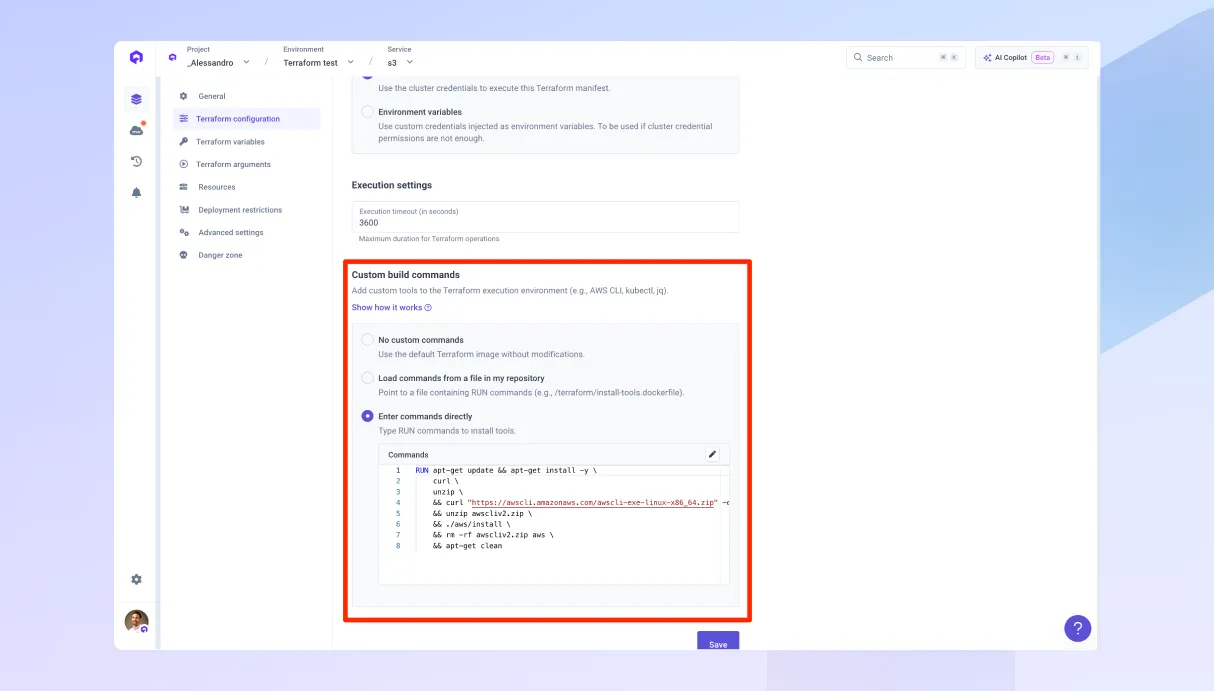
Customization can be defined inline or sourced from a Git repository, giving you full flexibility without breaking the managed experience.
⚙️ Karpenter migration update
All customer staging clusters have now been migrated to Karpenter. This brings faster scaling, better instance selection, and improved cost efficiency by dynamically provisioning nodes based on real workload needs.
Production cluster migration will be planned next, with more details shared ahead of time.
🚨 Qovery Observe now supports alert cloning
Managing alerts across multiple services just got easier. If you need the same alert condition, like CPU above 80 percent, on several services, you can now clone an existing alert instead of recreating it from scratch.
This saves time and helps keep alerting consistent across environments and teams.
🛠️ Minor updates
- Improved caching and connection handling for Git providers to reduce rate limiting
- Added Git token expiration management, automatically disabling expired tokens