Our Blog

Learn, build, and scale with the Qovery Blog. Access practical insights that help teams solve problems faster and deliver real results.
AI
Developer Experience
Kubernetes
 minutes
MCP Server is the future of your team's incident’s response
Learn how to use the Model Context Protocol (MCP) to transform static runbooks into intelligent, real-time investigation tools for Kubernetes and cert-manager.
Compliance
Developer Experience
 minutes
Beyond the spreadsheet: Using GitOps to generate DORA-compliant audit trails.
By adopting GitOps and utilizing management platforms like Qovery, fintech teams can automatically generate DORA-compliant audit trails, transforming regulatory compliance from a manual, time-consuming chore into an automated, native byproduct of their infrastructure.
Kubernetes
DevOps
11
 minutes
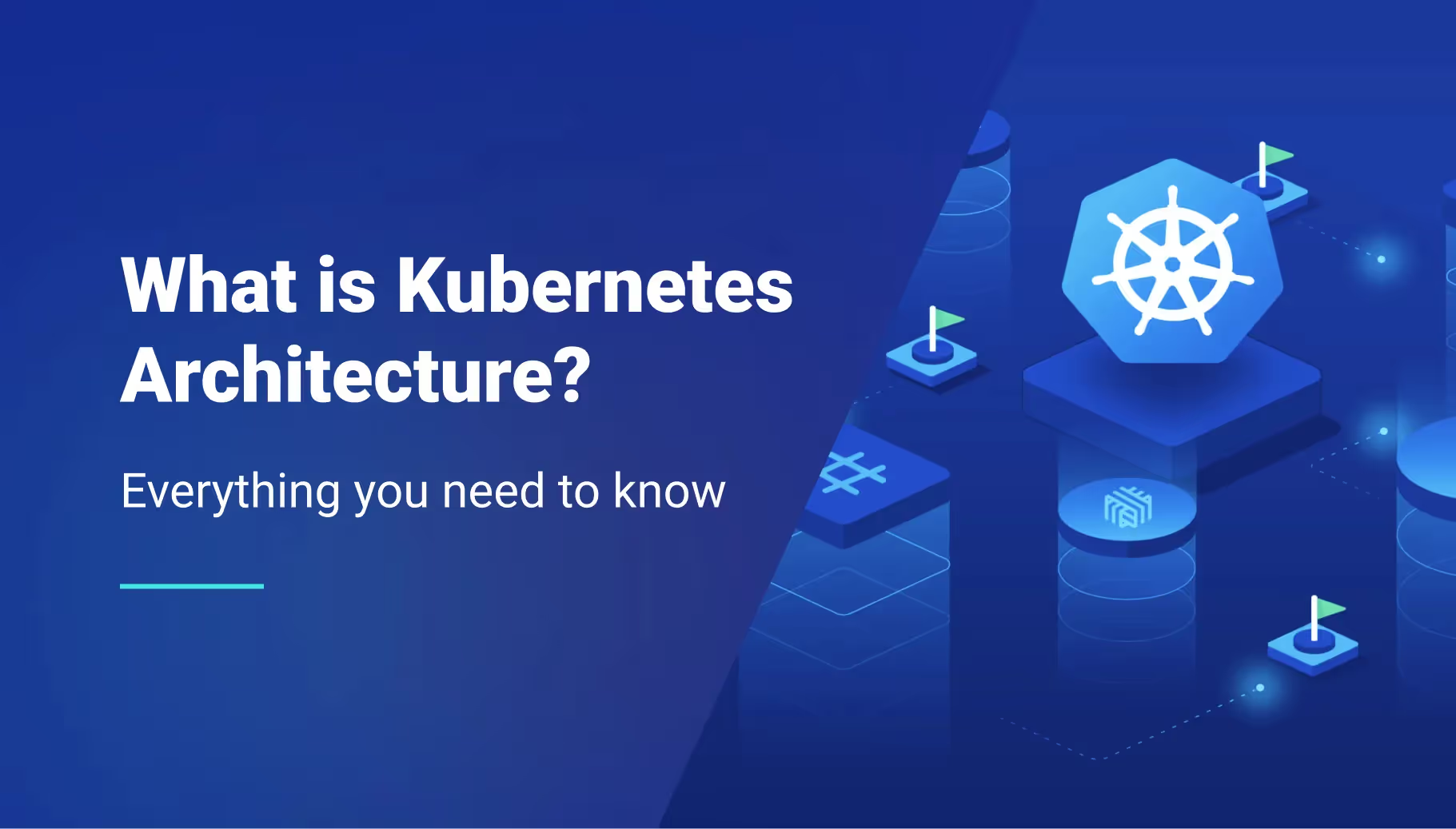
Kubernetes architecture: building resilient, multi-tenant control planes
Kubernetes architecture splits into the Control Plane (management) and Data Plane (workloads). For SaaS providers, this architecture must be tuned for high availability and multi-tenancy. Understanding the interplay between these components is critical to diagnosing bottlenecks that cause operational toil as user demand spikes.

Latest articles

Cloud
AWS
Kubernetes
Business
7
 minutes
Deploying Docker Containers on AWS: Elastic Beanstalk vs ECS vs EKS

Containerization packages a software component and its environment, dependencies, and configuration into an isolated unit called a container. That makes it possible to deploy an application consistently across different computing environments, whether on-premises or on the cloud. The concept of containerization is more than a decade old. Still, the emergence of Docker in 2013 - an industry standard for containers with simple development tools and a universal packaging approach - has accelerated the adoption of the technology. Organizations are now increasingly using containerization to build new applications and to modernize existing applications for the cloud. They start and stop much faster as compared to virtual machines. They are more portable because container host environments are very consistent, irrespective of the operating system hosting them. Containerized applications are easy to scale because containers can be added or removed quickly from an environment.

Morgan Perry
Co-founder
Kubernetes
Cloud
7
 minutes
Kubernetes vs Nomad: What to Choose in 2022?

Kubernetes has become an enormously popular choice for containerized applications since its 2014 launch. Many software developers rely on the tool, which is now in v1.23.1. However, there are other choices on the market for container orchestration. One such tool is Nomad, originally launched in 2015. Generally pitched as an alternative to Kubernetes, Nomad, which most recently released v1.2, promotes itself as a simple, flexible option for software teams. This article will offer a comparison of the two container orchestration tools, so you can decide which will work best for your applications in 2022.

Romaric Philogène
CEO & Co-founder
AWS
Terraform
6
 minutes
37 minutes to deploy a fullstack app on my new AWS account

Today, I was working on our Terraform Provider, and I noticed that I never tried to deploy an application from scratch on a new and clean AWS account. Meaning, an empty AWS account - with 0 resources created. No VPC, no EC2, no Load Balancer, nothing... just an IAM user to get access to my AWS account programmatically. This post explains what I did and how it took 37 minutes and 33 seconds to literally: create a VPC (10 min) create an EKS cluster and a load balancer (5 min) create an ECR repository (10 sec) deploy an RDS database (15 min) build and deploy my Django app from GitHub (2 min) add a custom domain to my app (2 min) create a TLS for my custom domain (15 sec) And tada! 🎉 😅 Let's explain all of that!

Romaric Philogène
CEO & Co-founder
Qovery
Business
9
 minutes
How We Defined The Pricing Model of Qovery

Our pricing model has evolved since we wrote this article - check out our new pricing model Pricing is a complex topic matter, and there’s no one-size-fits-all approach to pricing. Few things impact growth and revenue as much as your pricing. Finding the right balance between value and revenue will make or break your business. While most founders have a clear product vision and have thought through things like their go-to-market strategy or hiring plans, surprisingly, few have an idea about what their pricing should look like.

Morgan Perry
Co-founder
Cloud
Business
8
 minutes
Should Your Startup Hire a DevOps?

Software development no more emphasizes “final delivery” or deployment of a project. It is more about “continuous delivery and integration” today. The market also demands rapid delivery and updates without missing out on elements like ‘quality’ and ‘innovation.’ So, instead of building a super-robust well-tested product at once, developers focus on faster and bug-free releases to create a reliable product over time. For startups, the environment is even more pressing because these businesses have to meet their users’ requirements using a limited budget and resource-set. Competition is a different deal altogether. DevOps, a set of practices promoting continuous delivery/integration, can help you here.  Experts finding traditional operations 41% more time-consuming say it is why DevOps is a better choice. However, it doesn’t always mean that you need to hire DevOps engineers.

Morgan Perry
Co-founder
Kubernetes
Cloud
Business
6
 minutes
Should you use Kubernetes for your Startup?

Developers love containers for their portability and flexibility. Suitable for today’s cloud-native environment and agile development requirements, containers make it super-fast to develop, test, and run applications. Besides this, they are lightweight and can optimize the platform (and the host OS) they are deployed on. Now, for powerful applications with hundreds of containers, the platform should also be portable, flexible, extensible, and efficient. It should allow managing containerized workloads and services to support modern applications effortlessly. Kubernetes, the famous container orchestration platform, makes the best choice in this regard.

Morgan Perry
Co-founder
Qovery
Terraform
Product
6
 minutes
The Qovery Terraform Provider is Available Now

Big news! The Qovery Terraform Provider is now publicly available for everyone! This article will show you what you can do and why you should consider using Terraform with Qovery.

Romaric Philogène
CEO & Co-founder
AWS
Cloud
Business
9
 minutes
The 5 best AWS Deployment Options to Consider in 2023

When we talk about various deployment and infrastructure provisioning choices on AWS, each option serves a particular set of users and needs. Some of Amazon's most common deployment services include Elastic Beanstalk, CloudFormation, and CodeDeploy. In containerization, there are options like ECS, EKS, Fargate, etc.

Morgan Perry
Co-founder
Business
Product
Qovery
3
 minutes
How a team of 15 developers deploys 4200 times per Month using the Preview Environments

When the CTO of this growing company (freshly acquired by a billion-dollar company) contacted me, he was concerned by the ability of his team to deliver what they committed to for the current year. His main issue was 15 engineers working in the same development environment. Can you imagine developing on the same workstation? Things will get worst as they plan to quadruple their engineering team size in the next 18 months. They tried to set up ephemeral environments with Terraform, Kubernetes, and other great tools but they literally failed by the complexity of building such kind of system with a tech stack of 8 applications and databases.

Romaric Philogène
CEO & Co-founder
Thank you! Your submission has been received!
Oops! Something went wrong while submitting the form.

It’s time to change
the way you manage K8s

Turn Kubernetes into your strategic advantage with Qovery, automating the heavy lifting while you stay in control.