

Overview
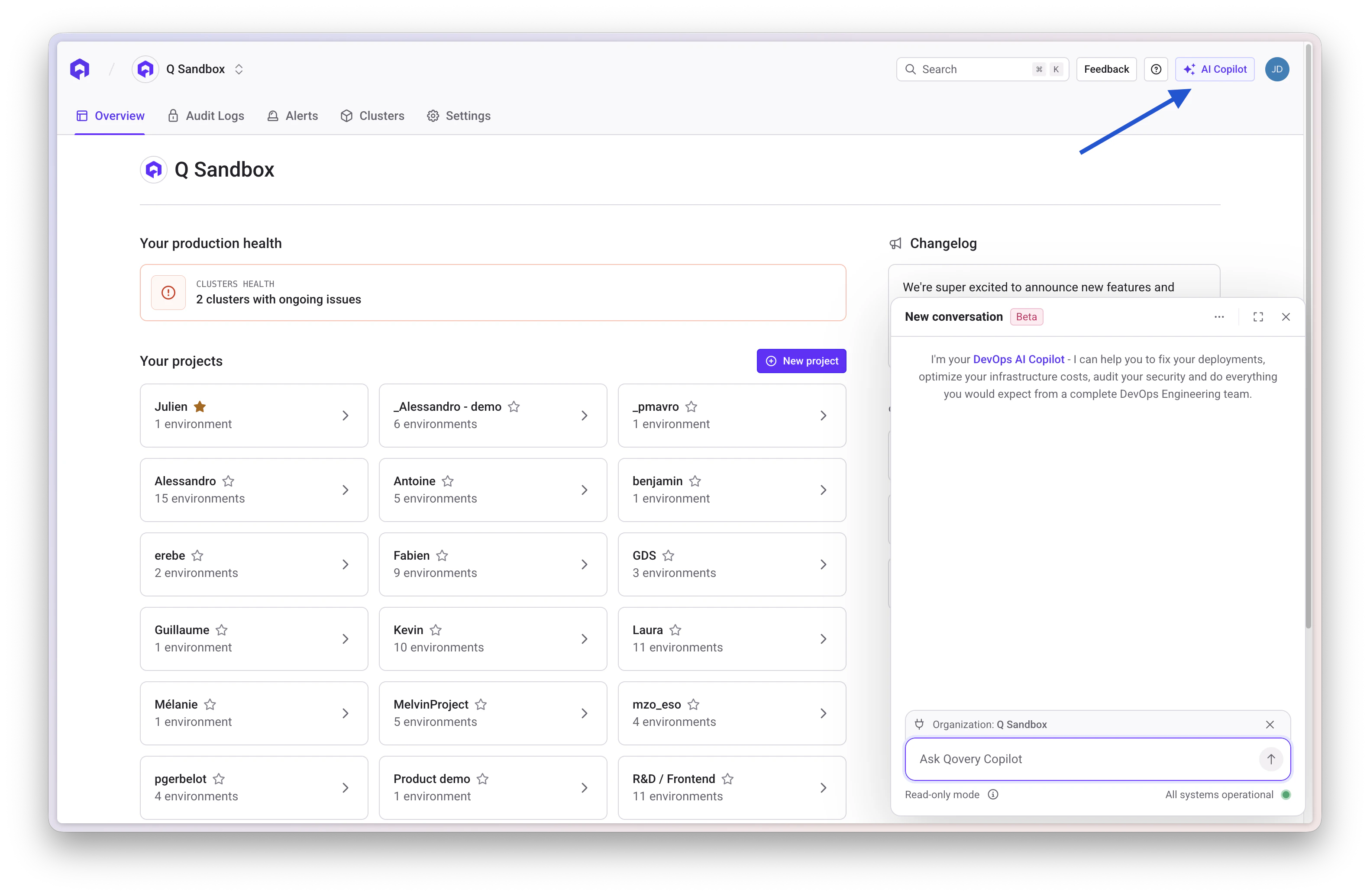
The Qovery Console includes a built-in AI Copilot that provides contextual assistance directly within the web interface. Access intelligent help, troubleshooting guidance, and infrastructure management without leaving the console.Available Now: The Console AI Copilot is available to all Qovery users. Simply click the AI Copilot button in the top-right corner of the console.
Settings: You can manage AI Copilot credits and activation under Settings > AI Copilot in the Console.
Operating Modes
The Qovery AI Copilot supports two operating modes:- Read-Only Mode (Default)
- Read-Write Mode
Default behavior - Safe for exploration and learningWhat it can do:
- ✅ View and display information
- ✅ Answer questions about your infrastructure
- ✅ Provide guidance and recommendations
- ✅ Explain concepts and features
- ✅ Show deployment status and logs
- ✅ List services, environments, and resources
- ❌ Create, modify, or delete resources
- ❌ Deploy or restart services
- ❌ Change configurations
- ❌ Update environment variables
- ❌ Execute any write operations
Read-only mode is enabled by default for safety. Each new thread starts in read-only mode, even when read-write is enabled in the settings.
Enabling Read-Write Mode
Read-write capabilities must first be enabled by an organization administrator in the Copilot settings panel.1
Open the Copilot Settings
In the Qovery Console, open the AI Copilot panel and navigate to its settings.
2
Enable Read-Write Mode
Toggle on the Read-Write Mode option. This unlocks write capabilities for all users in your organization who have the appropriate permissions.
3
Switch Mode Per Thread
Once enabled, a read/write toggle appears at the bottom of each Copilot thread. Each new thread starts in read-only mode by default — switch the toggle to read-write only when you intend to make changes.
This setting applies to the Console Copilot and the MCP Server. The Slack Bot is always read-only.
Accessing the AI Copilot
Opening the Copilot
There are two ways to open the AI Copilot in the console:- Click the AI Copilot button in the top-right corner of any console page
- Use keyboard shortcut: Press
⌘ I(Mac) orCtrl I(Windows/Linux)
The Copilot Panel
Once opened, the Copilot appears as a side panel on the right side of the console:- Contextual awareness: Automatically knows what page and environment you’re viewing
- Suggested actions: Pre-populated questions based on your current context
- Chat interface: Natural language interaction with your infrastructure
- System status: Shows operational status at the bottom
Contextual Suggestions
The Copilot provides contextual suggestions based on where you are in the console:Environment Page Suggestions
When viewing an environment, you’ll see suggestions like:- “What is an environment?” - Learn about environment concepts
- “Monitor the running and deployment status of your environments and services” - Check current status
- “How do I manage the deployment order of my services?” - Configure deployment pipelines
- “Manage the deployment lifecycle of your services and environments” - Control deployments
- “Check my deployments and application logs” - Investigate issues
Service-Specific Context
The Copilot automatically knows:- Which environment you’re viewing
- Which services are deployed
- Current deployment status
- Recent errors or issues
Using the Console Copilot
Ask Questions
Simply type your question in natural language:Get Contextual Help
The Copilot provides answers specific to your current context:- Environment Questions
- Troubleshooting
- Configuration Help
You ask: “What services are running?”Copilot responds: Based on your current environment “Julien dev”, you have:
- Frontend (Error)
- Grafana (Stopped)
- PostgreSQL (Starting)
- My service (Error)
- And 4 more services…
Features
Contextual Awareness
Automatically understands your current environment, services, and deployment status
Suggested Actions
Pre-populated questions based on common tasks for your current page
Natural Language
Ask questions in plain English without technical jargon
Real-time Status
Shows current system operational status
Quick Access
Keyboard shortcut (⌘ I) for instant access
Multi-Environment
Context switches automatically as you navigate
Common Use Cases
Getting Started
New to Qovery? Ask the basics:Troubleshooting Deployments
Having issues? Get instant help:Managing Services
Configure your infrastructure:Understanding Status
Check what’s happening:Current Mode in Console
Each Copilot thread starts in read-only mode by default, even if read-write is enabled in your organization settings. Use the toggle at the bottom of the thread to switch to read-write mode when you need to make changes.
Context Switching
The Copilot automatically adjusts its context as you navigate:1
Navigate to Different Environment
Switch to a different environment in the console
2
Copilot Updates Context
The Copilot immediately becomes aware of the new environment
3
Relevant Suggestions Appear
Contextual suggestions update to match the new environment
4
Environment Indicator
The current environment is shown in the Copilot panel (e.g., “Environment: Julien dev”)
Best Practices
Be specific about your context
Be specific about your context
While the Copilot knows your current environment, being specific helps:Instead of: “Why is it failing?”Try: “Why is the Frontend service deployment failing?”
Use suggested questions
Use suggested questions
The contextual suggestions are tailored to common tasks:
- Click on a suggested question to get started
- They’re designed for your current page context
- Great for learning what’s possible
Ask follow-up questions
Ask follow-up questions
Build on previous answers:
- “What services are in error state?”
- “Show me logs for the Frontend service”
- “How do I fix this deployment error?”
Use keyboard shortcuts
Use keyboard shortcuts
Speed up your workflow:
⌘ I(Mac) orCtrl I(Windows/Linux) to open- Type your question and press Enter
- ESC to close the panel
System Status
At the bottom of the Copilot panel, you’ll see the system status:- All systems operational 🟢 - Everything working normally
- Degraded performance 🟡 - Some issues affecting performance
- Partial outage 🟠 - Some features unavailable
- Major outage 🔴 - Significant service disruption
Authentication Modes
The Copilot supports two authentication modes, configured by an organization administrator in the Copilot settings. See the Getting Started guide for full details.JWT Mode (Default)
The Copilot acts on behalf of the currently logged-in user, using their JWT token. Actions are limited to what that user is authorized to do in Qovery.
Role Mode
The Copilot uses a token linked to a dedicated “AI Copilot” role. An admin can configure this role to define exactly which permissions the Copilot has, the role has viewer permissions by default — independently of individual users. Useful for centralized access control and cleaner audit trails.
Privacy & Security
What data does Copilot access?
What data does Copilot access?
The Console Copilot can access:
- Your current page context (environment, services)
- Service names and status
- Deployment history visible in the console
- Public documentation and help content
- Your application code
- Application logs content
- Secret values
- API tokens
Is my conversation private?
Is my conversation private?
- Conversations are associated with your user account
- Used to improve Copilot responses
- Not shared with other users
- Follow Qovery’s privacy policy
Comparison: Console vs Slack Bot vs MCP Server
- Console Copilot
- Slack Bot
- MCP Server
Best for:
- Quick help while working in the console
- Learning about features
- Understanding current status
- Troubleshooting guidance
- Read-only by default per thread
- Read-write available (requires admin activation in Copilot settings)
- No setup required
- Contextual awareness
- Always available
- Integrated experience
- Safe exploration by default
- You’re already in the console
- You need quick answers or contextual help
- Learning the platform
- You want to take actions directly from the console
Next Steps

Slack Bot
Use Copilot in Slack for team collaboration and automation
MCP Server
Use Copilot in Claude Desktop for power users
Capabilities
Explore all Copilot capabilities
Common Tasks
Learn from practical examples
Feedback
Help us improve the Console Copilot:- In-Console Feedback: Use the feedback button in the Copilot panel
- Email: Contact support@qovery.com
- Feature Requests: Share ideas for new capabilities