Blog
Engineering
2
minutes

Releasing IAM EKS User Mapper in open-source

I'm super excited to share something amazing our team at Qovery has been cooking up lately: the IAM EKS User Mapper. This isn't just any tool – it's our answer to a problem we know so many of you face: managing AWS IAM user access to Kubernetes clusters efficiently and securely. It's open-source and available to everyone now on GitHub.
September 26, 2025
Benjamin Chastanier
Software Engineer
Summary
Twitter icon
linkedin icon

So, why did we decide to build this? Well, at Qovery, we saw how tedious and error-prone it can be to manually handle cluster access. We thought, "There's got to be a better way!" And thus, the IAM EKS User Mapper was born, crafted with love in Rust 🦀. Why Rust, you ask? It's simple: for its unparalleled performance and reliability. We wanted a tool as robust and dependable as your needs.

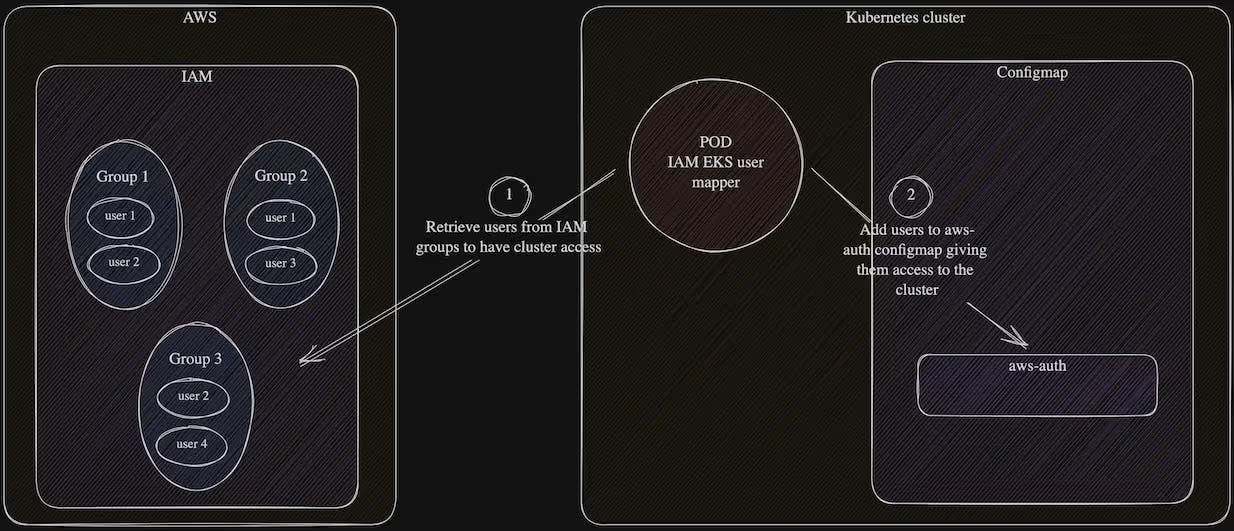
Diagram on how "IAM EKS User Mapper" works

Here’s a sneak peek into what makes this tool a must-have:

  1. Group Users Sync: Say goodbye to the hassle of manually updating access rights. This feature automatically syncs IAM users from groups directly into your Kubernetes cluster’s aws-auth configmap. It's all about making your life easier.
  2. SSO Support: We know how crucial SSO is for secure and efficient access management. That’s why our tool supports SSO roles in the aws-auth configmap, making it a breeze for users to connect to the cluster.

By open-sourcing the IAM EKS User Mapper, we’re inviting you to join in, contribute, and help shape the future of Kubernetes access management. Whether you're bug hunting, suggesting new features, or coding up a storm, we’re here for it and appreciate your input.

We’d love to hear from you. How do you currently handle Kubernetes cluster access? Any challenges or tips you'd like to share? Your experiences and feedback are gold to us. Please use this reddit thread or open an issue on GitHub if you want to share your experience.

In a nutshell, the IAM EKS User Mapper is our way of making Kubernetes management a little less stressful and a lot more secure. We can’t wait to see how you use it and make it even better.

Repository: IAM EKS User Mapper Repository

Share on :
Twitter icon
linkedin icon
Tired of fighting your Kubernetes platform?
Qovery provides a unified Kubernetes control plane for cluster provisioning, security, and deployments - giving you an enterprise-grade platform without the DIY overhead.
See it in action

Suggested articles

Compliance
Kubernetes
 minutes
Enforcing security baselines across 1,000s of Kubernetes clusters

The part teams consistently underestimate is that OPA Gatekeeper, the tool most people reach for first, only enforces policy at the cluster level. It blocks non-compliant resources from being created within a single cluster. Propagating consistent Gatekeeper policies across 300 clusters, and detecting when those policies drift, is a fleet orchestration problem that Gatekeeper was not designed to solve.

Mélanie Dallé
Senior Marketing Manager
Kubernetes
AI
 minutes
7 best AI deployment platforms for production Kubernetes workloads in 2026

Training a model in a notebook is easy. What breaks teams is the step after, serving it reliably without haemorrhaging cloud budget or burying your SREs in YAML. The common trap: picking a platform that handles the model but not the surrounding stack. An AI deployment platform should orchestrate the full application graph (inference endpoints, vector databases, caching layers, and frontends) inside a single VPC, with GPU autoscaling that doesn't require a dedicated platform engineer to babysit.

Mélanie Dallé
Senior Marketing Manager
Kubernetes
7
 minutes
Kubernetes multi-cluster architecture: the Day-2 enterprise strategy for 2026

The mistake teams make early is assuming Kubernetes namespaces provide sufficient isolation between workloads or teams. They do not. Namespaces share the control plane, the node pool, and the underlying network fabric. A misconfigured workload in one namespace can exhaust node capacity or crash the API server for every other namespace simultaneously. That is when the multi-cluster conversation starts.

Morgan Perry
Co-founder
Cloud Migration
Developer Experience
Engineering
 minutes
[Alan] From nginx to Envoy: What Actually Happens When You Swap Your Proxy in Production

Migrating from nginx Ingress to Envoy Gateway? Discover how Alan migrated 100+ services in one month, the technical hurdles they faced (like Content-Length normalization), and why staging isn't always enough.

William Occelli
Platform Engineer at Alan
Kubernetes
8
 minutes
Kubernetes management in 2026: mastering Day-2 ops with agentic control

The cluster coming up is the easy part. What catches teams off guard is what happens six months later: certificates expire without a single alert, node pools run at 40% over-provisioned because nobody revisited the initial resource requests, and a manual kubectl patch applied during a 2am incident is now permanent state. Agentic control planes enforce declared state continuously. Monitoring tools just report the problem.

Mélanie Dallé
Senior Marketing Manager
Kubernetes
6
 minutes
Kubernetes observability at scale: how to cut APM costs without losing visibility

The instinct when setting up Kubernetes observability is to instrument everything and send it all to your APM vendor. That works fine at ten nodes. At a hundred, the bill becomes a board-level conversation. The less obvious problem is the fix most teams reach for: aggressive sampling. That is how intermittent failures affecting 1% of requests disappear from your monitoring entirely.

Mélanie Dallé
Senior Marketing Manager
Kubernetes
 minutes
How to automate environment sleeping and stop paying for idle Kubernetes resources

Scaling your deployments to zero is only half the battle. If your cluster autoscaler does not aggressively bin-pack and terminate the underlying worker nodes, you are still paying for idle metal. True environment sleeping requires tight integration between your ingress layer and your node provisioner to actually realize FinOps savings.

Mélanie Dallé
Senior Marketing Manager
Kubernetes
DevOps
6
 minutes
10 best Kubernetes management tools for enterprise fleets in 2026

In 2026, the market has split clearly between basic infrastructure provisioners and agentic management platforms that handle Day-0, Day-1, and Day-2 operations. The following guide covers the ten tools that enterprise teams are actually running at fleet scale, what each one does well, and where each one will frustrate you.

Mélanie Dallé
Senior Marketing Manager

It’s time to change
the way you manage K8s

Turn Kubernetes into your strategic advantage with Qovery, automating the heavy lifting while you stay in control.