Blog
Product
2
minutes

Environment variables and Secrets - The Future of Qovery - Week #6

During the next five weeks, our team will work to improve the overall experience of Qovery. We gathered all your feedback (thank you to our wonderful community 🙏), and we decided to make significant changes to make Qovery a better place to deploy and manage your apps.

Romaric Philogène
CEO & Co-founder
Summary
Twitter icon
linkedin icon

This series will reveal all the changes and features you will get in the next major release of Qovery. Let's go!

Read the previous article: Qovery goes beyond app deployment - The Future of Qovery - Week #5.

Environment variables.

You have a NodeJS app that needs a PostgreSQL database - the good practice to connect your app to the database is to use environment variables to get the host, the port, and the credentials.
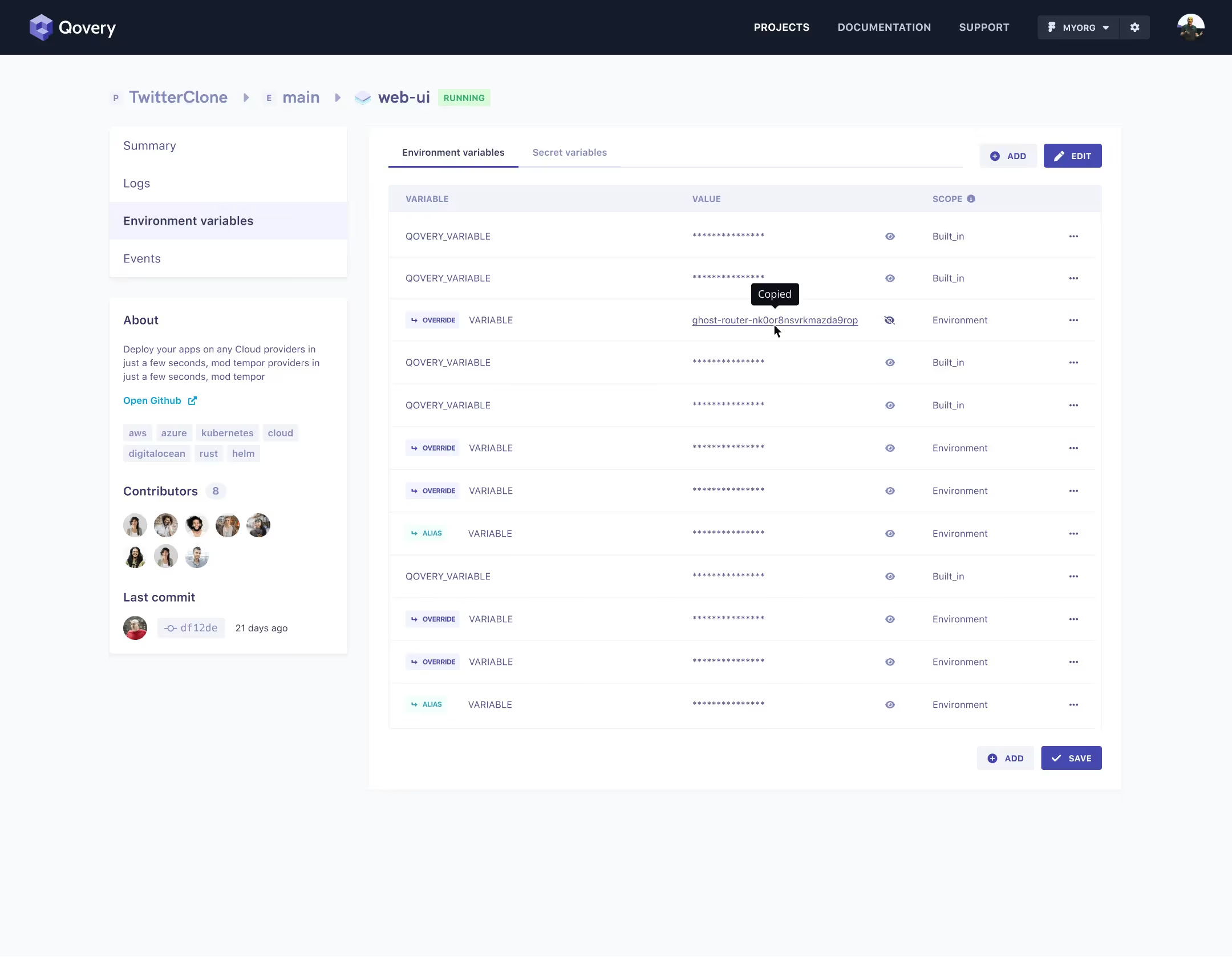
Manage environment variables from Qovery

With the next release of the web interface, managing environment variables will be easier than before.

The same system of "scope" will remain - meaning you will still be able to set environment variables for many applications if you need it. Four scopes exist:

  • BUILT_IN: Automatically generated variables based on your configuration (e.g., requested databases) propagated to all projects, environments, and applications.
  • PROJECT: Variables at the project level are shared across all environments and all applications of the project.
  • ENVIRONMENT: Variables at the environment level are shared across all project applications in one given environment.
  • APPLICATION: Variables available for one application in a single environment

Secrets

Now let's say that your app needs to use Stripe to bill your user. You want to keep this secret secure and immutable from any change. This is why we introduce Secret Management. Secrets are encrypted and can't be revealed and modified once they are set.
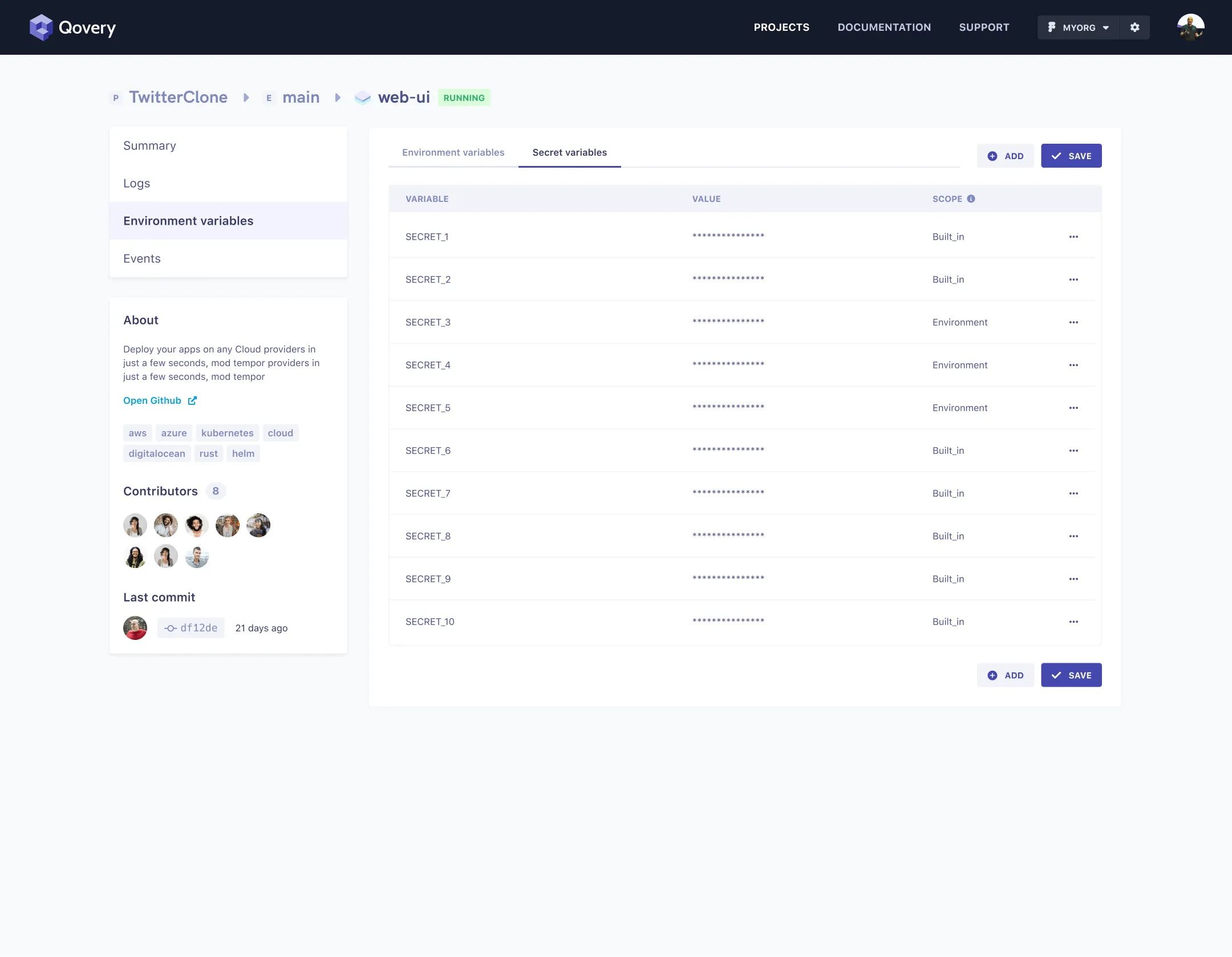
Manage secrets from Qovery

Secrets can also be scoped, overridden, and aliased.

Qovery takes care of injecting your environment variables and secrets during the build time, deployment, and runtime.

Conclusion

We spent some time improving the UX to manage environment variables - we also considered adding the Secret Management feature to avoid using sensitive data inside your app. My team and I are excited to release our next major version of Qovery. If you are interested in joining the beta in early June, let me know by contacting us on Discord.

--

See you next week -- same hour, same place 👋

Romaric from Qovery -- We are hiring

Share on :
Twitter icon
linkedin icon
Ready to rethink the way you do DevOps?
Qovery is a DevOps automation platform that enables organizations to deliver faster and focus on creating great products.
Book a demo

Suggested articles

Cloud
Heroku
Internal Developer Platform
Platform Engineering
9
 minutes
The Top 8 Platform as a Service (Paas) Tools in 2026

Build Your Own PaaS: Stop depending on fixed cloud offerings. Discover the top 8 tools, including Qovery, Dokku, and Cloud Foundry, that let you build a customizable, low-maintenance PaaS on your cloud infrastructure.

Morgan Perry
Co-founder
Kubernetes
 minutes
How to Deploy a Docker Container on Kubernetes: Step-by-Step Guide

Simplify Kubernetes Deployment. Learn the difficult 6-step manual process for deploying Docker containers to Kubernetes, the friction of YAML and kubectl, and how platform tools like Qovery automate the entire workflow.

Mélanie Dallé
Senior Marketing Manager
Observability
DevOps
 minutes
Observability in DevOps: What is it, Observe vs. Monitoring, Benefits

Observability in DevOps: Diagnose system failures faster. Learn how true observability differs from traditional monitoring. End context-switching, reduce MTTR, and resolve unforeseen issues quickly.

Mélanie Dallé
Senior Marketing Manager
DevOps
Cloud
8
 minutes
6 Best Practices to Automate DevSecOps in Days, Not Months

Integrate security seamlessly into your CI/CD pipeline. Learn the 6 best DevSecOps practices—from Policy as Code to continuous monitoring—and see how Qovery automates compliance and protection without slowing development.

Morgan Perry
Co-founder
Heroku
15
 minutes
Heroku Alternatives: The 10 Best Competitor Platforms

Fed up of rising Heroku costs and frequent outages? This guide compares the top 10 Heroku alternatives and competitors based on features, pricing, pros, and cons—helping developers and tech leaders choose the right PaaS.

Mélanie Dallé
Senior Marketing Manager
Product
Infrastructure Management
Deployment
 minutes
Stop tool sprawl - Welcome to Terraform/OpenTofu support

Provisioning cloud resources shouldn’t require a second stack of tools. With Qovery’s new Terraform and OpenTofu support, you can now define and deploy your infrastructure right alongside your applications. Declaratively, securely, and in one place. No external runners. No glue code. No tool sprawl.

Alessandro Carrano
Head of Product
AI
DevOps
 minutes
Integrating Agentic AI into Your DevOps Workflow

Eliminate non-coding toil with Qovery’s AI DevOps Agent. Discover how shifting from static automation to specialized DevOps AI agents optimizes FinOps, security, and infrastructure management.

Mélanie Dallé
Senior Marketing Manager
DevOps
 minutes
Top 10 Flux CD Alternatives: Finding a Better Way to Deploy Your Code

Looking for a Flux CD alternative? Discover why Qovery stands out as the #1 choice. Compare features, pros, and cons of the top 10 platforms to simplify your deployment strategy and empower your team.

Mélanie Dallé
Senior Marketing Manager

It’s time to rethink
the way you do DevOps

Say goodbye to DevOps overhead. Qovery makes infrastructure effortless, giving you full control without the trouble.