An internal developer platform (IDP) gives developers self-service for environments, deployments and infrastructure, while the platform team sets the guardrails once. The tools in this list split into three groups: portals (a catalog and front end), orchestrators (a backend you wire into your own stack) and ready-to-use platforms that deploy apps for you.
Most vendors repositioned around AI agents in 2026. OpsLevel, Humanitec, Mia-Platform, Appvia and mogenius now all pitch governance for agent-written code, so compare what each one deploys and runs for you.
Pricing ranges from free tiers (Qovery, Nullstone, Northflank, Portainer up to 3 nodes) to quote-only enterprise contracts (OpsLevel). Humanitec lists its Teams plan at $2,199 a month.
Qovery, the Agentic DevOps platform, is the ready-to-use option in this list: it deploys apps and preview environments on Kubernetes in your own AWS, GCP, Azure or Scaleway account, or on a cluster you already run, and it has a Free plan with no credit card.
What is an Internal Developer Platform?
An internal developer platform (IDP) is the layer of tools and automation a platform team builds or buys so developers can create environments, deploy applications and provision infrastructure on their own, without filing tickets. The platform team encodes security, cost and compliance rules once, and every self-service action follows them.
The goal of an IDP is to let developers spend their time on product features instead of on the infrastructure under them.
Developers want to build applications, not check that every cluster, database and pipeline meets the organization's standards. An IDP takes that check off their plate: it gives them one place to deploy, configure and observe their services, and it applies the standards automatically.
With a shared platform, teams stop rebuilding the same pipeline and environment setup for each project. Platform engineering gives everyone a common foundation, which removes the platform team as a bottleneck for routine changes and shortens the time from commit to production. For a wider view of the discipline, see our platform engineering hub.
Internal developer platforms compared
Prices and positioning were checked on each vendor's own site on 23 November 2026. "Quote only" means the vendor publishes no price.
Tool
Type
Where your apps run
Entry pricing
Best for
Qovery
Ready-to-use platform
Kubernetes in your AWS, GCP, Azure or Scaleway account, or your existing cluster
Teams that need compliance controls on many clusters
10 Best Internal Developer Platforms to Consider
1. Qovery
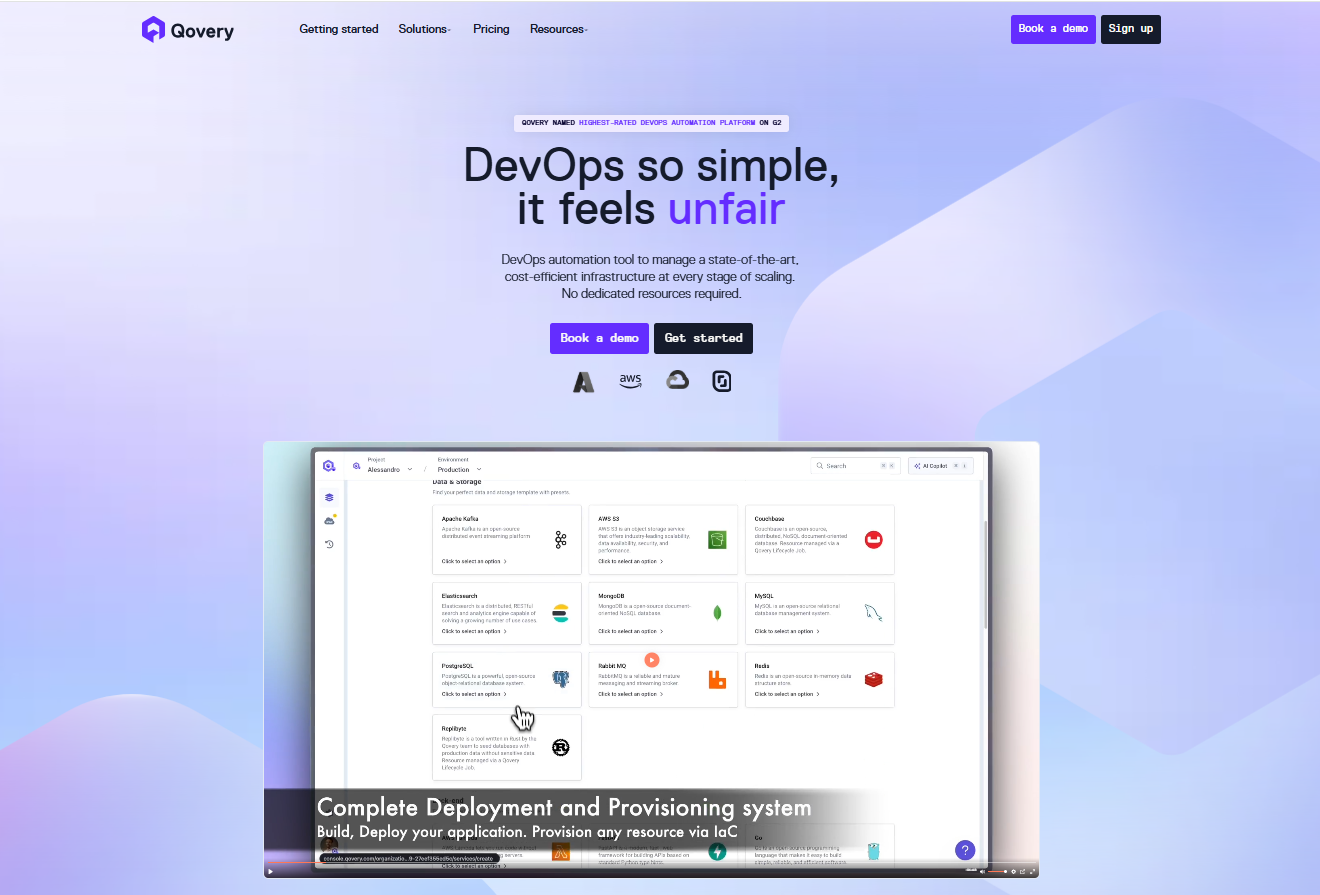
Qovery, the Agentic DevOps platform, is a ready-to-use internal developer platform. Developers and AI coding agents deploy applications, databases, Helm charts and Terraform modules on Kubernetes, and every environment can be cloned or created per pull request as a preview environment. Qovery never hosts your apps: they run in your own cloud account, and Qovery is the control plane on top.
Qovery provides usage reports, cost optimization, RBAC and audit logs. AI agents (Claude Code, Cursor, Codex) work through the Qovery MCP Server and Agent Skills, and API Policy Tokens limit what each agent may do.
If your platform team already runs Kubernetes, Qovery can sit on that cluster instead of creating a new one. On EKS, GKE or Scaleway Kapsule you install the Qovery Operator once with Helm; Qovery never stores your kubeconfig, and deployments and image builds run inside your cluster (BYOK docs). The Free plan covers one such cluster, 3 users plus unlimited AI agents and 1,000 deployment minutes a month, with no credit card.
Qovery is not a portal framework. If what you need is a service catalog with scorecards across hundreds of services, a portal such as Backstage or OpsLevel does that job, and Qovery can be the deployment layer behind it.
2. OpsLevel
OpsLevel Platform
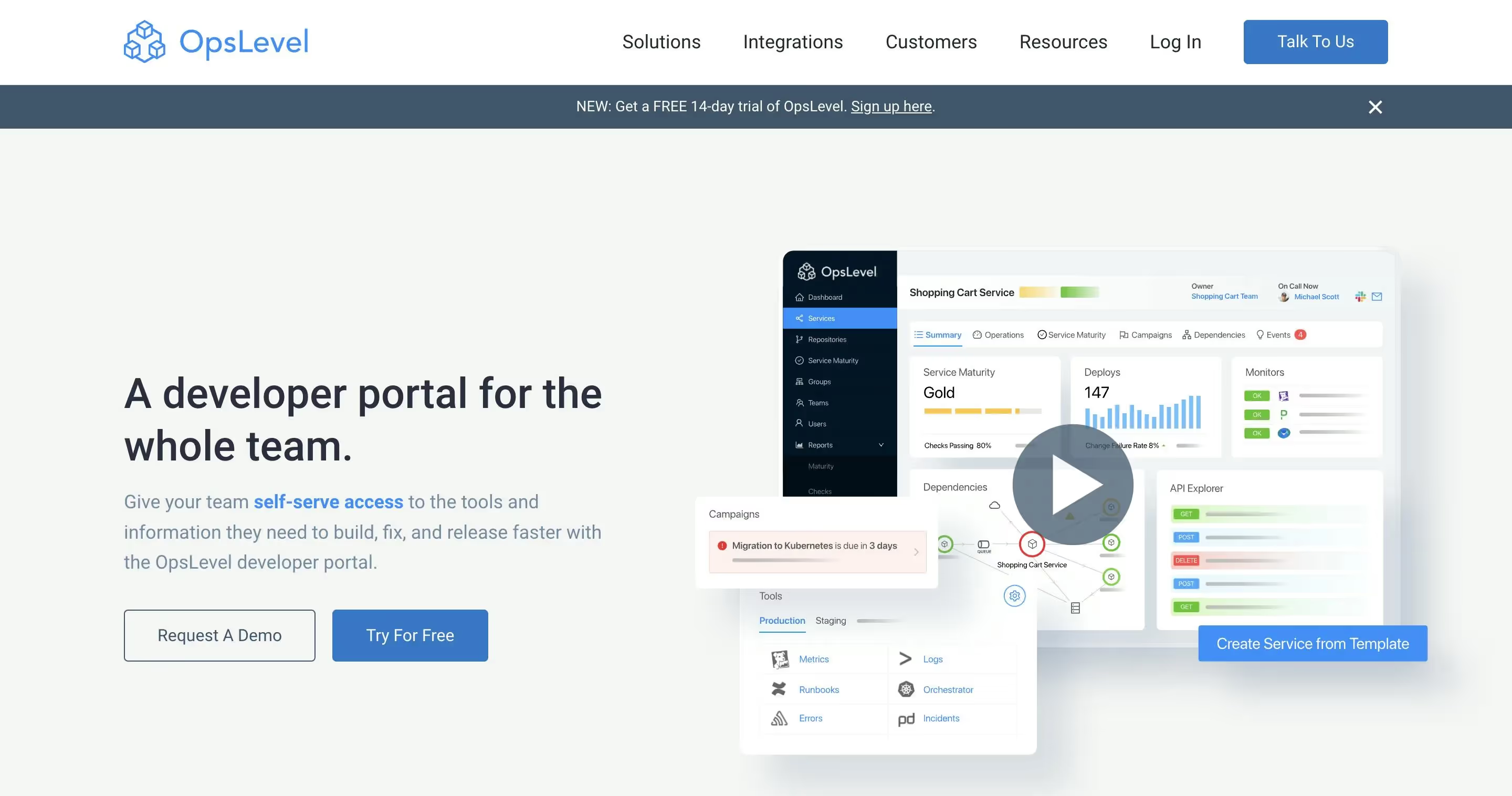
OpsLevel is an internal developer portal. It builds a software catalog with AI from your existing tools (services, owners and documentation), enforces standards with scorecards, checks and campaigns, and runs workflows with approval gates. In 2026 it describes itself as "The Agentic Delivery Engine" and feeds the catalog to AI agents as context. It connects to more than 50 tools, including GitHub, Kubernetes, AWS, PagerDuty and Slack. OpsLevel does not deploy your applications; it sits on top of whatever does. Pricing is quote-based and set by the number of developers using the portal.
3. Humanitec
Humanitec Platform
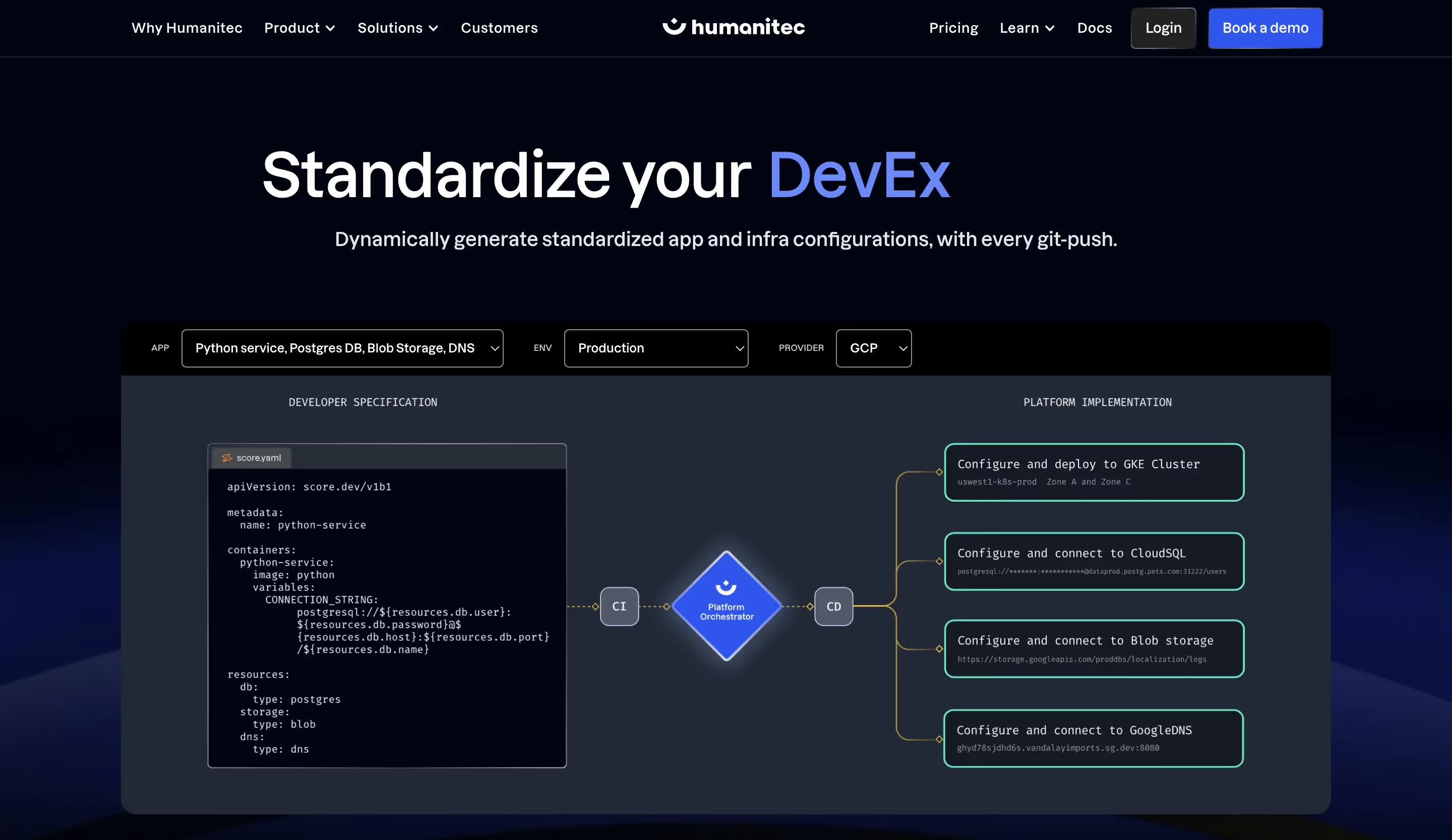
Humanitec sells the building blocks of an IDP rather than a finished one. The Platform Orchestrator is a graph-based backend that connects your existing CI/CD, infrastructure as code and cloud; the Portal is a catalog and self-service front end; Score is the open-source workload spec developers write. Its 2026 messaging focuses on governing infrastructure that AI agents provision, with progressive rollouts, impact analysis, one-command rollback and drift detection. Published pricing starts at $2,199 a month for the Teams plan (5 users, 1 project, up to 5 environments) and $5,499 a month for Pro. We compare both approaches in Qovery vs Humanitec.
4. Backstage
Backstage is the open-source framework for building developer portals, created at Spotify and accepted into the CNCF in 2020, where it is an Incubating project. It gives you a software catalog, templates for new services and a plugin system, under the Apache 2.0 license. Backstage is a portal: it shows and starts things, and you still need a platform behind it to deploy and run workloads. Running it means owning a TypeScript application and its plugins, which usually takes dedicated engineers. See Qovery vs Backstage for how the two fit together.
5. Mia Platform
Mia Platform
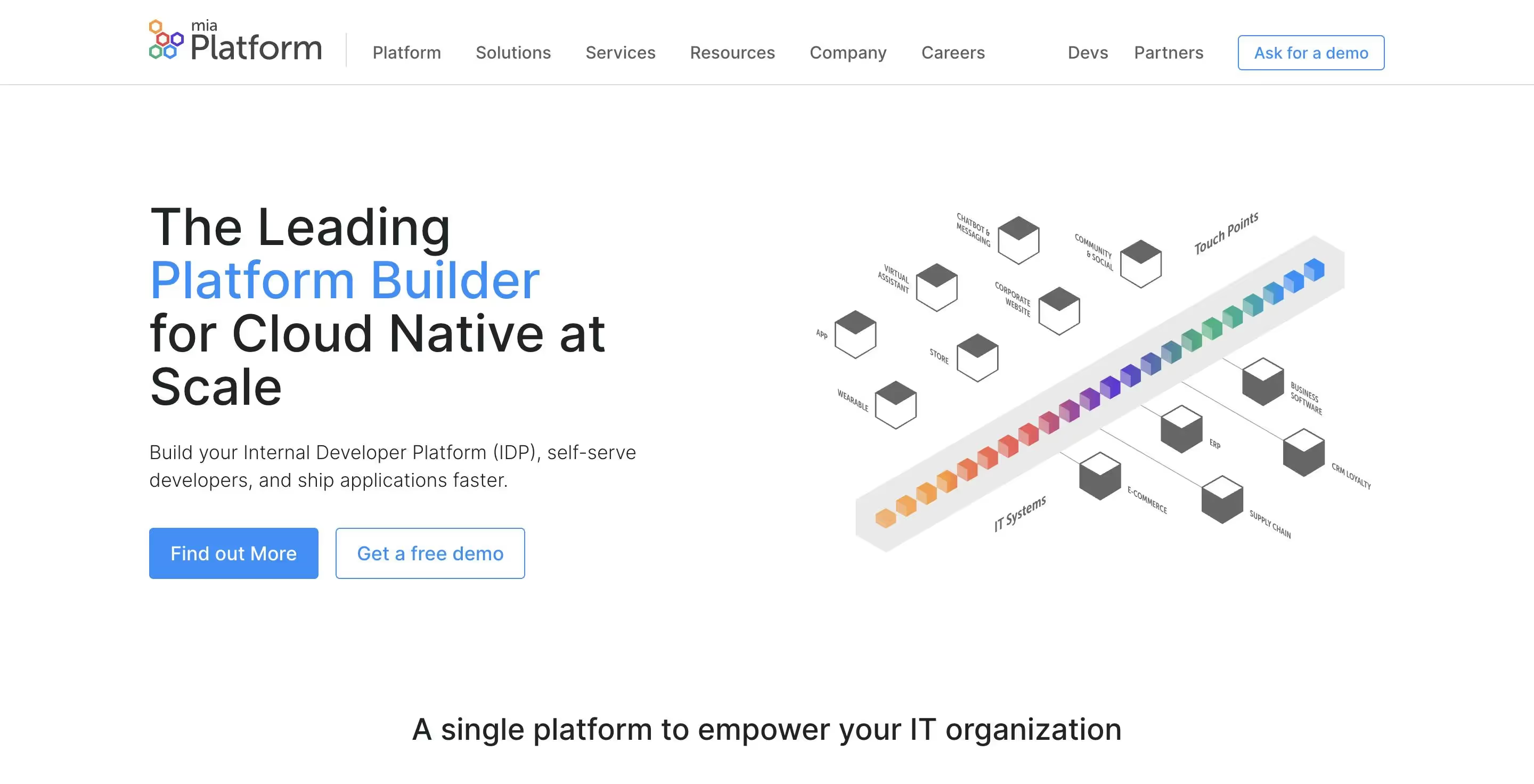
Mia-Platform now calls itself "The Developer Platform for agentic engineering". Its Console remains the core for self-service environment provisioning and deployment, and around it sit a Context Catalog (a registry of tools, datasets and integrations), AI Foundry for governed agent playbooks, Fast Data for real-time data, and API lifecycle management. The pitch is governance first: controls in place before any agent runs. Pricing is not published.
6. Portainer
Portainer Platform
Portainer is a centralized multi-cluster management platform for Docker and Kubernetes, in the cloud, on-premise or at the edge, with a single interface teams can use without deep Kubernetes skills. The open-source edition is still maintained, and Portainer offers its commercial product free for up to 3 nodes. Paid plans start at $1,045 a year (Starter) and $2,095 a year (Scale), billed annually. Portainer also offers a Portainer-IDP product.
7. Appvia
Appvia Platform
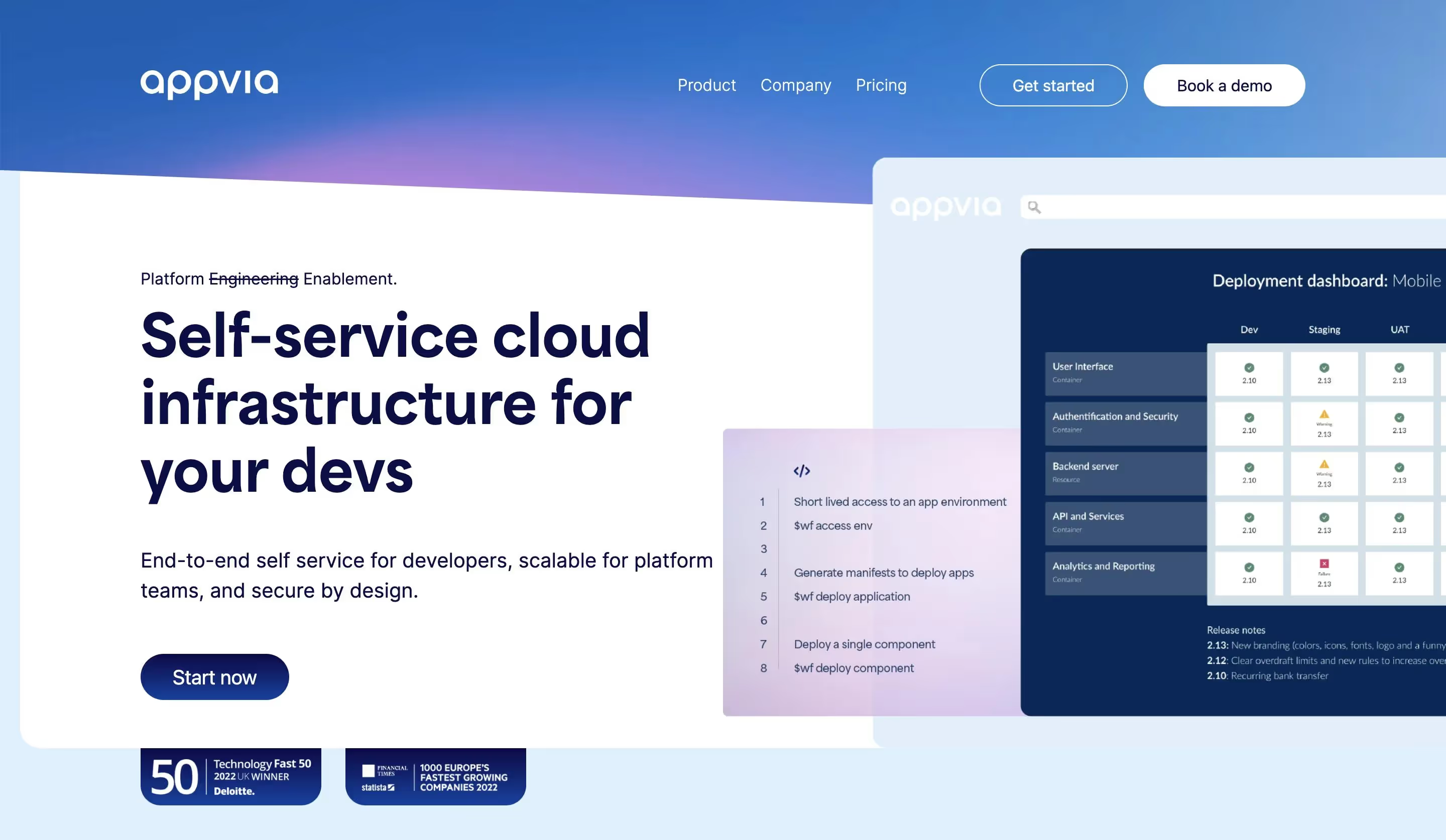
Appvia is a UK platform engineering company. Its product, Wayfinder, is described as "an agentic SDLC platform": developers describe what they need and AI agents build, test and deploy it within guardrails set by the platform team. Appvia also sells delivery services, accelerators and managed services, and maintains open-source tools such as Terranetes. Pricing is on request, with a free trial of Wayfinder.
8. Northflank
Northflank is a developer platform that runs services, jobs and databases either on Northflank's own cloud or in your cloud account (BYOC). Its free sandbox includes 2 services, 2 jobs, 1 database and 1 BYOC cluster up to 12 vCPU and 48 GB, with no card needed. On BYOC it charges $0.02083 per node vCPU per hour and your cloud provider bills the machines, so existing credits and commitments still apply.
9. Nullstone
Nullstone Platform
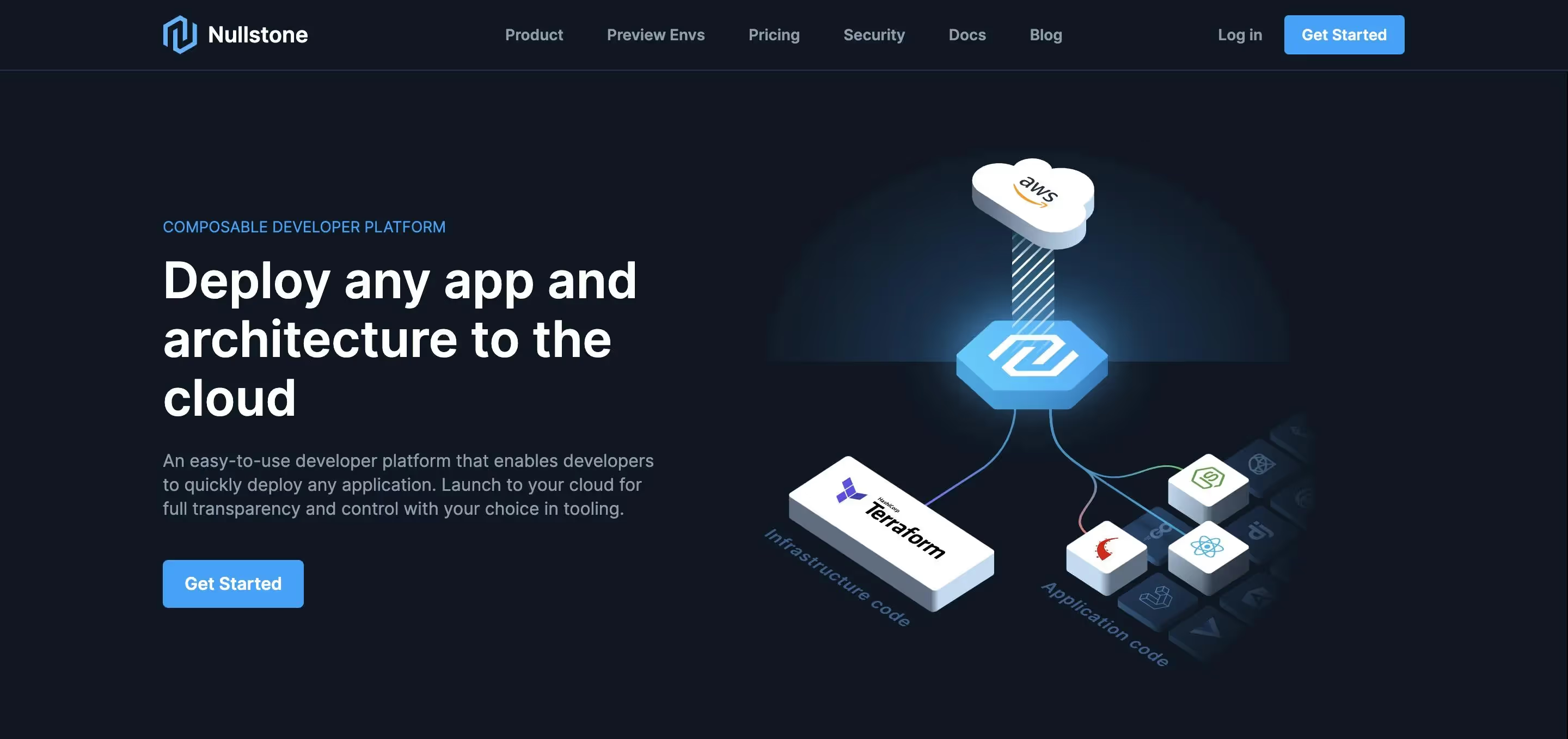
Nullstone is a developer platform for growing engineering teams that deploys full-stack apps and environments into your own AWS or GCP account, so Nullstone cannot access your data. It has a free Individual plan (1 user, 1 environment, 10 deploys a week), a Growth plan at $125 per user per month with a $625 monthly minimum, and Enterprise pricing on request. Growth adds bring-your-own Terraform and RBAC.
10. Mogenius
Mogenius Platform
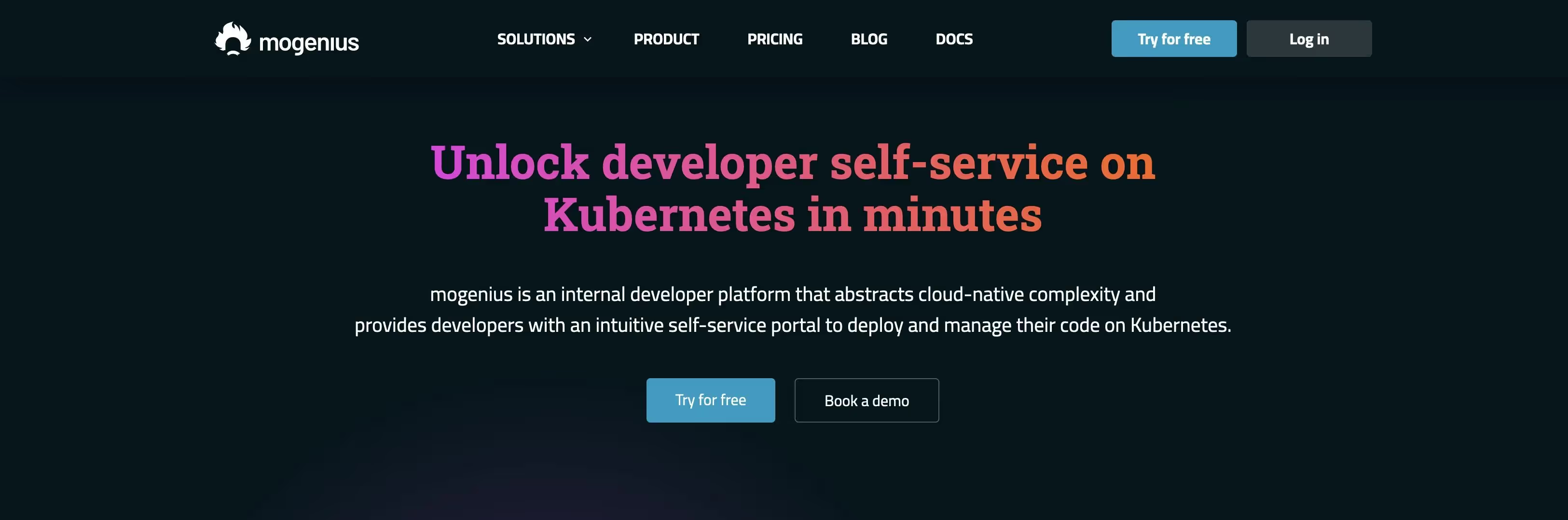
mogenius is a control plane for running containerized applications on Kubernetes across environments and clouds, with governance and compliance built in. Its 2026 tagline is "AI writes your software. We make it safe to ship." Plans start at €450 a month (Team: 5 users, up to 2 clusters), with Business at €1,150 a month and a managed cluster add-on at €650 a month per cluster. There is a free trial but no free tier.
Earlier versions of this list included Coherence and Argonaut. argonaut.dev now redirects to WarpBuild, a GitHub Actions runner company, and we could not load Coherence's site to confirm its current product, so both are out of the 2026 list.
Agents ship fast. Guardrails keep them safe.
Qovery ensures every agent action is scoped, audited, and policy-checked. Start deploying in under 10 minutes.
How to Select the Right Internal Developer Platform
Compare the platforms on the factors below, in roughly this order of importance for most teams.
1. Scalability
Check how each platform handles more services, environments and clusters. Ask what happens to pricing and to the platform team's workload when you double the number of services.
2. Integration Capabilities
Check how well the platform fits your existing Git provider, CI, infrastructure as code, secrets manager and observability stack. A platform that replaces tools your team likes will meet resistance; one that wires into them gets adopted faster.
3. Ease of Use
Developers who find a platform hard go around it. Look at the first deployment experience, the documentation, and whether developers need to learn Kubernetes to use it.
4. Security and Compliance
Check access controls, audit logs, secret handling and where your workloads and data run. If you are in a regulated industry, ask which controls the platform helps you meet and which remain your job. With AI agents now deploying code, also check whether you can scope and audit what each agent may do.
5. Cost
Compare list prices where they exist, then add the cost you do not see on the pricing page: the engineers who will host, upgrade and extend the platform. An open-source portal is free to download and rarely free to run.
6. Use Case Suitability
Some tools catalog services, some orchestrate infrastructure you already own, and some deploy apps for you. Decide which of those problems you have before shortlisting.
7. Support and Documentation
Check response times, the support channels on your plan, and whether the documentation covers your cloud and your stack.
8. User Reviews and Feedback
Talk to teams of a similar size that run the platform in production, and read both positive and negative reviews.
Conclusion
The right internal developer platform depends on which job you need done. If you need a catalog and standards across many services, start with a portal such as OpsLevel or Backstage. If you have a platform team that wants to assemble its own backend, look at Humanitec. If you want developers and AI agents deploying to your own cloud account this quarter without building the platform first, try Qovery on the Free plan.
Frequently asked questions
What is an internal developer platform?
An IDP is the set of tools and automation that gives developers self-service access to configuration, deployment, provisioning and environment management. The value is in the abstraction: developers ship without filing tickets or learning the underlying infrastructure, and the platform team encodes the guardrails once.
What is the difference between an internal developer platform and an internal developer portal?
A portal is the interface: a catalogue, documentation and templates, with Backstage as the reference implementation. A platform is the machinery underneath that actually provisions infrastructure and deploys applications. A portal without a platform behind it is a directory of links to systems developers still cannot operate themselves.
Should you build or buy an internal developer platform?
Building gives you an exact fit and a permanent maintenance obligation. The question to answer is whether platform engineering is a differentiator for your business or overhead. Small teams rarely recover the cost of a bespoke platform; the build case gets stronger with unusual compliance, network or multi-tenancy requirements.
What should an internal developer platform actually do?
At minimum: provision environments on demand, deploy applications without hand-written manifests, manage secrets and configuration, and expose logs and metrics in one place. Anything that still requires a platform engineer in the loop for a routine change is a gap.
Do you need Kubernetes to run an internal developer platform?
No, but most serious ones assume it, because Kubernetes provides the scheduling, networking and resource primitives an IDP would otherwise have to invent. What varies is how much of Kubernetes reaches the developer. The better platforms keep it as the substrate and never make it the interface.
Can Qovery be our internal developer platform without a platform team?
Yes, that is the use case Qovery, the Agentic DevOps platform, is built for. It deploys apps, databases and preview environments on Kubernetes in your own cloud account or on a cluster you already run, with RBAC, audit logs and scoped tokens for AI agents. You can start on the Free plan with one cluster and no credit card; it does not replace a service catalog if you need one.
Morgan co-founded Qovery and leads engineering. He writes about Kubernetes architecture, DevOps best practices, and building resilient infrastructure at scale.
Next step
Agents ship fast. Guardrails keep them safe.
Qovery ensures every agent action is scoped, audited, and policy-checked. Start deploying in under 10 minutes.