


Customization vs. Standardization: Striking the Right Balance in Developer Platforms


Decoding Internal Developer Platforms (IDPs)
What are IDPs and Their Importance?
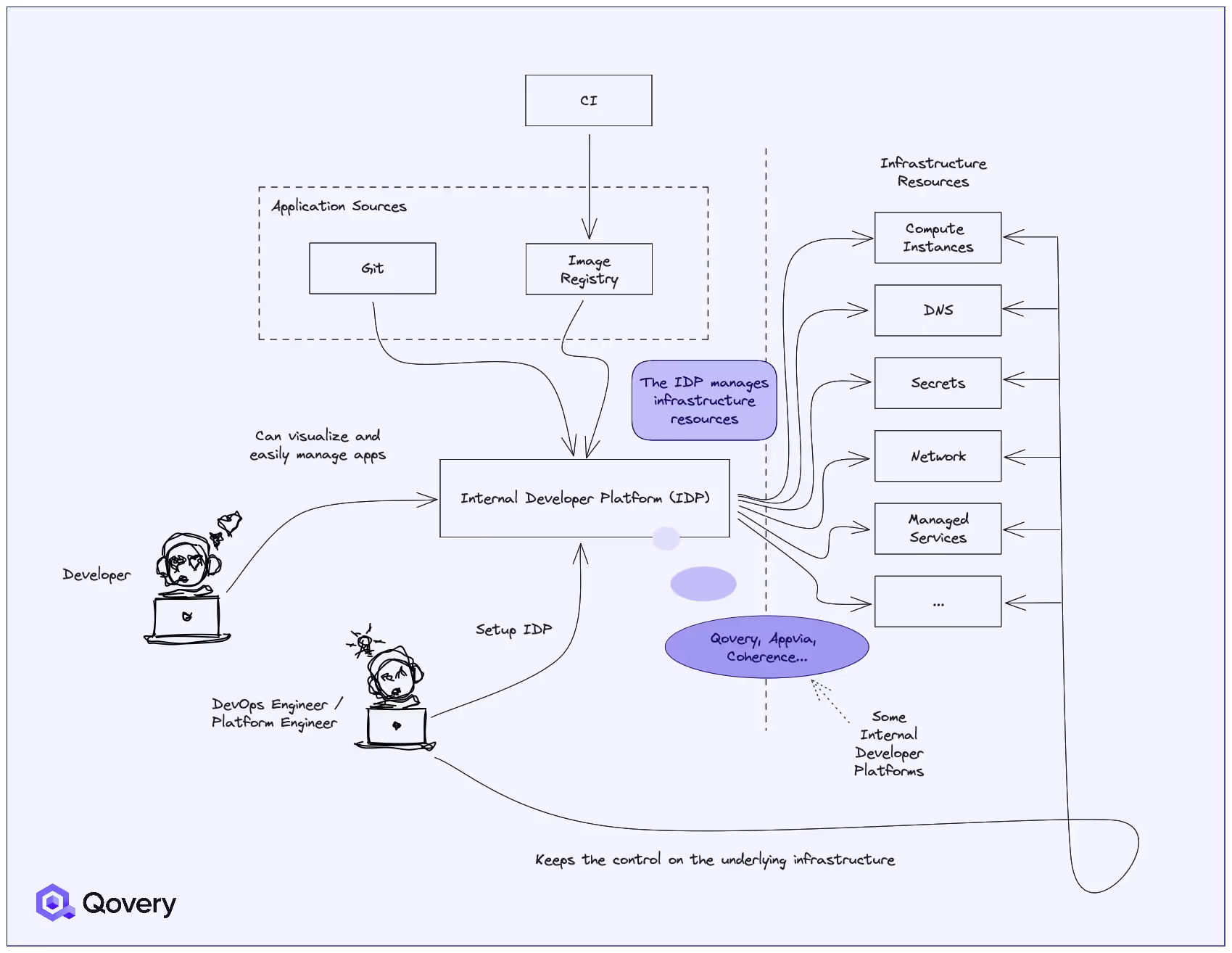
Internal Developer Platforms, often referred to as IDPs, represent an amalgamation of tools, services, and integrations designed to create a unified development environment. More technically, IDPs could be thought of as an orchestration layer atop infrastructure-as-code (IaC) tools, containerization technologies, and CI/CD pipelines. This orchestration can facilitate environment provisioning, testing automation, and deployment sequences, to name a few.
For instance, consider a company deploying microservices. Using an IDP, a developer can push code, and the platform might automatically provision a Kubernetes cluster, run tests inside isolated Docker containers, and then deploy using Helm charts. All these can be standardized yet allow individual teams to introduce custom configurations or tools as needed.
Optimizing Workflows with IDPs
The power of IDPs lies in their ability to abstract the complexities associated with individual tools and services, presenting a cohesive interface to developers. To delve deeper, consider a continuous integration scenario. Without an IDP, a developer might need to manage Jenkins configurations, manage artifacts on Nexus, and deploy using custom scripts. With a mature IDP, they could commit code and have the IDP handle build automation, artifact storage, and deployment, perhaps even across multi-cloud environments. This enhancement doesn't just save time but can reduce errors, streamline rollbacks, and introduce standardized monitoring and logging practices across the board.
Customization vs. Standardization in IDP Strategy
The challenge with IDPs revolves around the inherent pressure between the desire to leverage technology to standardize universal procedures (to reduce complexity) and the need for communication among team members to adapt to specific project or team requirements. Let's take a real-world analogy. Imagine using a shared library in software development. A standardized library ensures everyone uses the same methods and reduces bugs. However, sometimes, a project might have unique requirements that the library doesn't cater to. Here, customization, like adding a new module or tweaking an existing one, becomes crucial. Similarly, with IDPs, while you aim to standardize the deployment process, clear communication becomes essential when a specific application requires a unique environment variable or a different database version.
The key lies in ensuring that IDPs are flexible enough to allow such custom tweaks without compromising the core principles of standardization that guarantee operational efficiency.
The Power of Customization in IDPs
Customization: Beyond Standardized Solutions
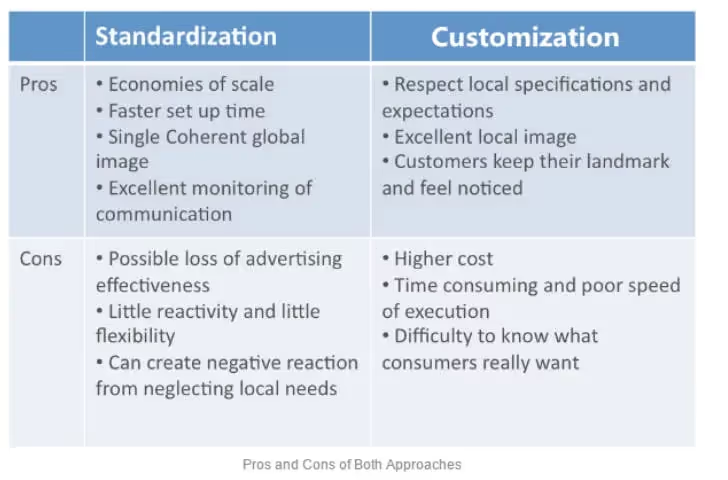
- Standardization vs. Customization: At its core, while standardization drives consistency across platforms, ensuring all users receive a uniform experience, customization delves deeper, enabling specific features and capabilities tailored for unique use cases in developer platforms.
- Marketing's Stronghold: The complex details of a developer platform, especially those based on unique selling propositions, are predominantly rooted in its customization abilities. Think of a scenario where an e-commerce platform requires a unique check-out flow that can dynamically adapt based on user behaviors. Only with robust customization capabilities can IDPs cater to such specific demands.
Direct Benefits of Embracing Customization
Every enterprise possesses its own set of challenges, objectives, and strategic visions. IDPs, when utilized to their full potential, can be shaped precisely to echo these unique attributes. Here's a deeper look:
- Scalability: For start-ups expecting rapid growth, customization in IDPs can pre-emptively optimize systems to handle future traffic surges, eliminating potential performance bottlenecks.
- Integration with Legacy Systems: Enterprises often run legacy systems. Customization in IDPs can ensure seamless integration with these older systems, bridging the technological gap.
- Regulatory Compliance: Certain industries operate under strict regulatory constraints. Customized IDPs can be fine-tuned to adhere to these regulations, ensuring data safety and compliance.
Practical Scenarios Highlighting Customization's Strength
To truly grasp the significance of customization, let's delve into real-world implications:
- Unique Software Needs: Consider a financial tech company aiming to introduce a revolutionary blockchain-based transaction system. Standard platforms might fall short, but a customized IDP can be tailored to handle specific blockchain interactions, ensuring efficiency.
- Time-sensitive Projects: Imagine a logistics firm wanting to develop a real-time tracking system during the peak holiday season. A customized IDP can rapidly integrate real-time data processing tools, enabling swift project deployment.
- Customer-driven Features: In cases where a significant clientele demands a specific feature – say, a new security protocol – customization allows the immediate pivot of development strategies to cater to this demand.
- Long-term Financial Prudence: At first glance, customization might appear costly. However, consider a scenario where a custom-built caching mechanism drastically reduces server callbacks, leading to significant savings on server costs over time.
The Benefits of Standardization in IDPs
Consistency Across Platforms
- With standardization, companies can ensure a uniform approach in their developer platforms. This allows for easy adoption and a streamlined experience for developers.
- Ensures that products are consistent in quality and functionality.
Cost-Effectiveness
- By following standardized strategies, businesses can cut down on costs linked to customization. It saves time and money on reinventing the wheel.
Ease of Management
- Standardization simplifies resource management. A company doesn't have to juggle different methodologies or products, making the process smoother.
- Reduces the time spent on managing custom solutions, allowing a focus on growth.
Scalability Benefits
- Companies with standardized processes can scale up (or down) with ease. It promotes flexibility while maintaining core business strategies.
Fostering Collaboration
- Having a standardized IDP ensures developers and other teams collaborate within a consistent framework, leading to efficient teamwork and fewer misunderstandings.
- A unified platform approach ensures that all teams are aligned, promoting clearer communication and collaboration around the platform's capabilities and features.
For instance, when a company adopted a standardized IDP, miscommunication between the development and IT operations teams was drastically reduced. With a clear understanding of the platform's capabilities, both teams could seamlessly coordinate projects and troubleshoot issues faster.
Promoting DevOps Practices
- With standardization, the bridge between development and operations (DevOps) is clearer. It aligns with company objectives, ensuring customer satisfaction and product quality.
Striking the Right Balance in IDPs
The IDP Balancing Challenge
Striking a balance between customization and standardization is critical. For instance, when deploying microservices in a containerized environment like Kubernetes, how much freedom do you give developers in crafting YAML files? Too much freedom can lead to an unstable cluster, while excessive restrictions might stifle application-specific optimizations. Let’s explore what potential issues you will face if you fall for over-standardization or if you do over-customization.
Risks of Over-Customization
- Complexity: Let's discuss an example scenario. While a custom Kubernetes operator might perfectly fit a particular use case, it can introduce challenges when attempting to upgrade the cluster or integrate third-party tools. Just imagine an e-commerce platform trying to integrate an advanced recommendation engine, but due to overly tailored backend services, the integration becomes a daunting task.
- Maintenance overhead: Custom-built CI/CD pipelines, such as one carefully designed for a niche serverless architecture, may require constant tweaking with every new tool or update, pulling the DevOps team into a continuous loop of revisions and updates.
Problems with Over-Standardization
- Limited innovation: Over-relying on off-the-shelf software such as Helm charts might limit optimization opportunities specific to your applications. For businesses like media streaming services that demand rapid content delivery, standardized configurations might not fully exploit edge caching potential.
- Reduced marketing appeal: In a SaaS-driven world, if every IDP-driven product seems identical, differentiation becomes tough, impacting customer acquisition. Think of a cloud storage provider using a generic interface - it might fail to appeal to graphic designers needing thumbnail previews.
Example
Consider the example of a large freight company once hampered by custom deployment scripts, they shifted towards an IDP strategy that blended standardized Terraform modules with room for on-demand custom integrations. This balance not only reduced their go-to-market time but also enhanced the platform's robustness. The result was improved developer agility, cost savings, and a product suite that appealed to a diverse clientele.
Key Factors to Consider Between Customization and Standardization in IDPs
Here are some key factors to consider when deciding between customization and standardization in IDPs:
Influential Factors in Choice Decision
- Project Complexity
Highly intricate projects may lean towards customization for unique solutions. Simpler projects could benefit from the time-saving benefits of standardization. - Team Expertise
Companies with seasoned teams may opt for customization to leverage their unique skills. Businesses new in the game might find standardized products easier to manage. - Industry Regulations
Certain sectors mandate strict standards. Here, standardized strategies save costs and ensure compliance. Where flexibility is allowed, companies can tap into the marketing benefits of a custom approach.
Guidance for choosing the best approach
- Recognize Your Needs
For instance, if your company aims to create a product targeting a niche customer group, customization may better cater to specific preferences. - Balance Benefits
Consider the cost savings of standardized solutions versus the potential market edge from a unique, customized offering. - Strategy Matters
If a business's strategy emphasizes rapid scalability, standardized platforms can offer quicker deployment times. However, if differentiation in a crowded market is key, a custom approach may be invaluable.
Customization Vs. Standardization: What to Choose?
Select Customization if:
- Unique requirements arise: For instance, deploying a niche healthcare app that must adhere to specific regional health guidelines might necessitate a customized environment.
- Flexibility and innovation take precedence: Imagine creating a groundbreaking IoT application. Customization would allow unique integrations, granting your product an edge in a crowded market.
- Team expertise is high: Got a team seasoned in Kubernetes? They can handle and even thrive with the challenges a customized platform presents.
Select Standardization if:
- Scalability Is key: Planning to onboard hundreds of developers? A standardized platform simplifies onboarding. Everyone uses the same toolkit, reducing complexities.
- Budget constraints exist: Standardized platforms often come with predictable costs. Think of a startup, cautious about unexpected expenses that could strain limited funds.
- Uniformity and compliance are a must: Developing a banking app; standardization ensures consistent deployments, meeting stringent financial regulations.
Conclusion
Internal Developer Platforms (IDPs) utilize technology to achieve a harmonious balance between standardized processes and customization capabilities. By blending these two approaches, IDPs ensure both product customization for tailored solutions and process standardization for efficiency. The benefits of such a balance are evident: reduced costs, simplified management, and consistent product quality. Standardizing these platforms facilitates better communication and information flow across development teams, enhancing the customer experience. Choose standardization if cost-efficiency and streamlined management are your priorities. Opt for customization if tailored solutions and unique features align with your goals. As companies assess their IDP strategy, striking the right balance between personalization and standardization is vital. Reflecting on specific business needs and utilizing the insights from this article can guide them toward a successful developer platform.


.svg)
.svg)
.svg)

Suggested articles


Migrating from nginx Ingress to Envoy Gateway? Discover how Alan migrated 100+ services in one month, the technical hurdles they faced (like Content-Length normalization), and why staging isn't always enough.

The cluster coming up is the easy part. What catches teams off guard is what happens six months later: certificates expire without a single alert, node pools run at 40% over-provisioned because nobody revisited the initial resource requests, and a manual kubectl patch applied during a 2am incident is now permanent state. Agentic control planes enforce declared state continuously. Monitoring tools just report the problem.


The instinct when setting up Kubernetes observability is to instrument everything and send it all to your APM vendor. That works fine at ten nodes. At a hundred, the bill becomes a board-level conversation. The less obvious problem is the fix most teams reach for: aggressive sampling. That is how intermittent failures affecting 1% of requests disappear from your monitoring entirely.

Scaling your deployments to zero is only half the battle. If your cluster autoscaler does not aggressively bin-pack and terminate the underlying worker nodes, you are still paying for idle metal. True environment sleeping requires tight integration between your ingress layer and your node provisioner to actually realize FinOps savings.
The structure, table, tool list, and code blocks are all worth keeping. The main work is fixing AI-isms in the prose, updating the case study to real metrics, correcting the FAQ format, and replacing the CTAs with the proper HTML blocks. The tool descriptions need the "Core strengths / Potential weaknesses" headers made less template-y, and the intro needs a sharper human voice.
For years, Red Hat OpenShift has been the safe choice for heavily regulated, on-premise environments. It operates as a secure fortress. But in the public cloud, that fortress acts as an expensive prison. Paying proprietary per-core licensing fees on top of your standard AWS or GCP compute bill is a redundant "middleware tax." Escaping OpenShift requires decoupling your infrastructure from your developer experience by running standard, vanilla Kubernetes paired with an agentic control plane.



Agentic Kubernetes resource reclamation is the practice of using an autonomous control plane to continuously identify, suspend, and delete idle infrastructure across a multi-cloud Kubernetes fleet. It replaces manual cleanup and reactive autoscaling with intent-based policies that act on business state, eliminating the configuration drift and cloud waste typical of unmanaged fleets.


.webp)